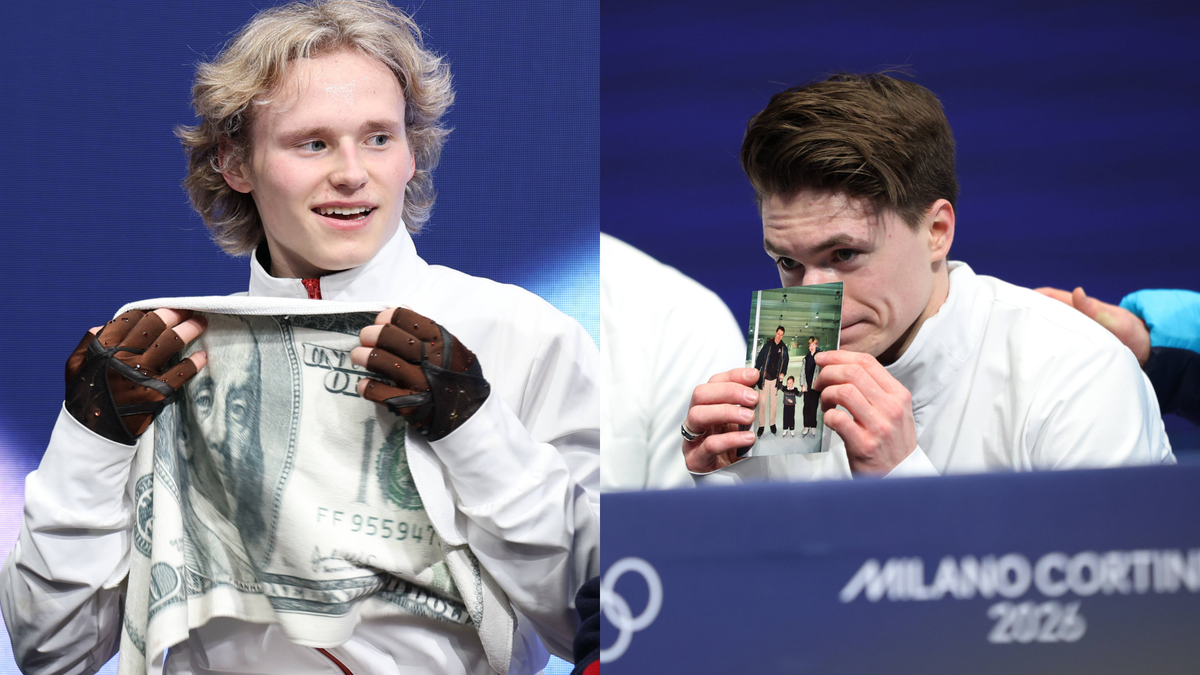
While Ilia Malinin strengthened his “quad god” reputation by soaring to the top of the Olympic short program, the most powerful moment for the U.S. team belonged to his teammate, Maxim Naumov. Malinin took gold with a score of 108.16, but for Naumov, the night carried far greater emotional weight, something Malinin himself noticed.


Maxim Naumov’s parents were on the American Eagle Flight 5342, which collided with a Black Hawk Army helicopter near Ronald Reagan Washington National Airport, killing all 67 people involved. Thus, his Olympic debut under the shadow of his parents’ tragic deaths, delivered a performance defined by resilience.
Watch What’s Trending Now!
Afterward, Ilia Malinin spoke with admiration about the courage it took for the young skater to step onto the Olympic ice carrying such profound inspiration and loss.
“I’m so proud of him, like the strength and the bravery, and obviously everything he has is just so heartwarming for me,” Malinin said.
“I could not imagine myself in this situation but I’m so happy for him that he went out there and did as much as he can he’s always a fighter and I knew that ever since I was skating with him when I was little it’s just I feel so blessed for him and really just thankful that he’s still trying so hard no matter what happens.”
The admission came after Naumov delivered a short program that earned 85.65 points and a standing ovation at the Milano Figure Skating Arena. As his score was announced, he held up a childhood photograph of himself with his parents and smiled.
Asked Ilia Malinin about his teammate Maxim Naumov, who made his Olympic debut tonight one year after tragically losing his parents in the plane crash outside Washington D.C. pic.twitter.com/wvpcU16QL3
— Greg Rosenstein (@grosenstein) February 10, 2026
The victorious performance also saw Naumov drop to his knees at center ice, as he looked upward and said, “Look what we just did.”
Naumov later shared that he was speaking to his parents, Evgenia Shishkova and Vadim Naumov. The former world champion pair were among 28 members of the U.S. Figure Skating community returning from a development camp in Wichita, Kansas.
Naumov described the skate as the realization of a goal they had worked toward for years.
“I can’t say I wasn’t a little bit nervous, but I felt so calm and so confident and was just really taking my time on everything,” he told NBC News. “I felt like I was being guided like a chess piece on a chessboard. As I was going into one element and another, I didn’t have any fear in my mind, just confidence and ready to go.”
Naumov’s moment of raw triumph and tribute echoes a poignant chapter in figure skating’s history of resilience.
Sixteen years earlier, at the 2010 Vancouver Olympics, Canadian skater Joannie Rochette delivered one of the sport’s most unforgettable performances under similar heartbreak.
Just two days before her short program, her mother, Thérèse Rochette, suffered a sudden and fatal heart attack shortly after arriving in Vancouver to watch her compete. Despite the devastating loss, Joannie chose to skate, honoring both her mother’s lifelong support and her own deep commitment to the sport, just as Naumov’s journey now testifies to the same unbreakable spirit.
Skating to Nocturne No. 20 by Frédéric Chopin, Maxim Naumov delivered a composed and technically secure performance that underlined both his preparation and poise. He opened with a quad Salchow, then cleanly executed a triple Axel and a triple Lutz–triple toe combination, maintaining control from start to finish.
His season-best total of 85.65, including 47.77 for technical elements and 37.88 for program components, placed him second in the early standings behind Petr Gumenik (86.72). But why did he credit the success to his late parents? Did they have a role in his growth?
Who were Maxim Naumov’s parents?
Evgenia Shishkova and Vadim Naumov were respected figure skaters, coaches, and parents who played a central role in their son, Maxim Naumov’s, life and career. They competed in pairs skating for Russia and were among the top teams of the 1990s.
Their most significant achievement came in 1994 when they won the World Championship title in pairs. They also represented Russia at two Winter Olympics. At the 1992 Games in Albertville, France, they finished fifth. Two years later, at the 1994 Olympics in Lillehammer, Norway, they placed fourth, just missing a medal.
Between 1993 and 1995, they earned three medals at the World Championships and three more at the European Championships. During this successful period, they married in 1995.
After retiring from competition in 1998, they moved into coaching. They worked at the historic Skating Club of Boston in Massachusetts, where they trained young athletes and helped build a youth skating program. Many students looked up to them, including their son. Maxim has said, “I would not be here without them in any capacity.”
Written by

Edited by

Tanay Sahai