

Ewa Kłobukowska, Maria Jose Martinez-Patino, Dora Ratjen, Foekje Dillema. These names sit in a part of sports history that still feels uncomfortable to revisit. All of them were caught in the system of “s– testing” once used in women’s sport. Eventually, that chapter was closed due to accuracy and ethical concerns. But almost 27 years later, those conversations seem to be returning at the Olympics.
Watch What’s Trending Now!
Back in March, the IOC introduced a policy that bans transgender women from competing in women’s Olympic events starting from the 2028 Los Angeles Olympics. The rule is being presented as a way to protect fairness in women’s sport. But the method remains questionable.
Reports say the rule will use genetic screening, including the SRY gene test, to decide who can compete in women’s events. But when human bodies do not always fit into fixed categories, is it really going to be that simple?
The X and Y idea, and its limits
Biologically, the XX chromosome pair is linked to females and the XY chromosome pair to males. But it is not always that clean.
IOC’s new policy leans on the SRY gene as a marker. The gene is usually found on the Y chromosome and helps start male development before birth. So the logic is simple. If SRY is present, it is treated as male biology. If it is not, the athlete may be allowed in women’s events. But that is only part of the story.
SRY does not decide everything. It only starts a process.
There are real biological cases that do not fit a strict SRY rule:
- In rare situations, the SRY gene can appear in people with XX chromosomes due to a genetic shift. This condition, known as 46,XX testicular disorder of sex development, occurs in about 1 in 20,000 people. In most of these cases, the body develops male traits.
- Some people have XY chromosomes, but their bodies do not respond to testosterone. This condition is called Androgen Insensitivity Syndrome (AIS). In its complete form, individuals develop typical female physical traits despite having XY chromosomes. Though it is rare, estimated at around 1 in 20,000 to 1 in 50,000 births.
- Then there are intersex variations, also called Differences in Sex Development (DSD). These are natural conditions where chromosomes, hormones, or reproductive anatomy do not fit typical male or female categories. Estimates suggest they may affect up to around 1.7 percent of people, and many may not even know they have them.
All this to say that biologically, sex is not always binary, but sport categories often are.
Even early scientific work warned against this kind of sex testing. Murray Barr, whose research contributed to sex testing, “cautioned against using it as the sole determinant of sex”, as noted by scholars Jörg Krieger, Lindsay Parks Pieper, and Ian Ritchie in their work on fairness in sport. And that warning becomes clearer when you see how testing has played out in real sports history.
The problem of unequal testing in the Olympics
One of the biggest issues with this policy is that it does not apply equally. Women are being asked to undergo genetic testing to prove they belong in their category. Men are not. If fairness is the goal, the rules should be the same. In this case, only one group is being examined, tested, and verified.
Even Payoshni Mitra, founder of Humans of Sport, labelled the ruling “a safeguarding disaster”:
“It’s not science-based, it’s stigma-based. It’s more under political pressure rather than really what is required in women’s sport.”
The issue is not just about science or eligibility; it is about unequal standards. And that pressure reaches athletes themselves.
Sex testing can affect all women in sport
Even if such policies begin at the Olympic level (2028 Los Angeles Olympics), their impact rarely stays put.
As the IOC recommended its policy be adopted “by IFs and other sports governing bodies, such as NOCs, National Federations and Continental Associations.” It cautioned that the policy should not apply to “any grassroots or recreational sports programs.” On paper, it looks limited to the top level. But sport systems often mirror Olympic standards over time.
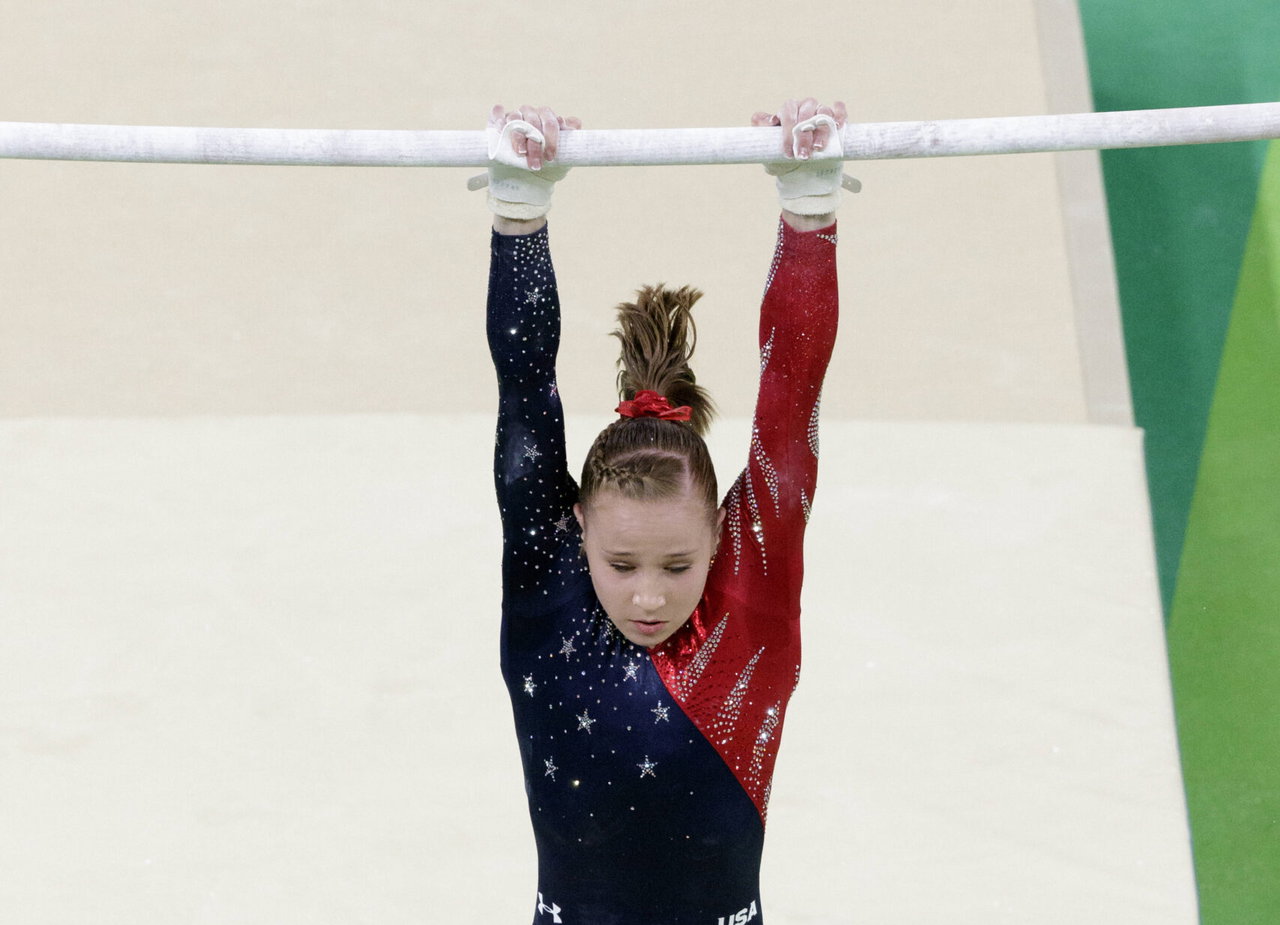
Imago
OLYMPICS RIO 2016 Rio de Janeiro, Brazil. 7 August 2016.Madison Kocian USA performs on the uneven bars during Women s Gymnastics qualifying at the 2016 Olympic Summer Games. Paul J. Sutton/PCN Photography. Rio de Janeiro Rio Olympic Stadium Brazil Copyright: xPaulxJxSutton/PCNx OL1617GY07-832
National federations follow Olympic standards, and, with time, those standards can trickle down to the national and junior levels. Young people might be raised in a culture where questioning, testing, or eligibility checks are all commonplace long before they reach the elite level.
The effects are not just limited to elite sport.
According to human rights lawyer and Olympic swimmer Nikki Dryden, “If these rules are adopted, it could mean that when you sign your daughter up to play sport, she may be subjected to sex testing just to participate. Worse, it creates a culture where someone like a coach, an official, or even another parent, feels entitled to question whether your daughter ‘looks female enough’ to belong.
“That is not protecting women’s sport. That is policing girls’ bodies. And once sport starts deciding which women are ‘acceptable’, no woman or girl is truly safe.”
It can show up as embarrassment about being questioned, constant self-doubt, anxiety before competition, and increased public attention and judgment. Even studies on sex verification in sport note that these tests can trigger “Sex verification…can cause sex identity crises, elicit demeaning reactions (publicly and privately), isolate athletes socially, and lead to depression and sometimes suicide.”
There are real examples that show how this plays out.
Caster Semenya became the center of global attention after her breakthrough at the 2009 World Championships in Berlin. At that time, she was just 18, but her win led officials to question her eligibility, not because she broke any rule, but because she did not match how people expected a woman athlete to look. She was subjected to sex verification testing, showing testosterone levels three times as high as most women.
Although the results were meant to stay private, parts of the reports were leaked. She faced intense scrutiny and online abuse, and her identity was debated far beyond sport. Years later, she continues to oppose such systems.
In 2026, she said about the policy, “For you as a woman, why will you be tested to prove that you fit? You know, it’s like now we need to prove that we are worthy as women to take part in sports. That’s a disrespect for women.”
This wouldn’t be the first time that this rule has been under scrutiny. Years ago, it was outrightly rejected.
The past that keeps reappearing in new policies
The International Olympic Committee in 2021 approved the Framework on Fairness, Inclusion, and Non-Discrimination. The framework was to change the approach to eligibility. This was to be a more flexible approach, where decisions about eligibility should be evidence-based, sport-specific, and guided by human rights and inclusion.
But in 2026, under the presidency of Kirsty Coventry, the IOC shifted back from a flexible approach and towards more rigid eligibility in women’s sport. But this change raises a big question: why does this conversation keep popping up time and time again?
It began in the 1930’s with the issue of “sex ambiguity” in sport. At that time, officials began doubting whether some women athletes fit into traditional ideas of female categories. At that time, there was no science involved. Decisions were often based on appearance or visual inspection.
Around 1966-1967, researchers discovered the Barr body linked to the X chromosome, and sports authorities began exploring biological testing as a way to verify sex. In the 1968 Mexico City Olympics, Barr body testing became mandatory for women athletes, even though cracks of the test had already appeared before.
Ewa Kłobukowska was one of the fastest sprinters of the 1960s, an Olympic gold medallist and world record holder. In 1967, her career collapsed after she failed a chromosome-based sex test. She was declared ineligible, banned from racing, and all official records were annulled. A year later, she became pregnant and had a child.
Imago
Ski jumping, Skispringen, Ski, nordisch – Milano Cortina 2026 Winter Olympics Day 8 Olympic rings seen at Predazzo Ski Jumping Stadium in Predazzo on February 14, 2026 Predazzo Italy PUBLICATIONxNOTxINxFRA Copyright: xFotoxOlimpikx originalFilename:jastrzebowski-skijumpi260214_npRAw.jpg
By the early 1990s, testing methods had changed.
DNA-based screening was introduced, which included checks for genetic markers such as the SRY gene. This approach was used at events like the 1996 Atlanta Olympics. This was considered more “modern”, but it still didn’t fully address sex-defined in any consistent manner.
At those Games, about 3,387 female athletes were tested. Eight returned positive results linked to SRY screening. These cases were later connected to natural differences in sex development (DSD conditions). After medical review, all eight athletes were cleared to compete.
In 1999, the IOC terminated sex testing. The reason was that science could not define sex in all cases, and the system produced more confusion than resolution.
But now that this trialling idea has reappeared in 2026 and is connected to the 2028 Olympics, it could have significant consequences. It could deter some women from playing sport, and if it does this, there will be fewer women on the field. If that happens, it’s not just the Olympics; it affects the sense of safety and inclusion in sport for years. And this is the problem, because a rule designed to ensure fairness now may be something the Olympics will regret in the future.