
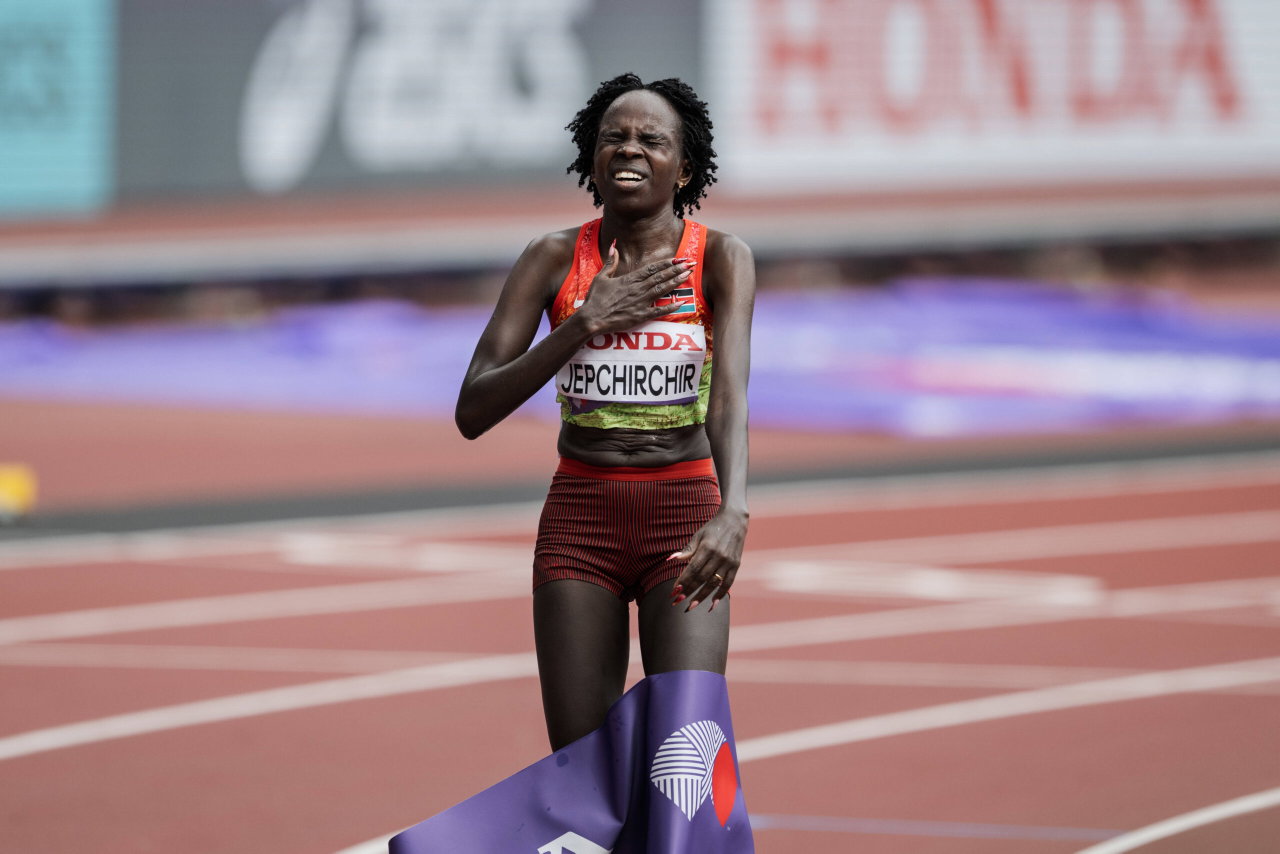
Peres Jepchirchir looked untouchable at the 2026 Sydney Marathon, clocking 2:18:31 on August 30 to win by more than three minutes. Fellow Kenyan Irine Cheptai finished second, while Ethiopia’s Shure Demise claimed third. However, less than two months after her dominant victory, Jepchirchir’s Sydney title is under threat after the Athletics Integrity Unit provisionally suspended her following an adverse analytical finding for erythropoietin. This news has sparked angry reactions from fellow athletes, with some raising concerns about the fairness of results and the wider problem of doping in Kenyan athletics.
Watch What’s Trending Now!
Canadian Olympic marathon runner Rory Linkletter was among those who reacted strongly to the news. Commenting on Instagram, he wrote, “ This should be the nail in the coffin for Kenyan Athletics IMO, if one of their most decorated and long standing athletes is convicted who presumably has been tested for years is cheating then the problem has become even more systemic than we can comprehend.”
His remarks reflect the frustration surrounding another high-profile doping case involving a Kenyan distance runner, although the allegations against Jepchirchir have yet to be established.
The AIU announced the provisional suspension on October 23 after an out-of-competition sample collected in Kenya before the Sydney Marathon returned an adverse analytical finding for EPO. According to Jepchirchir’s agent, Gianni Demadonna, the sample was collected on July 17, several weeks before the race. EPO can increase the body’s production of red blood cells, improving its ability to carry oxygen and potentially enhancing endurance performance.
Demadonna also voiced his disappointment over the finding. “I can only say that I feel terrible about what happened and I think it’s only right that an athlete who uses the performance enhancing drugs should be disqualified,” he said, according to Reuters.
Sydney Marathon organisers also expressed disappointment but stressed that Jepchirchir is entitled to due process. Reaffirming their stance on clean competition, they said, “Our commitment to clean sport is unwavering. Every athlete who lines up in Sydney deserves to race on a level playing field, and every participant and spectator deserves to trust the result they see at the finish line.”
The organisers added that, alongside the other Abbott World Marathon Majors, they had invested in increased out-of-competition testing in partnership with the AIU. They also confirmed that they would make no further comment on the case until the process had concluded.
The consequences of Jepchirchir’s case could reach far beyond her latest victory. Under Abbott World Marathon Majors rules, any athlete who receives a doping ban of three months or more faces a lifetime ban from all eight Majors. If an anti-doping violation is established and her Sydney Marathon result is disqualified, the final standings could change. For now, however, no final ruling has been announced, and Jepchirchir’s victory remains officially intact.
Despite the unresolved case, her provisional suspension has already sparked criticism, with fellow athletes questioning whether current penalties are strong enough to deter doping.
Call grows as athletes react to Peres Jepchirchir’s doping suspension
Amateur endurance runner and digital creator Griff Duncan reacted to the news by writing, “Why are we doing suspensions? These need to be lifetime bans.”
A two-time British marathon champion and three-time British half-marathon champion added, “😮😮😮😮”, reflecting the surprise surrounding the case. Meanwhile, American distance runner Natosha Rogers, who won gold in the 5,000 metres at the 2022 NACAC Championships, expressed frustration over what she sees as a lack of urgency in addressing doping. “Just another casual update, hopefully everyone stops shrugging this off at some point,” she wrote.
The reaction comes as Jepchirchir’s case draws attention because of her standing in the sport. She won Olympic marathon gold at the Tokyo 2020 Olympics, claimed the women’s marathon world title at the 2025 World Athletics Championships and secured major victories in New York, Boston, London and Sydney. Her provisional suspension has therefore raised questions about the potential impact on one of the most decorated careers in women’s distance running.
The case also comes amid years of doping controversies involving Kenyan athletes. More than 140 Kenyan athletes have faced sanctions since the Athletics Integrity Unit (AIU) was established in 2017, including several prominent marathon runners.
One of the most recent high-profile cases involved Albert Korir, winner of the 2021 New York City Marathon. He received a five-year ban in March 2026 after testing positive for CERA, a synthetic form of EPO, in three out-of-competition tests in October 2025. His results from October 2025 onward were disqualified, including his third-place finish at the 2025 New York City Marathon.
Women’s marathon world-record holder Ruth Chepngetich also received a three-year ban in 2025 after admitting anti-doping rule violations involving hydrochlorothiazide. Her case did not involve a positive EPO test, but it added to concerns surrounding doping in elite distance running.
Another prominent case involved Jemima Sumgong, who won Olympic marathon gold at Rio 2016. She tested positive for EPO in 2017 and initially received a four-year ban. The suspension was later extended to eight years after an anti-doping tribunal found that she had tampered with the process by submitting false medical evidence.
These cases help explain why Jepchirchir’s provisional suspension has attracted such a strong response. Another Olympic marathoner, Aliphine Tuliamuk, said she was shocked by the news and disappointed by the development. “I am now just seeing this, I am shocked, honestly not even sure what to make if this, very disappointing,” she commented.
Two-time Olympian Kevin Seaward also highlighted how doping can affect far more than an athlete’s individual career. “Medals, prize money, spots at major championships, qualifying standards, contracts, reputation – all impacted by this. A big problem and no appetite from WA to solve it. Feels like athletics version of Whac-a-Mole!” he wrote, criticising what he sees as a lack of urgency from World Athletics in tackling the problem.