
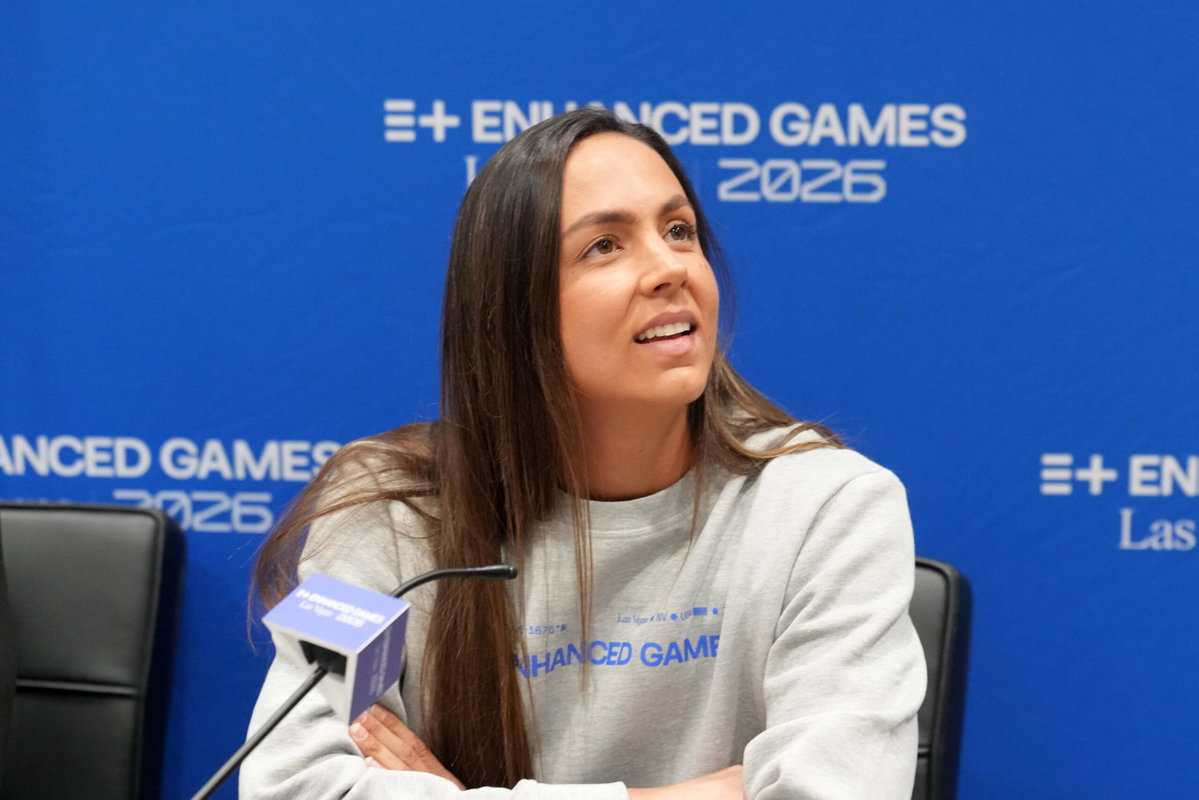
Enhanced Games CEO Max Martin is confident that world records will be broken, while an Olympian wonders whether her body may pay a price long after the finish line. The two remain on opposite ends of the spectrum, yet Isabella Arcila will compete at the “Steroid Olympics”. That’s because for the Colombian, the chance to rebalance the scales has made it worthwhile even if it comes at the cost of her fertility.
Watch What’s Trending Now!
For Arcila, her biggest concern was her fertility. The 32-year-old last professionally competed more than three years ago but has returned for the Enhanced Games and is on a regimen.
“Fertility was one of my biggest concerns,” Arcila told DW. “They were honest with me: ‘Look, Isa, the truth is we’re going to use very low doses that are far from posing a real danger to you. But the possibility exists.'”
Yet the chance to balance the scales and compete on a level playing field was tempting for Arcila. That’s especially given what she knows about the current state of athletics.
“Too often, we applaud false heroes who shamelessly stand on podiums to receive medals, knowing they are cheating [doping]. If you’re so interested in these substances, if you want to see how far you can go, then come do it here.” Arcila explained.
The Colombian swimmer competed at the 2016 Olympics, finishing 30th in the women’s 50m freestyle as a 22-year-old. She never quite hit the same heights, failing to medal outside South America afterward. However, she thrived during her time in the NCAA, winning seven All-American honors and multiple conference championships. Now she’s back at the Enhanced Games and on a regimen like the other 50 athletes.
That’s why it’s not just a concern or a possibility but a genuine fear when it comes to fertility. 2018 research found PEDs reduce ovarian function by disrupting hormonal signals to the reproductive system. However, that’s for long-term usage only, as the study reports that the brain effectively tells the reproductive system to shut down.
That’s because with the addition of performance-enhancing drugs (PEDs), the brain believes that the body has enough hormones. Short-term PED use carries immediate risks: ovulation shutdown, irregular periods, and months-long amenorrhea.
These reproductive risks loom for Enhanced Games’ female competitors, and male athletes face parallel threats. Like the female athletes, the study reported that the men could potentially see their reproductive system hit hard by short-term use of PEDs. Everything from potentially becoming temporarily sterile to hormones flip-flopping is a possibility.

The Enhanced Games in Las Vegas allow athletes to use performance-enhancing drugs despite major health risks. DW follows Colombian swimmer Isabella Arcila to see why athletes take the risk.
Furthermore, recovery, even for short-term usage, could take anywhere from six months to a year, sometimes even longer. It’s exactly what one World Anti-Doping Agency (WADA) spokesperson pointed out recently.
“Steroids, for example, can increase the risk of heart attack, stroke, and liver damage,” the spokesperson said as per the Guardian. “Human growth hormone can trigger diabetes, heart problems, and abnormal growth in organs and bones.
“And taking exogenous testosterone can lead to an increased risk of hypertension, heart attack, and blood clots, as well as infertility and testicular shrinkage, increased aggression, anxiety, and depression.”
However, not everyone at the Enhanced Games is using performance enhancers. Sprinter Fred Kerley declared he will try to beat Usain Bolt’s 100m record cleanly. Olympic medalist Hunter Armstrong has joined the Games and is competing sober to stay in contention for LA 2028.
But, Arcila’s argument is simple: if doping is happening anyway, why not do it in the open? Yet, Benjamin Cohen, the director general of the International Testing Agency, has heard that argument. He just doesn’t buy it.
Benjamin Cohen reflects on the Enhanced Games
The Enhanced Games, which openly market and sell PED use, have faced heavy criticism since their 2024 announcement. Now, with hours left, things officially start, and the playing field is not just even; it has been elevated. For many athletes, the event is the chance to return to their heydays with the help of PEDs, having long since retired. The financial appeal is too strong to turn down as the Games reward a $1 million prize to world record breakers and $250,000 to event winners.
For others, it’s the chance to break world records and prove their mettle. Yet, not everyone will be on a regimen of PEDs, as quite a few athletes will be competing clean. Even then, the criticism has naturally hit the event hard, with several comparing it to a circus and more. Benjamin Cohen believes it doesn’t even deserve the moniker of “Steroid Olympics”.
“I’ve heard some people calling it the ‘Doping Olympics,’ but even using the word ‘Olympics’ (is a stretch),” Cohen told AP News. “At the end of the day, it’s a one-day event, it’s 2,000 people eating popcorn, and there’s a music concert. It’s 50 athletes. It’s not right to put it on the same level.”
The director general of the International Testing Agency, Cohen, does believe that world records will be broken during the weekend. Yet, even then, he feels it won’t be the same as when Bolt did it back in 2009.
“For me, it will be difficult to draw conclusions from one race this weekend,” Cohen added. “For Usain Bolt to have broken a world record at the Olympics, it means he had to perform at a certain level for a number of months in the lead-up to qualify to get to that stage. It’s not the same as a one-day competition where you had a six-month doping regimen.”
Arcila has made her peace with the risks, eyes open and scales in hand. Whether the Enhanced Games delivers on its promise or simply delivers consequences, she’ll be the one living with the answer.