Imago
Credits: X/@Lucas Pinheiro Braathen
Imago
Credits: X/@Lucas Pinheiro Braathen
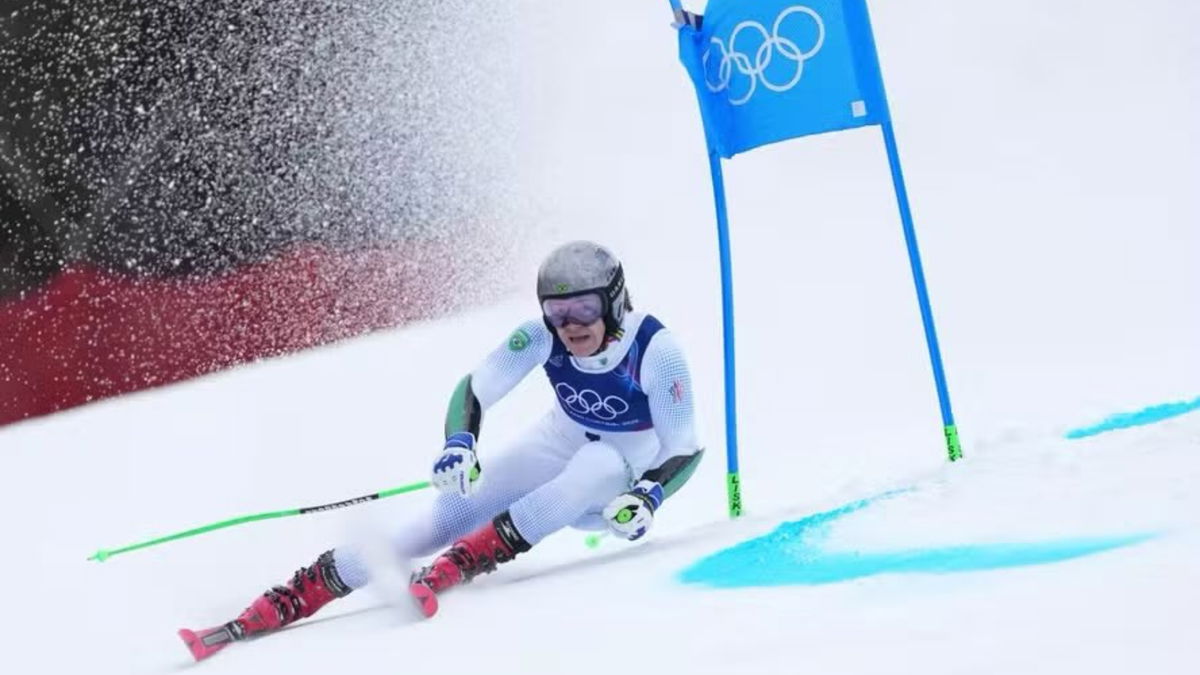
Lucas Pinheiro Braathen was all over the place. He twirled, hopped, and tossed samba steps on the ground repeatedly, letting pure joy take over even without music. When even Brazil’s national anthem was heard, the celebration got stronger: pride, relief, history in the palm of your hand. This was beyond dance… more than feelings. It was Brazil’s first medal at the Winter Olympics, made possible by a 25-year-old skier whose story is anything but ordinary.
Watch What’s Trending Now!
On 14 February 2026, at the Stelvio Ski Centre in Bormio, Italy, Braathen won gold in the men’s giant slalom. That gold isn’t just Brazil’s first ever…it’s the first Winter Games medal for any South American country. And without a doubt, the giant slalom is no joke.
Two runs, tight gates, technical twists and turns. Braathen nailed it: 1:13.92 on his first run, 1:11.08 on the second, for a total of 2:25.00.
That put him ahead of Swiss favorite Marco Odermatt by 0.58 seconds. “Somehow, I’m a skier now,” he laughed, holding that shiny gold. “But at least I’m a champ.” And with this win, South America’s drought is over: it had not won a medal at the Winter Olympics for 102 years, since the very first Winter Games in 1924.
“It’s a moment that’s hard to grasp even though it’s crystal clear that you are officially the Olympic champion,” Pinheiro Braathen explained. “Even though I had such faith and I knew that this was written for me, it is still so incredible to live that dream turned reality. I couldn’t quite grasp it.” And his story? Pretty wild.
Brazil has brought South America its first-ever Winter Olympics medal
And it was gold on the very first try. Twenty-five-year-old Lucas Pinheiro Braathen won the giant slalom.
It’s a historic moment: neither Brazil nor any South American country had ever won a medal at the… pic.twitter.com/XYPo4W47FV
— NEXTA (@nexta_tv) February 14, 2026
Born in Oslo, Norway, to a Brazilian mom and Norwegian dad, he competed for Norway before, even at the 2022 Winter Olympics. Then he switched to Brazil, carried the Brazilian flag at the opening ceremony, and made history. But at the same time, he’s also a model, a DJ, a celebrity juggling multiple lives alongside his sport. But that fame and lifestyle weren’t the only obstacles he faced.
Lucas Braathen’s journey from crashing at Adelboden to standing tall on the podium
In January 2021, during a giant slalom race at Adelboden in Switzerland, Lucas Braathen crashed hard just after crossing the finish line, badly injuring his left knee. The injury was serious enough that he had to end his season and take time off to recover. It was a major setback early in his career. “I was very scared of the last steep slope. I was also thinking about last year,” he said later.
Then, in October 2023, 23-year-old Braathen shocked the skiing world by retiring…just two days before the new World Cup season was set to start. Speaking at a press conference in Sölden, Austria, he explained, “I’m done with the sport. I feel happy and free to leave competitive skiing.”
He added, “In order for me to continue skiing within this system, I had to not only put my dreams aside, but also my joy of living. I’m not willing to do that.” The primary problem, he explained, was the prior dispute with the Norwegian Ski Federation regarding athlete image and marketing rights. The regulations restricted who he could sign as a sponsor and for personal endorsements, resulting in continual resentment.
But stepping away didn’t last long. Less than five months later, Braathen realized how much he missed racing and the thrill of competing. In March 2024, he announced he was returning to ski racing…this time representing Brazil, his mother’s homeland.
But the injury he faced in 2021 still haunted him. But in January 2026, he finally conquered the slope again, reaching the podium at Adelboden. He said. “You couldn’t see anything. It was shaking from start to finish. It was a real test for a technician. As a skier, this is a success I’m most proud of. The Chuenisbärgli is one of the biggest challenges in our sport.”
That race, too, brought its bodily reminders of trauma. Braathen ended up with a bleeding finger after competing in brutal conditions. “My adrenaline is going through the roof right now. I could have lost a finger, and I wouldn’t feel a thing,” he said. And that spirit? It’s exactly what carried him to capture a place on the Olympic podium.