
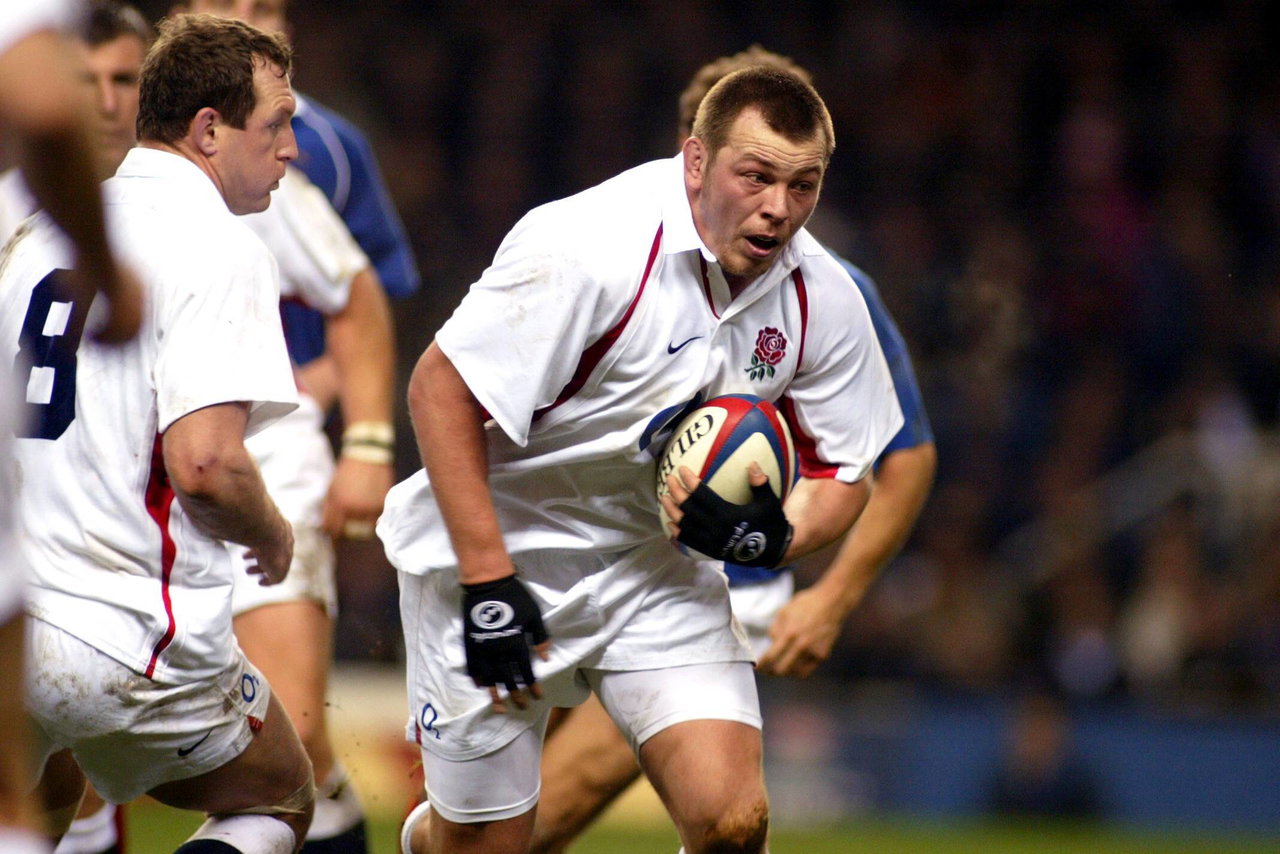
Steve Thompson once lived every rugby player’s dream. Back in 2003, he was part of the England team that defeated Australia to lift the Rugby World Cup. However, more than 20 years later, the former England star, now 48, cannot remember being part of that winning team. Thompson was diagnosed with early-onset dementia in 2020, and since then, his life has changed. While he struggles with the disease each day, his wife, Steph, is also dealing with a difficult reality as she tries to care for him and keep him safe.
Watch What’s Trending Now!
For Steph, the hardest part of caring for her husband is not always dealing with his memory loss or helping him through everyday tasks. “The biggest struggle for me at times is trying to stop him from killing himself. Every day. That’s my hardest job, isn’t it?” she admitted to the Daily Mail. Thompson has also spoken about experiencing su**idal thoughts “quite a bit.”
The situation became particularly difficult during a dark period over the summer, when Thompson received support from neuropsychologist Dr Gavin Newby. Steph does not let him travel alone and checks on him even when she is out doing the school run. She also makes sure he carries a photograph of their four children, who are aged between seven and 13. Thompson has previously spoken about reaching a point when he considered taking his own life at a nearby train station, but thoughts of his children stopped him.
His condition has also changed the way he experiences ordinary family moments. During a recent trip to pick pumpkins in Hartford, Cheshire, the family saw just how much his health had changed. In previous years, the outing could last for hours. This time, Thompson managed only about 15 minutes before becoming exhausted and developing a headache. He then slept for much of the afternoon.
These changes have become part of everyday life. At times, he forgets people’s names or cannot recall what happened the previous evening. He also experiences speech difficulties and changes in mood. Still, Thompson tries to keep a routine.
He takes the children to school, cleans the house, hoovers, and picks up after the family dog. These small jobs give him a sense of purpose, although he sometimes pushes himself too hard and ends up dealing with exhaustion and headaches. While Thompson deals with the effects of dementia, Steph has had to put much of her own life on hold. She previously worked as an air hostess for Emirates, but gave up her career and independence to care for her husband.
The family has also faced financial worries. Thompson has no employment income or rugby pension and receives Personal Independence Payment. They have had to rely on savings and help from friends to manage their expenses. For Steph, the pressure of caring for her husband while handling the family’s finances has made an already difficult situation even harder.
Thompson is among more than 1,000 former rugby players involved in legal action against rugby authorities over brain injuries. He believes the repeated blows to the head he experienced during his playing career contributed to his condition. Despite everything, Thompson has not lost his sense of humour. He jokes about Steph finding him in the middle of an aisle at Aldi, next to the fishing rods. Steph responds with a smile, saying, “It’s a good job I love you, I suppose.”
Thompson has also stepped away from much of the rugby world. He does not attend World Cup team reunions and only occasionally watches England play. Although he may look and sound much as he did a few years ago, he knows how much his life has changed. “My world is shrinking,” he has said, describing how dementia has gradually limited the life he once knew.
For Steph, one of the hardest parts has been finding help. When Thompson was diagnosed, she did not know where to turn, which forms to fill in or who to contact. The emotional strain was made worse by paperwork, financial concerns, and the feeling that she was facing much of it alone. Thompson knows how much his wife has done for him. “I’m not sure where I’d be without Steph,” he said. He has also spoken about the need to support people caring for loved ones with dementia, warning, “When we stop caring for the carers, we’re in real trouble.”
While dementia has taken away many of Thompson’s memories, it has not erased what he achieved on the rugby field.
The career that made Thompson an England rugby great
Before dementia changed his life, Thompson had enjoyed a remarkable career in rugby. He made his England debut against Scotland in February 2002 and quickly established himself as one of the team’s leading hookers. Over the next nine years, he earned 73 caps for his country and became part of one of the strongest England sides of that era.
His first major success with England came in 2003, when the team won the Six Nations Grand Slam after defeating all five opponents. However, the biggest moment was still ahead of him. Later that year, Thompson travelled to Australia for the Rugby World Cup and played in the final against the hosts on November 22. England won 20-17 in extra time, with Jonny Wilkinson’s famous drop goal sealing the country’s first-ever men’s Rugby World Cup title.
Thompson’s success was not limited to international rugby. He also helped Northampton Saints win the Heineken Cup in 2000, when they defeated Munster 9-8 in the final. His performances earned him another major honour in 2005, when he was selected for the British & Irish Lions tour of New Zealand. He went on to earn two Test appearances against the All Blacks.
After suffering a serious neck injury in 2007, Thompson eventually returned to professional rugby. He continued playing for several clubs and made England’s squad for the 2011 Rugby World Cup. In March that year, he also became England’s most-capped hooker, surpassing the previous record held by Brian Moore. However, another neck injury later in 2011 brought his playing career to an end at just 33.