
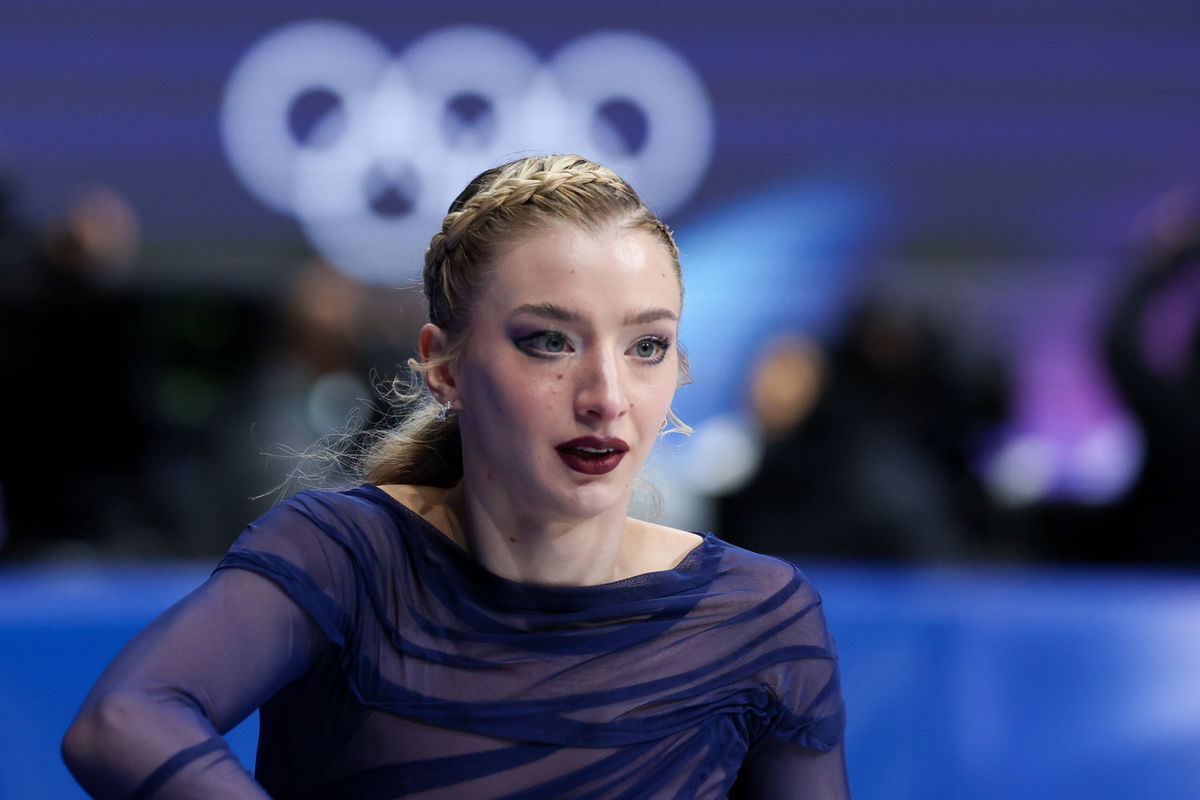
Winning Olympic gold required Amber Glenn to shut out the noise and concentrate on her performance. Days after Team USA’s triumph at the Milano Cortina Winter Olympics, the figure skater even addressed the online backlash she had received and explained that it had not affected her performance in the team event. That mindset which won Amber Glenn Olympic gold is now her biggest obstacle on the ballroom floor
Watch What’s Trending Now!
Glenn explored this difference during her November 12 appearance on The Zach Sang Show. The Olympic champion explained how her relationship with public opinion changed throughout her figure skating career and why competing on DWTS has brought back a challenge she once worked hard to overcome.
For years, Glenn struggled with worrying about how people perceived her.She explained, “And eventually I, said, ‘I can’t deal with that, I’m gonna be myself,’ and that’s when I started doing better on the ice, was when I was just truly myself.”
That shift allowed Glenn to concentrate on what she could control: her performance. She no longer needed everyone to approve of her to feel confident about what she was doing on the ice. DWTS, however, has introduced a different equation.
In an October 13 interview with Elite Daily, she discussed how difficult it can be to understand the judges’ scoring compared to figure skating. “We get these score sheets, and I know exactly what everything is worth,” Glenn explained about skating. However, DWTS has a different approach. “With Dancing with the Stars, it’s really hard to know what deserves what.”
The audience also has a significant say in the competition. Glenn acknowledged, “It’s also about who enjoys our performance, who wants to vote for us, and who we entertained.” She further explained how that expectation has changed her social media habits. “In skating, I try to limit my time online a lot, but on Dancing with the Stars, it’s part of it. You interact with people online.”
The competition has made her realize that connecting with viewers is just as important as delivering a strong performance. Glenn acknowledged that people have to like her, support her, and want to vote for her. She also admitted that she cannot control how everyone feels about every action she takes. For someone who spent years learning to ignore public judgment, that is an unfamiliar position.
Glenn had to make more changes to adapt to ballroom dancing
Social media was not the only adjustment Glenn had to make. She also had to unlearn some of the movements and habits that had become natural after more than 20 years of figure skating.
During an interview with The Hollywood Reporter, Glenn discussed how different the physical demands of ballroom dancing were from skating. She had spent years performing alone, where she could interpret choreography through her own movements. Dancing with Pasha Pashkov required her to follow precise counts and remain synchronized with another person.
Glenn explained that some of her skating instincts actually became obstacles. In ballroom, certain steps and weight shifts have to be performed in a particular way. Movements that felt completely natural on the ice could be considered incorrect on the dance floor.
She also pointed out that skating choreography had traditionally allowed her to make movements her own. DWTS demanded greater precision, with every movement happening at the right moment. Even her muscle memory needed adjustment because she had spent so many years developing a different style of movement.
Her experience before DWTS also offered an interesting starting point. Glenn revealed that she had done a little ballet when she was younger, but she had never formally experienced the demands of ballroom choreography. She admitted that hearing the familiar dance count of “5, 6, 7, 8” was not the same as actually following it.
Her skating background has still provided advantages. Waltz and foxtrot movements felt more familiar because of their similarities to skating, particularly their flow. Latin dances, however, introduced movements that were less familiar. Glenn also enjoys spinning and has found ways to use her natural athleticism within the routines.
The partnership with Pashkov has been another important part of that learning process. As a singles skater, Glenn was accustomed to controlling her own performance. Ballroom requires her to coordinate every movement with her partner. She has had to learn when to lead with her movements, when to follow, and how to make their choreography work as one performance.
Glenn is now learning to combine the athleticism and performance experience that helped her become an Olympic champion with the precision and partnership required in ballroom dancing. The challenge is no longer simply about executing a routine. It is about adapting to a completely different way of performing and finding a connection with the audience along the way.