
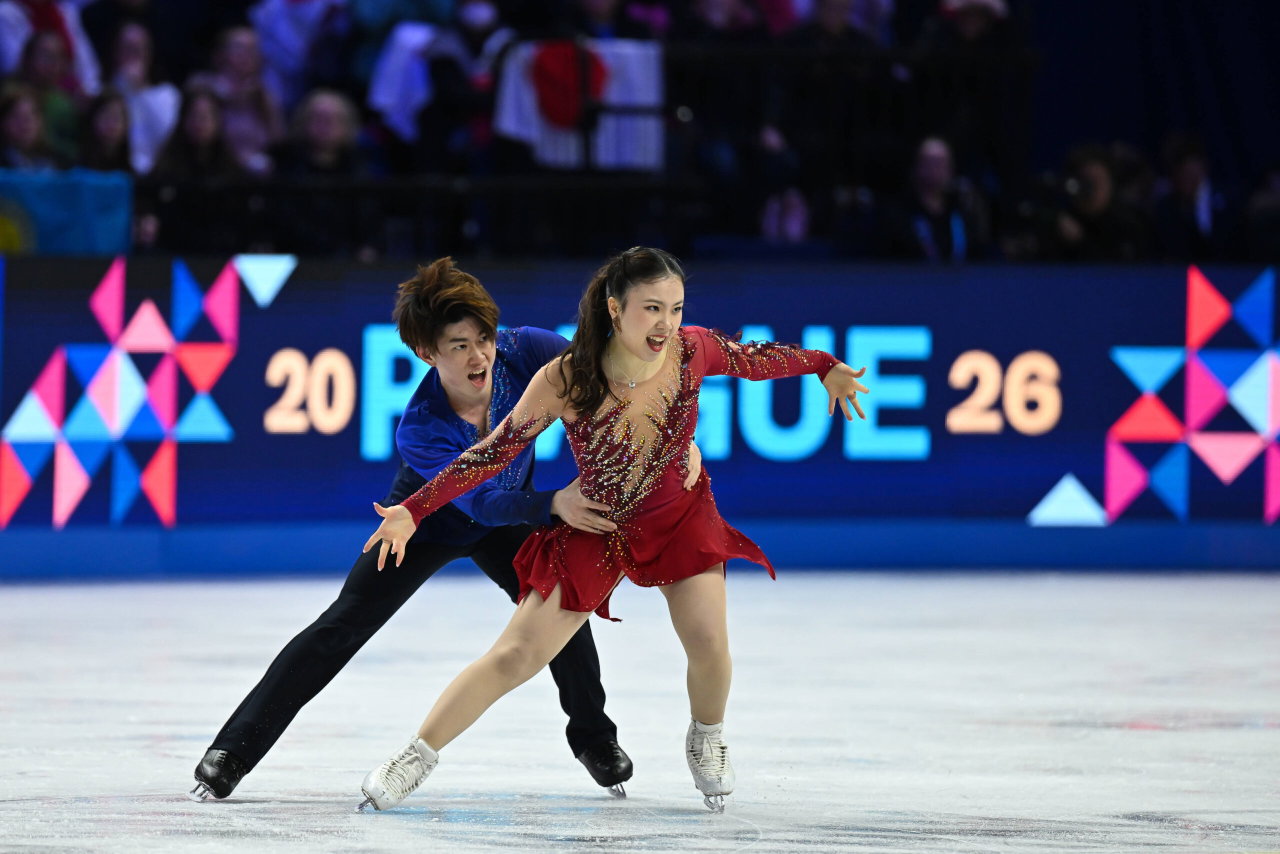
Utana Yoshida and Masaya Morita were hoping to end 2026 on a high note after a memorable year for the Japanese ice dance pair. They helped their country win silver at the Milan-Cortina Winter Olympics in February and continued their winning run by claiming their second consecutive Japanese national title. Popularly known as ‘Utamasa’, they arrived at the NHK Trophy hoping to give their home fans another performance to remember. But their plans came crashing down after a practice accident that forced the Olympic silver medalists to withdraw from the competition.
Watch What’s Trending Now!
The Japan Skating Federation announced its withdrawal on the morning of November 27, just hours before the ice dance rhythm dance was scheduled to begin. The reason was a ligament injury in Morita’s left knee, which he suffered after falling during official practice the previous day. The 23-year-old had initially hoped to recover in time, but the situation became more difficult during their final practice on Friday.
The accident happened on November 26 at Keio Arena TOKYO, where the pair were preparing for the Grand Prix event. Morita fell during official practice after his and Yoshida’s skates collided. He later accepted responsibility for the mistake, telling reporters, “120%, it was completely my mistake. Apparently, our skates collided.”
Despite the fall, Morita initially tried to remain positive about his condition. When asked about his knee, he said, “I’m okay.” He was also confident that he could make the necessary adjustments before the competition, telling reporters, “We’ll do our best to make adjustments for tomorrow’s performance.” The following morning brought a difficult moment for the Japanese pair. Yoshida and Morita returned to the ice for their official practice ahead of the rhythm dance. They went through their movements with music, but Morita appeared to be struggling with his left leg and omitted some elements from the routine.
Near the end of the session, emotional scenes unfolded. Morita became visibly upset and broke down in tears, with Yoshida hugging him on the ice. The pair eventually left the session, and their withdrawal was announced shortly afterwards.
The timing made the setback even harder for the duo. They had spent the previous month preparing for NHK Trophy and were looking forward to competing on home ice. During an interview with World Figure Skating Web after practice on November 26, Yoshida said, “We’ve had really good practice sessions, and we’re feeling good…”
Morita also explained that they had “been working hard on improving our expression, including the small details such as what facial expressions to use. I hope we can show how much we’ve improved.”
They also had specific targets for NHK Trophy. Yoshida hoped to score 75 points in the rhythm dance and wanted the pair to reach the later starting group in the free dance. Morita said he wanted to perform their programs from beginning to end while continuing to improve and get closer to the world’s leading couples. The duo had also prepared two programs with contrasting themes.
Yoshida described their rhythm dance as representing the world of death, while their free dance explored the heart, blood flow and the power of life. They wanted audiences to feel the difference between the two performances and see the different sides of their skating. The pair’s recent results had given them plenty of confidence. At the East Japan Championships in late October and early November, they won the ice dance competition with a combined score of 175.82 points. Their free dance score of 104.39 was the highest among the participating couples, giving them an encouraging result ahead of NHK Trophy.
The withdrawal also means they have missed an opportunity to earn points at the final event of the 2026-27 ISU Grand Prix Series. NHK Trophy was held in Tokyo from November 27 to 29, with the ice dance rhythm dance scheduled for Friday afternoon. While their immediate focus will now be on Morita’s recovery, the setback also brings attention to the journey that took the pair from a new partnership to the Olympic podium.
The long road that took Yoshida and Morita to Olympic silver
Utana Yoshida and Masaya Morita’s journey to the top of ice dance began with a simple search for new partners. In April 2023, both skaters were at a point in their careers when they needed someone with whom they could build a future. Morita reached out to Yoshida through Instagram and asked if she would be interested in trying out with him. They had briefly crossed paths at a competition in 2020, but had never skated together. Their first proper tryout took place at the Okayama International Skating Rink in Japan. After spending around two and a half hours testing their skills and seeing how well they worked together, they decided to give the partnership a chance.
Neither was a newcomer to the sport. According to Ice-dance.com, Yoshida began skating in 2009. The ISU’s official profile, however, lists 2010 as her starting year. Watching Mao Asada compete at the 2010 Vancouver Winter Olympics also inspired Yoshida to pursue figure skating more seriously, according to her personal background account. Before joining Morita, she had competed with Shingo Nishiyama and won the mixed team gold medal at the 2020 Winter Youth Olympics.
Morita also had years of skating experience before teaming up with Yoshida. Ice-dance.com lists 2013 as his starting year, when he visited a public skating session with his mother. He enjoyed it so much that he began taking lessons and eventually pursued the sport competitively. Before teaming up with Yoshida, he had skated with Nao Kida and represented Japan at the World Junior Championships.
Both had also experienced their share of difficult moments. Yoshida once competed at the All Japan Novice Championships while dealing with severe headaches and nausea. Morita, meanwhile, spent six years trying to master the double Axel during his singles career. One particularly exhausting training session even left him with a mild concussion on his journey home by train. Years of training had taught them how demanding figure skating could be, but forming a new partnership brought a different challenge: learning to trust each other and move as one on the ice.
Their first season together in 2023-24 gave them an encouraging start. They won bronze at the Japanese National Championships, showing that their new partnership had promise. But they were still learning how to bring out the best in each other and compete against more experienced teams. They kept working on their technique, timing, and connection, knowing that one good result would not be enough to establish themselves internationally.
A major change came in their season when they moved their training base to London, Ontario, Canada, where they worked with coaches Scott Moir and Madison Hubbell. Leaving home and adjusting to a new training environment was another step in their journey. The move gave them the chance to learn from coaches who understood what it took to compete at the highest level. Their hard work soon began to pay off. In 2025, they won their first Japanese national title and claimed gold in ice dance at the Asian Winter Games. Their rise continued into 2026.