
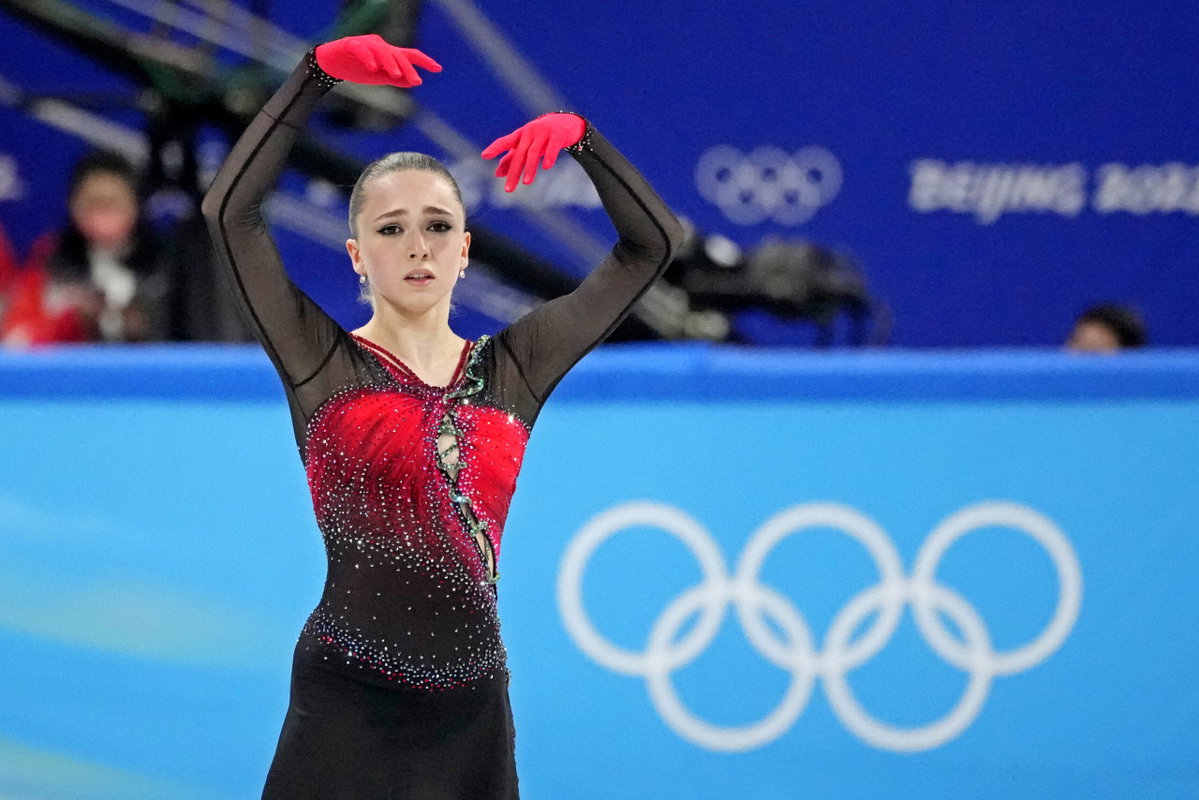
Kamila Valieva’s Olympic journey came to an abrupt end. The 15-year-old Russian figure skater had already created history at the Beijing 2022 Winter Olympics by performing her first quadruple jump at the Games. However, days later, she was informed that her doping test had failed. So, Valieva was later handed a four-year suspension. Now, after serving her four-year ban, Valieva has received a new development in her long-running legal battle.
Watch What’s Trending Now!
On September 8, 2026, the European Court of Human Rights accepted her complaint for consideration in the proceedings involving the Court of Arbitration for Sport and the Swiss Federal Court. Her complaint concerns Article 6, Article 8, and Article 13.
The case dates back to December 25, 2021, when Valieva participated in the Russian Figure Skating Championships. She won the free skate, and her doping sample was discovered to contain trimetazidine. The result became known only after the Beijing Olympics had already begun. By that point, Valieva had already helped the Russian Olympic Committee team win the figure skating team event.
But once her positive test was made public, her involvement in the Games was put into question. Valieva was eventually allowed to compete in the Games. However, following Beijing, the legal battle continued.
In December 2022, Valieva did not receive a period of ineligibility from a Russian Anti-Doping Disciplinary Committee. But then on January 29, 2024, CAS overturned the Russian decision and imposed a four-year period of ineligibility on Valieva.
Valieva’s defence said it may have been contaminated by her grandfather preparing a dessert. But this was rejected by CAS, which upheld the anti-doping violation. Later, Valieva appealed this CAS decision to the Federal Court of Switzerland. She applied for a revision of the award of the CAS, which was denied by the Swiss Federal Tribunal in October 2025. However, Valieva’s lawsuit did not come to an end there.
In 2025, she submitted her case to the European Court of Human Rights. Her complaint was not simply asking the ECHR to act as another sports court and decide whether the doping violation occurred. Instead, Valieva argues that the legal process surrounding the case violated her rights. According to Article 6, she did not get a fair hearing.
Valieva also claims Article 8, as it relates to the publication of the CAS award and the associated press releases, infringed upon her right to private life and family life. Her claim also relies on Article 13, which has to do with the right to an effective remedy. Valieva states that, before the Federal Court of Switzerland, she was unable to find an effective mechanism to contest the CAS decision, given that she had only a narrow scope of review.
The ECHR has now moved the application forward by asking questions to the parties. The case is one of the more general issues as to whether the court has jurisdiction over the complaints and what ties the cases have to Switzerland. The court is also considering the role of the World Anti-Doping Agency, based in Lausanne, in the overall anti-doping system. For Valieva, this is an important legal development, but it does not mean that she has won her case.
Interestingly, the latest ECHR development comes just days after another setback in Valieva’s career.
Kamila Valieva’s comeback takes another turn after ban ends
On September 5, it was reported that the International Skating Union had withdrawn Kamila’s neutral-athlete status, which had enabled her to consider returning to international competition. Valieva would not be allowed to compete in ISU events without it. This follows the suspension of Valieva from competitive skating for four years due to the use of drugs. However, her ban expired on December 25, 2025.
And then on January 31, 2026, Valieva made her comeback to competition at the Russian Jumping Championships in Moscow which took place over a period of several days. The event was an unusual comeback as it was all jumps, no short program and free skate.
Valieva immediately reminded fans of the ability that once made her one of the biggest names in figure skating. In the women’s quarterfinals, she landed a quadruple toe loop and advanced to the semifinals. She also joined Mark Kondratiuk in the duets competition at the event, where the pair got to the sixth position. But the next day was more of a struggle.
Valieva finished sixth in the women’s semifinal and failed to advance to the final. She also made a mistake on her first quadruple toe loop and fell on another jump, making it a much less impressive second day on her comeback. Nevertheless, the event was a significant one for Valieva.