
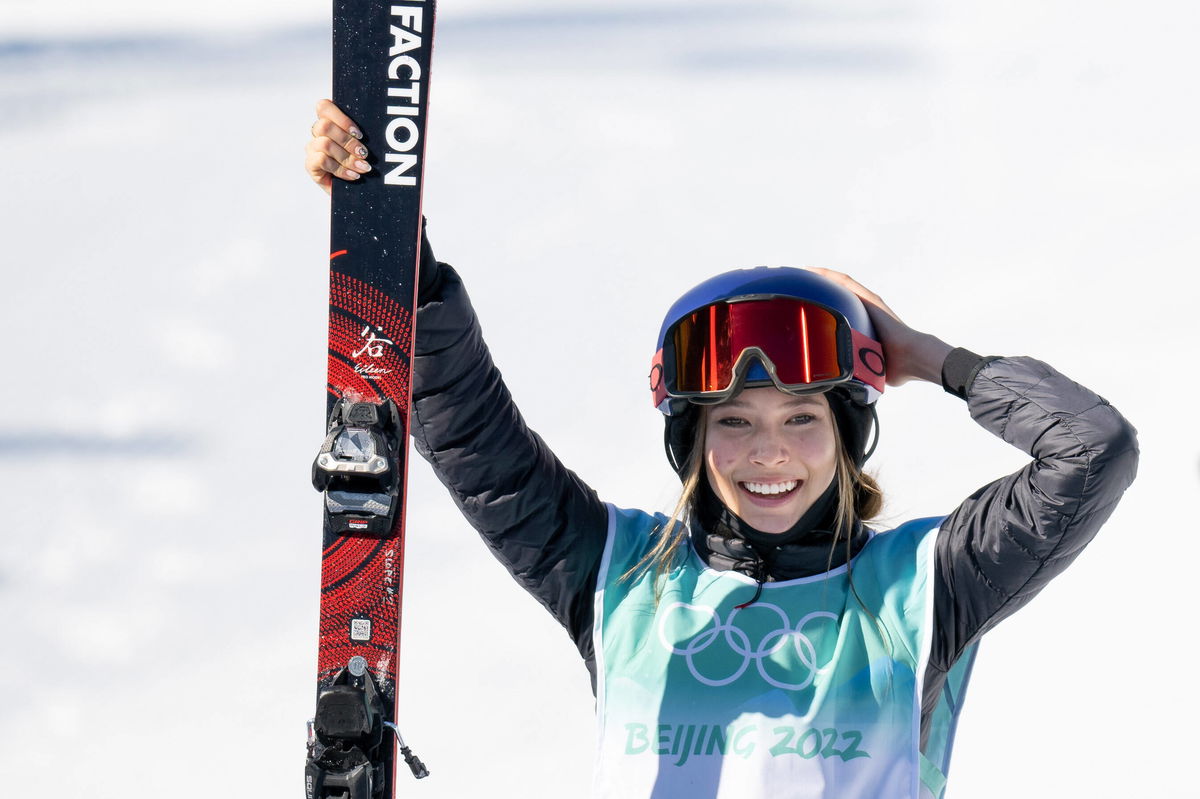
Eileen Gu has spent years pushing the limits of freestyle skiing. But behind her Olympic success lies a relationship that has attracted just as much attention as her performances. Now, the three-time Olympic gold medalist is setting the record straight about her mother, Yan Gu, and the “tiger mom” label that people have attached to her.
Watch What’s Trending Now!
Speaking at the KFF Inspiring Women Leadership Series at Singapore Management University on October 12, Gu reflected on how her mother’s parenting shaped her ambitions, independence, and outlook on life. In front of an audience of more than 1,000 people, the 23-year-old offered a very different picture of the woman behind her success.
“Um, a lot of people make the incorrect assumption that she’s a tiger mom. And I think the tiger mom definition is that, you know, it’s like a helicopter parent that pilots you and, like, forces you to do various things. She was in many ways the opposite of that, where she just vigorously provided me with freedom and agency and like enforced my freedom really intensely, and that was like the effect of her tiger mom,” Gu explained.
Rather than pushing her daughter down a predetermined path, Yan encouraged her to explore different interests and discover what she wanted for herself. For Gu, that distinction lies at the heart of their relationship, one that has evolved from a parent guiding a child into a partnership built on trust and mutual respect.
Gu made her admiration for Yan unmistakable when moderator Lily Kong asked about her mother’s influence on her journey. Smiling, the skier responded, “My mom’s the best for sure. Like, let’s just get that off the table.”
She also recalled how Yan viewed her responsibilities as a parent as her daughter grew older. “She would always say that up until I was 13, I was her job, and then after I turned 13 I was the job of the world,” Gu shared.
That philosophy helps explain why Yan exposed her daughter to so many activities during childhood. Gu tried everything from ballet, piano, and archery to basketball, soccer, and cross-country running. She also attended math and science camps and took singing lessons, even when she wasn’t particularly interested in them.
“I think she really optimized for play and she optimized for optionality,” Gu said.
The idea was to give her daughter enough experiences to make informed decisions later in life. Instead of choosing a future for Gu, Yan wanted her to understand the possibilities available to her before committing to one.
“When I was younger, she really gave me the full spread so that when I was older and when I knew myself better and when I was responsible to make those decisions, I could make an informed one having tried all the options,” the Olympic champion explained.
That freedom eventually helped Gu find her calling on the slopes. She began skiing at three, took up freestyle at eight, and started winning competitions the following year. Her mother’s support helped create the conditions for that success, but Gu’s account suggests that the final choice always belonged to her.
Knowing more about Eileen Gu’s mother, Yan Gu
Yan’s influence extended beyond encouraging her daughter’s interests. A Chinese immigrant who moved to the United States in the 1980s, she raised Gu in San Francisco as a single mother while building her own professional career. Yan studied at Peking University before pursuing further education in the United States, including a master’s degree in biochemistry and molecular biology at Auburn University.
She also shared her love of skiing with her daughter. On weekends, Yan drove Gu from San Francisco to Lake Tahoe, a journey of roughly four hours, so the young skier could train. Those long trips became an important part of their bond.
Gu previously told TIME that the drives were integral to their relationship. Yan also recorded her daughter’s runs so they could review the footage together, turning time on the mountain into another opportunity to learn and improve.
Their closeness has remained central to Gu’s life. During the 2022 Beijing Winter Olympics, she told Olympics.com that they had become increasingly like friends as she grew older. She also credited her mother with knowing how to motivate her at crucial moments, including when fatigue threatened to affect her performance.
That understanding now informs how Gu describes their relationship. Rather than simply calling Yan her parent or mentor, she has found another term that better captures how they work together.
“I keep calling us co-founders because I really think that’s like the best way to encapsulate our partnership,” Gu said. “We travel together every day. We live together. We work together. We develop together. We change together. We evolve… We have dialogue that is respectful, that is critical, that is conducive, that is productive.”
The conversation in Singapore also moved beyond family, touching on mental training, neuroplasticity, and the importance of continuing to learn. Gu explained that freestyle skiing demands more than physical ability because every new trick challenges an athlete to move beyond previously established limits. “By definition, to progress in the sport of free skiing is to ask your body to do something that’s never been done before, ever,” she said.
“Every new trick that I learn, I’m breaking a physical, mental, emotional boundary that had been set for me before… it’s breaking new ground every time.”
For Gu, progress begins with understanding her own emotions and learning to distinguish between fear, doubt, and nerves. She believes that recognizing how the mind responds to discomfort can help people discover room for growth, both in sport and in everyday life.
That mindset mirrors the freedom she says Yan gave her growing up. Her mother opened the door to different possibilities, but Gu had to learn how to navigate them herself.
As Gu continues to pursue excellence in freestyle skiing while exploring opportunities beyond the slopes, her reflections offer a different perspective on the familiar “tiger mom” stereotype. She credits Yan not for controlling every move she made, but for giving her the freedom to explore her interests, make her own choices, and chart a path toward success.
For Gu, the greatest lesson from her mother may be that support does not have to mean control. Sometimes, it means giving someone the confidence to choose their own path – and trusting them to see how far they can go.