Imago
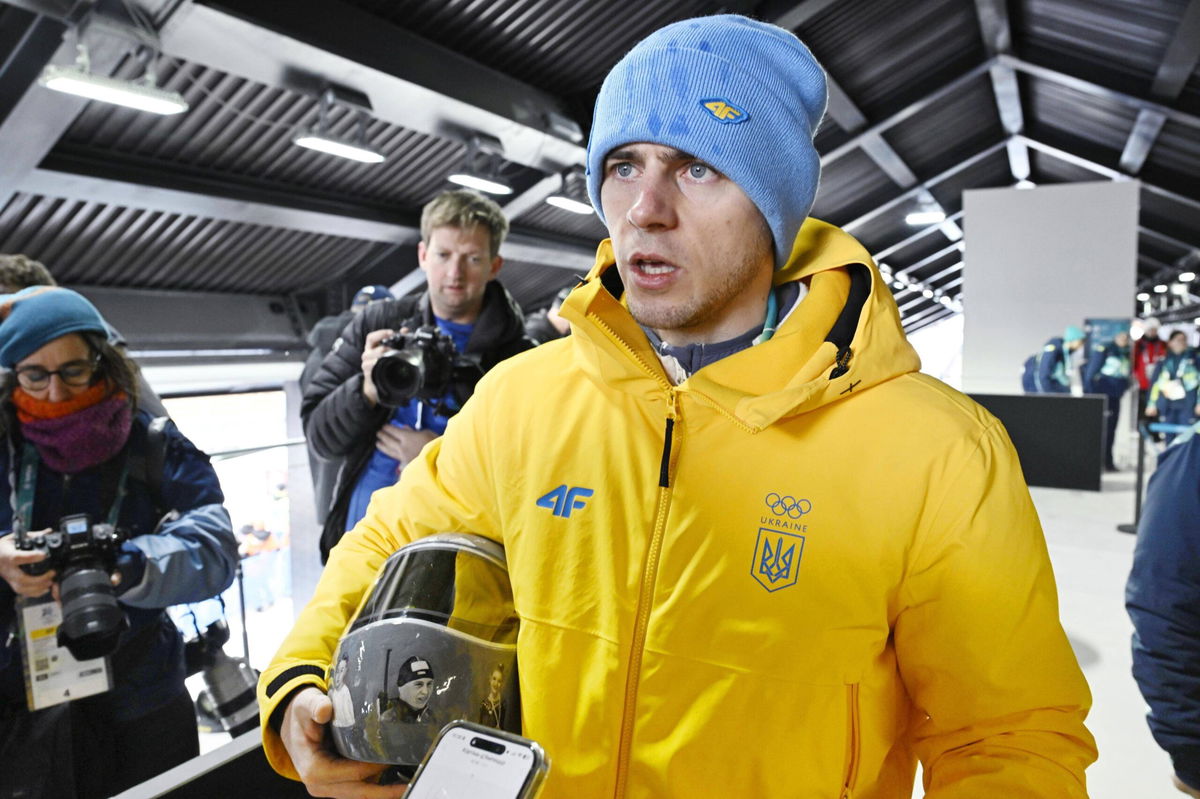
Milan Cortina Olympics: Ukrainian athlete disqualified from games Ukrainian skeleton racer Vladyslav Heraskevych meets the press in Cortina d Ampezzo, Italy, on Feb. 12, 2026, after being disqualified from competition at the Milan Cortina Olympics for pledging to wear a helmet displaying images of athletes who were killed during Russian attacks on Ukraine. PUBLICATIONxINxAUTxBELxBIHxBULxCZExDENxESTxFINxFRAxGEOxGERxGRExHUNxISLxIRLxITAxLATxLTUxLUXxLIExMKDxNORxPORxPOLxROUxSVKxSUIxSRBxSLOxESPxTURxUKxUAExONLY A14AA0005274189P
Imago
Milan Cortina Olympics: Ukrainian athlete disqualified from games Ukrainian skeleton racer Vladyslav Heraskevych meets the press in Cortina d Ampezzo, Italy, on Feb. 12, 2026, after being disqualified from competition at the Milan Cortina Olympics for pledging to wear a helmet displaying images of athletes who were killed during Russian attacks on Ukraine. PUBLICATIONxINxAUTxBELxBIHxBULxCZExDENxESTxFINxFRAxGEOxGERxGRExHUNxISLxIRLxITAxLATxLTUxLUXxLIExMKDxNORxPORxPOLxROUxSVKxSUIxSRBxSLOxESPxTURxUKxUAExONLY A14AA0005274189P
For Ukrainian skeleton racer Vladyslav Heraskevych, wearing the ‘helmet of remembrance’ was not a protest against the geopolitical tensions that engulf his country, but a tribute to his fallen fellow athletes. Thursday morning, right before the Winter Olympics event, he was suspended, but he is reluctant to fight for his cause.


In a social media post just before the proceedings began, he provided an update, stating, “The fight for truth continues. In a few minutes, the hearing at the Court of Arbitration for Sport (CAS) will begin. I am confident that I did not violate any IOC rules, so I consider my disqualification absolutely unjustified. I see all your support — and it inspires me immensely.”
Watch What’s Trending Now!
As the men’s skeleton competition barreled toward its medal finals without him, Heraskevych took his fight to the CAS. The 27-year-old, who also served as Ukraine’s flag bearer during the opening ceremony at the Milan Winter Olympics, still believes that his helmet which contained the portraits of the deceased, was just an act of remembrance without any political agenda behind it.
“I feel the same as the last four days. I believe I didn’t violate any rules, so therefore I shouldn’t be suspended and I should be today part of the Olympic Games, part of the competition, but not part of the hearing. And yeah, so we continue to fight for our truth,” he said, as reported by Repubblica. When asked if he was confident about his stance. The Winter Olympics star added, “Of course.”
However, the IOC saw it through a different lens, flagging the helmet for a violation of Rule 50.2 of the Olympic Charter. And what does it say? The rule strictly prohibits athletes from committing any form of political, religious, or racial propaganda at Olympic sites. The IOC’s response?
“No-one is disagreeing with the messaging. The messaging is a powerful message of remembrance, it’s a message of memory, and no-one is disagreeing with that,” IOC president Kirsty Coventry said, who visited Heraskevych and his father before the competition.
“What I proposed to him this morning and to his dad – because he also said when he goes down it’s blurry, you can’t really see it – so I said: ‘Could we find a solution where we pay homage to his message, to his helmet before he races, then as soon as he’s finished racing going into the mixed zone where you can see the pictures?’ Sadly, we’ve not been able to come to that solution. I really wanted to see him race today. It’s been an emotional morning.”
The IOC maintains that the focus on the field of play must remain on sport, a stance spokesman Mark Adams defended by noting the existence of over 130 global conflicts.
“We want him to compete. We really, really want him to have his moment. That’s very, very important. And we will reiterate the many, many opportunities that he has to express his grief,” Adams said before the suspension.
Боротьба за правду триває
The fight for truth continuesЗа кілька хвилин розпочнеться судове слухання у Спортивному арбітражному суді (CAS). Я впевнений, що не порушував правил МОК, тому вважаю свою дискваліфікацію абсолютно неправомірною.
Я бачу всю вашу підтримку – і вона… pic.twitter.com/b5ee52KBJ7— Vladyslav Heraskevych OLY (@heraskevych) February 13, 2026
“He can do so on social media, in press conferences, in the mixed zone. He can, and we would encourage him to express his grief. We feel his grief. We would expressly want him to do that. But, you know, in the end, let me be clear. It’s not the message. It’s the place that counts. And that’s us. And not actually us. We are in this, in a sense, in a back seat.”
However, the ones who supported him throughout his Winter Olympics journey in Milan were also left disappointed and heartbroken, owing to his suspension from the event.
A tough pill to swallow at the Milano Cortina Winter Olympics
For Vladyslav Heraskevych, his father, Mykhailo, has always been a pillar of support. And watching him compete at the Winter Olympics was a proud moment for him.
“I felt joy. However, it is worth noting that he deserved this honorable and responsible mission. Vladyslav does a lot. He trains a lot, and also carries not only a sports mission, but also a national one, so to speak. We constantly talk about the difficult situation, about the war in which Ukraine is currently [involved],” Mykhailo said on February 6, before the IOC’s decision to ban his son from competing.
The broadcasting cameras caught Heraskevych’s father in tears when he received the news that the athlete had been suspended, and he was consoled by Chanmin Chyun, the president of the Korea Bobsleigh and Skeleton Federation, on the site.
Team GB’s two-time Olympic skeleton gold medalist Lizzy Yarnold shared, “This [wearing the helmet] was a reaction to something which was an act of memorial and incredibly emotionally important to him. I think the IOC owe him an apology and this was the wrong decision.” Indeed, his fellow athletes weren’t delighted.
Even Ukraine’s President Volodymyr Zelenskyy called out the IOC, stating, “Unfortunately, the decision of the International Olympic Committee to disqualify Ukrainian skeleton racer Vladyslav Heraskevych says otherwise. This is certainly not about the principles of Olympism, which are founded on fairness and the support of peace.”
He added, “I thank our athlete for his clear stance. His helmet, bearing the portraits of fallen Ukrainian athletes, is about honour and remembrance.” The Ukrainian skeleton racer arrived at the Winter Olympics with hopes of not only getting a medal but also honoring the fallen athletes. However, his fight will continue for now, as the world awaits the CAS’ decision.
Written by

Edited by

Tanay Sahai