
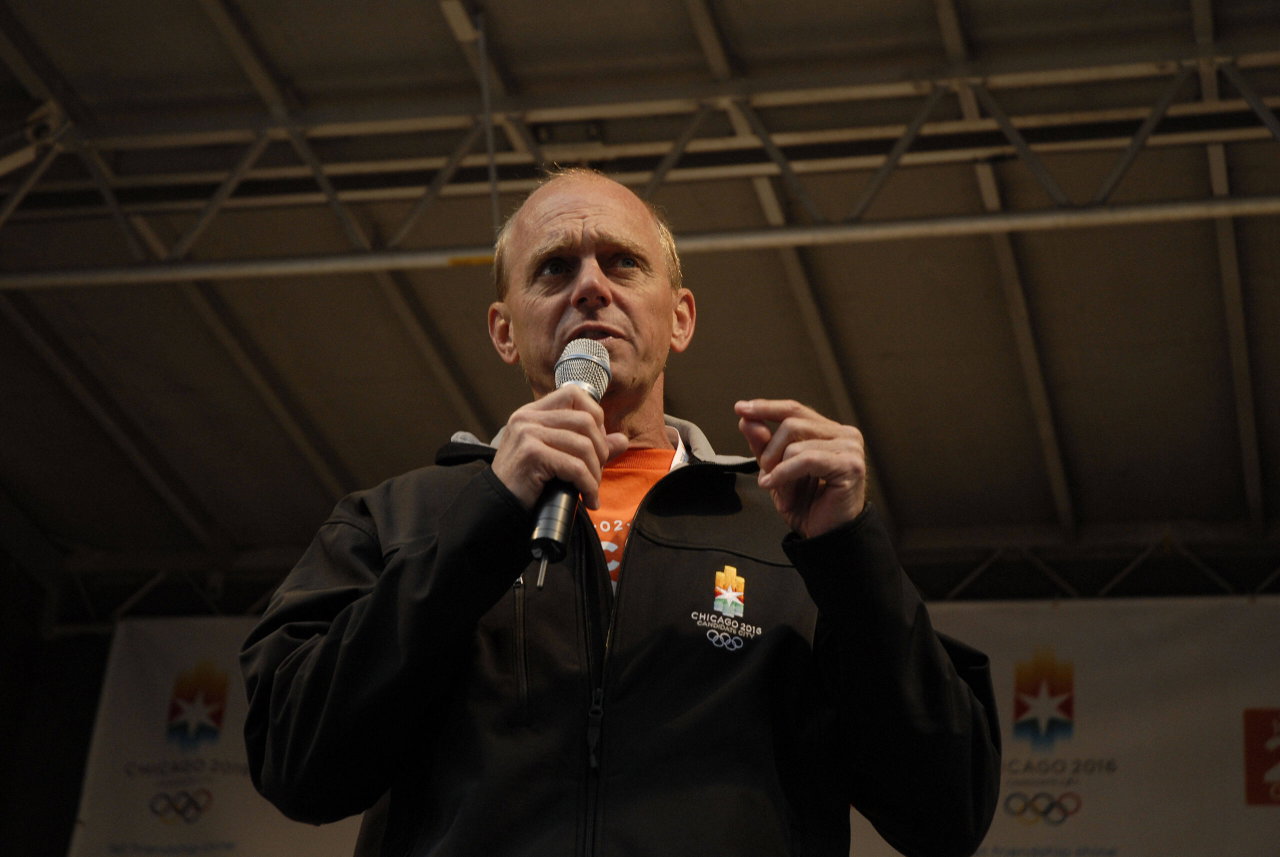
Growing up in Winter Haven, Florida, Rowdy Gaines lived beside a lake and learned to swim when he was just nine months old. But competitive swimming was far from his first choice. Before finding the sport at 17, Gaines tried different sports but repeatedly failed to make the teams. Nearly five decades later, as the swimming world looks ahead to the 2028 Los Angeles Olympics, Gaines was left stunned by a Chinese teenager who is already making her mark on the international stage at just 13.
Watch What’s Trending Now!
“13 and 17. What is the world coming to? I didn’t even start swimming until I was 17,” Gaines wrote on X on September 24. The two ages he mentioned tell a story of their own. While Gaines was only beginning his competitive swimming journey at 17, Japan’s Shin Ohashi is already making history at the same age. And China’s Yu Zidi is doing it even earlier, with the 13-year-old putting together a remarkable run at the Asian Games.
Yu completed her three-gold run on September 23, winning the women’s 400m individual medley in an Asian Games-record time of 4:28.56. It was her third individual gold of the Games after victories in the 200m butterfly and 200m individual medley. Her first gold came in the 200m butterfly, where she clocked 2:05.08 to set an Asian Games record.
She then won the 200m individual medley in 2:06.10, breaking the Asian record and Asian Games record. The time also put her just 0.40 seconds away from Canada’s Summer McIntosh’s world record of 2:05.70. Yu then returned to the pool for the 400m individual medley on September 23 and produced another record-breaking swim. Her 4:28.56 was around 4.5 seconds faster than the previous Asian Games record set by China’s Ye Shiwen in 2014. With that victory, Yu completed a clean sweep of all three individual events she entered at her first Asian Games.
While Yu was making her mark at 13 another teenager also set even bigger moment on September 24. Japan’s Shin Ohashi lined up for the men’s 200m breaststroke final at the Tokyo Aquatics Centre with another Asian Games gold in sight. In the race, Ohashi broke the previous world record set by Chinese athlete Qin Haiyang, winning the race with a time of 2:04.83.
Qin had set the previous mark of 2:05.48 at the 2023 World Championships in Fukuoka. The Japanese teenager also dominated the final, finishing 3.84 seconds ahead of silver medalist Denis Petrashov of Kyrgyzstan. “My target had always been to break the world record, and I’m so happy to have done it,” Ohashi said after the race.
The victory was Ohashi’s second individual gold medal at the Asian Games. Earlier in the competition, he won the men’s 100m breaststroke after tying with China’s Dong Zhihao in 58.64. The two swimmers shared the gold after finishing with exactly the same time. For Gaines, the performances of the two teenagers offer an interesting contrast with his own path.
The late start that eventually took Gaines to Olympic glory
Before Rowdy Gaines seriously tried the sport, he had already attempted football, baseball, basketball, tennis and golf, only to be cut from all five. Swimming was almost an afterthought for the teenager who would eventually become an Olympic champion. It was not until his junior year of high school, at 17, that Gaines finally turned to swimming. The change was dramatic. He improved so quickly that within about two years, he had earned a swimming scholarship to Auburn University, where he trained under coaches including Eddie Reese and Richard Quick.
At Auburn, Gaines quickly established himself as one of the school’s top athletes. He won eight NCAA championships, including five individual titles, became a 22-time All-American and won 14 SEC championships. As a senior, he was also named the SEC Athlete of the Year. His rise continued at the international level. By the time the 1980 Moscow Olympics approached, Gaines had become one of the world’s leading freestyle swimmers and had broken 11 world records. He was expected to challenge for multiple Olympic gold medals, but the United States boycotted the Games following the Soviet invasion of Afghanistan.
The boycott hit Gaines hard. After finishing his senior season at Auburn, he initially retired from competitive swimming, unsure whether he could continue without the Olympic opportunity he had spent years chasing. His father encouraged him to reconsider, and with support from Richard Quick, Gaines returned to training in 1981 and moved to Austin, Texas, to prepare for the 1984 Olympics.
Three years later, Gaines finally got the Olympic moment he had missed in Moscow. At the 1984 Los Angeles Games, the 25-year-old won three gold medals, taking the 100m freestyle and helping the United States win the 4x100m freestyle and 4x100m medley relays. The teenager who had been cut from five sports had become an Olympic champion in Los Angeles.
His career later took another difficult turn. In 1991, Gaines was diagnosed with Guillain-Barré syndrome, but he eventually recovered and returned to the pool. At 35, he qualified for the 1996 U.S. Olympic Trials, becoming the oldest swimmer to do so at the time, although he ultimately chose not to compete at the Atlanta Olympics.
Gaines later became one of swimming’s most recognizable broadcasters. He has worked as an NBC swimming analyst for decades and has remained involved in the sport through appearances and work with young swimmers, including at Auburn’s swim camps.