Imago
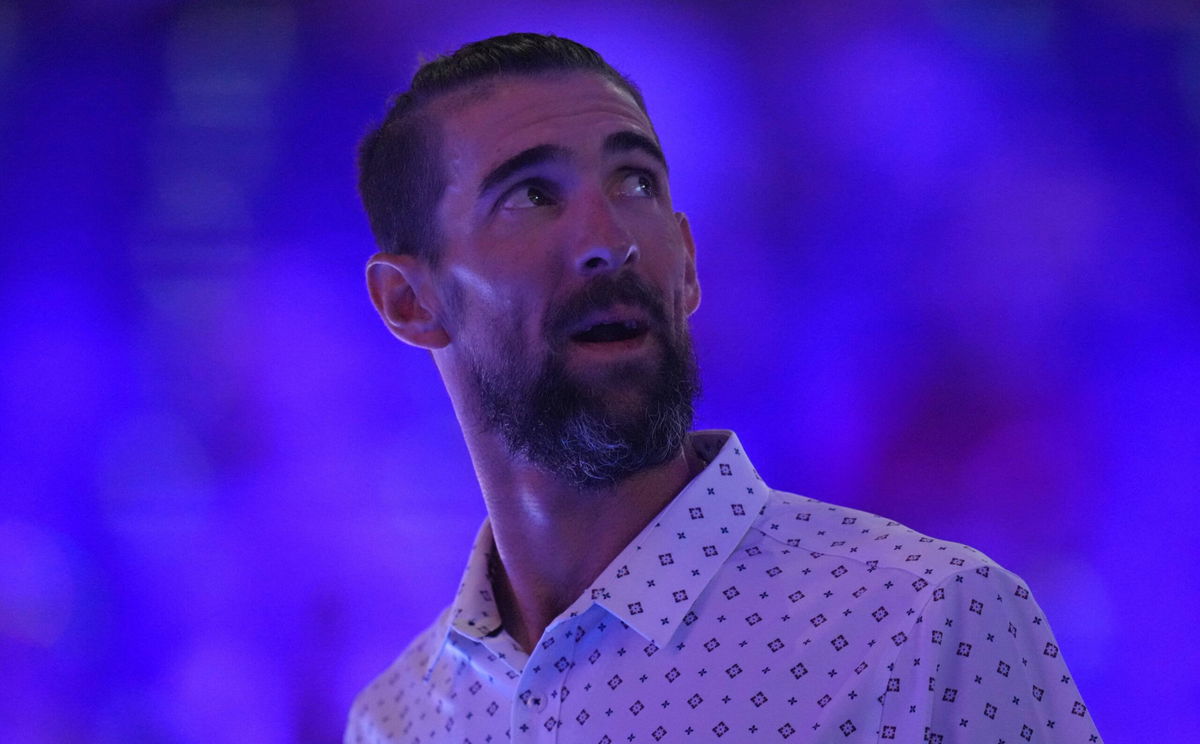
Syndication: Journal-Courier Michael Phelps looks up, Saturday, June 22, 2024, during the eighth day of the U.S. Olympic Team Swimming Trials at Lucas Oil Stadium in Indianapolis. Lafayette IN , EDITORIAL USE ONLY PUBLICATIONxINxGERxSUIxAUTxONLY Copyright: xGracexHollars/IndyStarx USATSI_23603079
Imago
Syndication: Journal-Courier Michael Phelps looks up, Saturday, June 22, 2024, during the eighth day of the U.S. Olympic Team Swimming Trials at Lucas Oil Stadium in Indianapolis. Lafayette IN , EDITORIAL USE ONLY PUBLICATIONxINxGERxSUIxAUTxONLY Copyright: xGracexHollars/IndyStarx USATSI_23603079
It’s been a decade since Michael Phelps swam his last race, but the 23-time Olympic gold medalist has sprung back into the headlines. With a medal tally that few will ever match, Phelps has long been the face of American swimming. But now, he has turned his attention to some Team USA Swimmers criticizing him. Phelps remained calm and spoke out not to attack, but to clarify that the things said about him are incorrect.
Phelps’ recent remarks drew fresh attention after an interview where he reflected on the sport’s evolution. In a conversation with Will Ahmed, founder and CEO of WHOOP, Phelps pushed back on the idea that his era was easier to compete in.
“People…I heard some current swimmers say it was easier to compete against the rest of the world when I was swimming. I don’t really agree with that,” Michael Phelps said.
He reminded fans of the legendary competitors he raced against.
“I was like Ian Thorpe, Grant Hackett, Pieter van den Hoogenband, Ian Crocker, Tom Malchow, and Tom Dolan, some of the greatest swimmers in history.” But what made him say so?
The history of this argument goes back to the 2025 World Aquatics Championships in Singapore. Despite the United States ending up top of the medal table with 9 golds and 29 medals overall, the meet was not as dominant as it had been in previous years. The fact that acute gastroenteritis struck the team at a pre-championship training camp meant that it cut short the preparation of several of the best swimmers.
Olympic Legend Michael Phelps responds to Bobby Finke:
"I heard some current swimmers say that it was easier to compete against the rest of the world when I was swimming. I don't really agree with that… I was swimming against some of the greatest swimmers on the planet." https://t.co/Uw53tevvjE pic.twitter.com/sHusPRdbah
— Swim Updates (@swimupdates) March 8, 2026
Due to that, there were unexpected outcomes of some events that Americans used to dominate, and some races of men did not include the final appearance that the fans were used to. And seeing these results clearly pained Phelps, and soon after the championships, he issued a lengthy public statement criticizing USA Swimming’s leadership.
“First, I must be clear that I have the utmost respect for the US swimmers that competed at the World Championships,” Michael Phelps wrote. “…My criticism is about the system, its leadership, and how it’s failing.”
Phelps pointed to cracks in the system he has seen grow over the past nine years, saying the organisation’s leadership has been weak, and its operational controls poor. He also said he sent a letter earlier in the year to USA Swimming and the United States Olympic & Paralympic Committee outlining his “frustrations with the current state of the sport,” but felt it “fell on deaf ears.” He made it clear that the issue is with the structure around athletes.
But at the same championships in Singapore, Olympic champion Bobby Finke defended Team USA against critics, emphasizing pride in the squad’s performance despite outside commentary. He called some criticism indirectly, pointing out to Phelps.
“I’m proud of the USA team and what we’ve been able to accomplish despite all the people back at home saying whatever they want to say,” Finke said. “But you know I’m proud of these boys. If someone’s angry my DMs are open.”
One year later, Michael Phelps touched upon these discussions once again. He emphasized the fact that the talent pool in the world has expanded tremendously, and the international swimmers are not afraid to pursue records that were previously unreachable. But does that mean the U.S. is falling behind?
Michael Phelps calls for leadership overhaul ahead of LA 2028
Well, Michael Phelps argued the current situation isn’t about a decline in U.S swimming but about global competition catching up and sometimes surpassing expectations.
“The talent level on the high end is unbelievable,” he said. “I think it’s kids from all over the globe that aren’t afraid to reach as high as they possibly can. The sky is the limit, and that’s what they’re going for.” But how does this weak leadership show up in results and the team’s future prospects?
Phelps has made it very clear that he is not angry with the athletes but rather the way USA Swimming has been managed. In a press announcement at the 2025 World Championships, he told people that there have “always been cracks in the system, but in the last nine years, I’ve seen those cracks grow.”
“There needs to be more transparency with absolutely everything. There needs to be more accountability,” Michael Phelps said. His concerns about weak structures naturally lead to a look at recent results that illustrate the problem.
Part of Phelps’ worry comes from how Team USA performed in major competitions, such as the 2024 Paris Olympics, where U.S. swimmers won roughly 44 % of the medals they competed for – the lowest proportion since the late 1980s.
Looking ahead, Michael Phelps has voiced concern about Team USA’s future heading into the 2028 Los Angeles Olympics. Without changes to how the organisation is governed and how key decisions are made, he fears the team may not be fully prepared for a home Olympics, where pressure and expectations will be intense.
However, at the same time, Phelps has also proposed some tangible solutions. He requested that the USA Swimming Board of Directors and organisational structure be independently reviewed in order to determine the point at which the system is failing. He supported the idea of a more athlete-centered philosophy, improved systems, and support services for swimmers.
Michael Phelps also recommended strengthening grassroots programs to grow participation and nurture future talent. Most notably, he offered his own time and experience to help implement these reforms, hence emphasizing that his “door is open” to support meaningful change. What do you think about this? We’d love to hear your take in the comments below!