
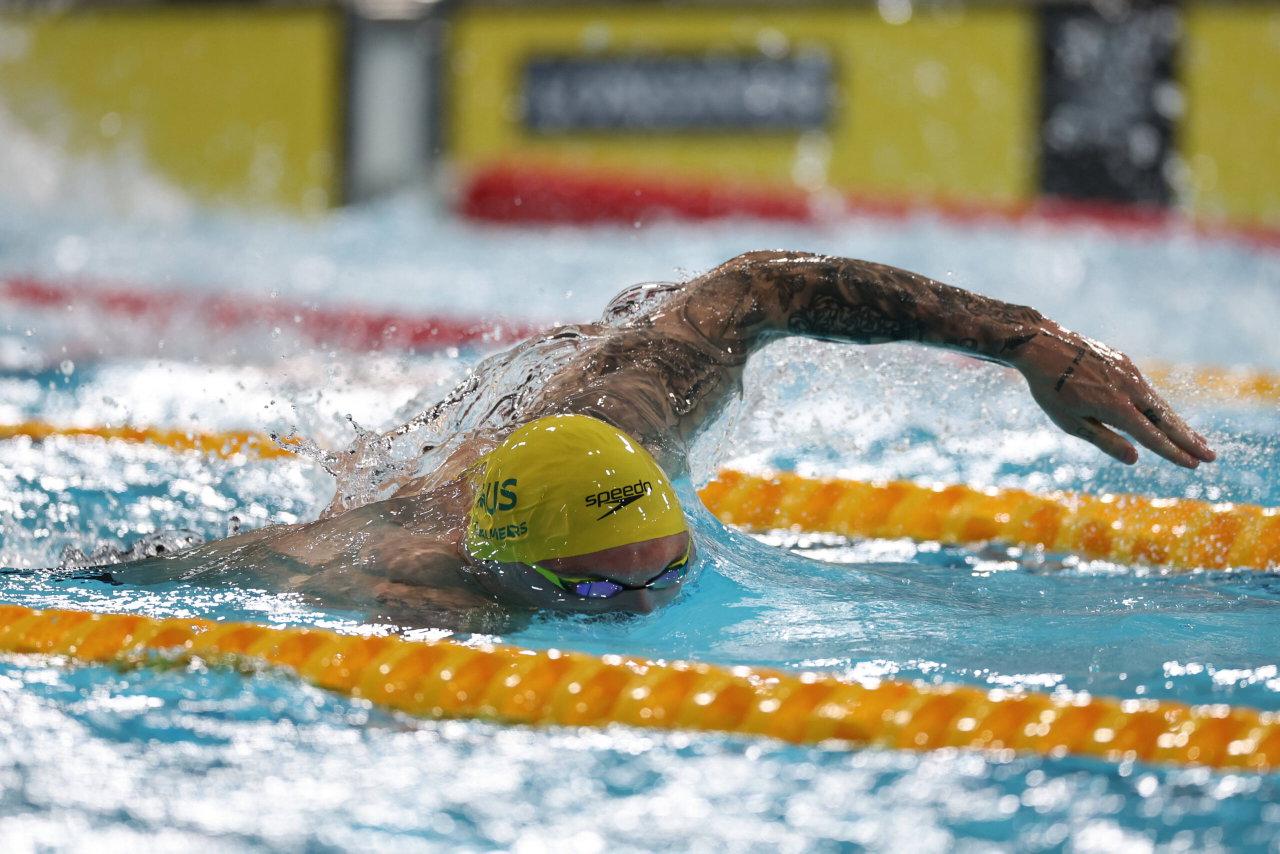
Kyle Chalmers had been looking well beyond the 2026 Commonwealth Games. The Australian swimming star, who won Olympic gold at Rio 2016, had made it clear that the LA 2028 Olympics remained his biggest goal. Although he expected Glasgow to be his final Commonwealth Games, he planned to continue toward LA 2028, aiming to help Australia in the relays. But after one of the biggest surprises of the meet, those plans are no longer certain.
Watch What’s Trending Now!
On July 29, in the men’s 100m freestyle final, 21-year-old Flynn Southam defeated Chalmers in 47.13 seconds, with the Olympic champion settling for bronze. It marked the first time Chalmers had lost an international 100m freestyle race to a fellow Australian. The result left the 28-year-old reconsidering whether another Olympic cycle is the right path.
Speaking after the race, Chalmers admitted that while competing at LA 2028 is still a dream, his priorities have changed. “It would be amazing. That would be my ultimate dream, but I know also that my career isn’t all about me anymore,” Chalmers said. “I have to walk away from this meet and have a really good chat with my wife and make sure that this is the best decision for us.”
His doubts are about far more than one disappointing result. Since becoming a father, Chalmers said every decision now has to take his family into account, especially with the demands of life as two professional athletes, as his wife, Ingeborg Vassbakk Løyning, is also a Norwegian swimmer and former Olympian.
“It’s not as easy as it sounds when you’re both athletes. My wife’s Norwegian so we don’t have her family’s support around us. My family is mainly from Port Lincoln so we’ve got my mum and dad in Adelaide, but that’s all we really have to rely on to be able to juggle parenthood, so we have to work out and really plan out how we’re actually going to get to that point.”
While the road to Los Angeles remains open, Chalmers acknowledged that his family’s needs will ultimately decide whether he continues. Even with the disappointment in the 100m freestyle, he still had moments to celebrate in Glasgow. He shared gold with teammate Ben Armbruster in the men’s 50m butterfly and matched Australian great Ian Thorpe’s record of 10 Commonwealth Games swimming gold medals. Australia also had a record 37 swimming gold medals, ensuring their dominance in the pool.
For now, though, medals and records have taken a back seat. This is not the first big challenge Chalmers has encountered. The Australian has faced a series of personal setbacks during his career that would have ended many athletes’ careers.
The challenges that nearly ended Chalmers’ career
One of the most difficult times came after the men’s 100m freestyle final of the Paris 2024 Olympics. Chalmers finished second behind China’s Pan Zhanle, who set the new world record, but the race quickly became embroiled in controversy. The Australian was then the victim of a barrage of online abuse from some Chinese social media following Pan’s suggestion that Chalmers had ignored him beforehand in the final.
According to Chalmers, the attacks soon escalated into death threats and eventually spread to his family. “It was very stressful in that period, getting heaps of death threats come through and pretty horrendous messages,” Chalmers said. “They started targeting my fiancée and family, and that becomes hard.” Chalmers later made it clear there was never any bad blood between him and Pan.
The abuse was only one chapter in a career filled with adversity. Before becoming Olympic champion at Rio 2016, Chalmers underwent three heart surgeries to treat supraventricular tachycardia. He has also battled a degenerative spine condition and bulging discs for years.
Ahead of the Australian Olympic Trials in 2024, his back went into spasm after taking a day off from training, forcing him to receive four cortisone injections just to keep racing. By then, he had undergone 10 cortisone injections in his back during his career.
Looking back on his journey, there was a time when Chalmers came close to walking away from the sport altogether. He fought through it all to remain one of the world’s top swimmers.