
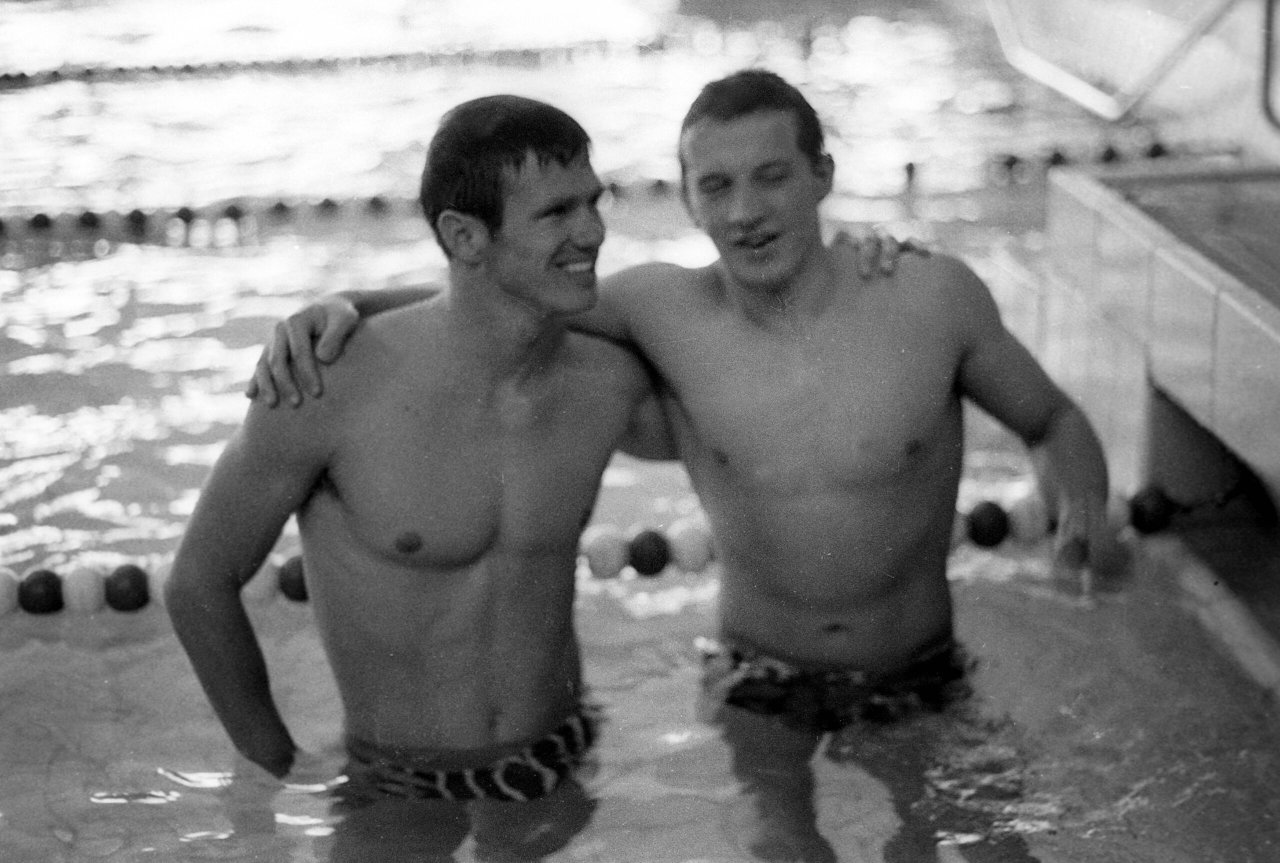
Mike Burton was not feeling well when he arrived at the 1968 Mexico City Olympics. In fact, the American swimmer had passed out and vomited before his races. Still, he got into the pool and went on to win two gold medals for the United States, taking the 400-meter freestyle before dominating the 1,500-meter freestyle by 18 seconds. Now, nearly six decades after those unforgettable races, Burton has touched the wall for the final time, passing away at the age of 79 on September 18, 2026.
Watch What’s Trending Now!
His son, Eric Burton, announced his death on Facebook, saying, “My dad, Mike Burton, has passed away after a grueling battle with Alzheimer’s and dementia,” Eric wrote. “My dad was by far the toughest man to have ever lived. He always inspired me to greatness.”
That toughness was visible throughout Burton’s life. Long before he became an Olympic champion, swimming was something he turned to after a serious childhood accident changed the direction of his life. Burton was born in Des Moines, Iowa, on July 3, 1947, and moved with his family to Sacramento, California, when he was young. He loved sports growing up, particularly football and basketball, and was developing into a talented athlete.
That changed when he was struck by a truck while riding his bicycle. The accident left him with serious injuries and ended his chances of continuing in contact sports. Swimming became an option because it was something he could do while recovering. Even doctors allowed Burton to try swimming but warned him not to expect much from it. But that pushed the teenager to prove them wrong. He joined the Arden Hills Swim Club, where legendary coach Sherm Chavoor took him under his wing.
Then, Burton began swimming competitively at 14 and quickly started making a name for himself. During his time at El Camino High School, he won 10 AAU titles. By 16, he was competing at the Nationals, and by 17, he was swimming internationally. Interestingly, Burton had been swimming competitively for only about three years when he qualified for the 1964 U.S. Olympic Trials. He entered the 1,500-meter freestyle and finished fifth, narrowly missing a place on the Olympic team.
Instead of ending his Olympic dream, the experience gave him another target: the 1968 Games in Mexico City. At UCLA, Burton continued to develop into one of America’s top distance swimmers. He won five individual NCAA titles between 1967 and 1970 and set records in freestyle and butterfly. He also won the 1,500-meter freestyle at the 1967 University Games in Tokyo.
Before the 1968 Olympics, Burton spent 40 days training in Colorado Springs to prepare for the altitude in Mexico City. The hard work paid off. He won the 400-meter freestyle in 4:09.00, beating Canada’s Ralph Hutton in a close race and setting an Olympic record. Two days later, he returned to the pool for the 1,500-meter freestyle and produced an even more dominant performance, winning by 18 seconds over fellow American John Kinsella. Four years later, Burton returned to the Olympics in Munich with another challenge in front of him.
By 1972, Burton was no longer entering the Olympics as an unquestioned favorite. He had dealt with a vitamin deficiency and struggled at the U.S. Olympic Trials. He failed to qualify for the 400-meter freestyle and 200-meter butterfly, leaving the 1,500-meter freestyle as his only route back to the Olympic team. He made it.
Burton then defended his Olympic title in Munich, winning the 1,500-meter freestyle in 15:52.58 and setting a world record. He became the first swimmer in Olympic history to win the 1,500-meter freestyle at two different Games. That victory gave Burton his third Olympic gold medal and made him the first American to successfully defend the Olympic 1,500-meter freestyle title. Decades later, Bobby Finke matched Burton’s feat by winning the event at the 2020 and 2024 Olympics.
And then, at the age of 25, Burton retired from competitive swimming. But swimming was never really something he left behind.
Mike Burton kept his connection to swimming alive for decades
After retiring, Burton moved into coaching. He spent about 35 years coaching, working with swimming programs in Iowa, Washington, and Montana. He also coached at BYU, where he was part of a program that won an NCAA national championship.
His years as a coach allowed Burton to pass on what he had learned during his own career. The Sacramento Sports Hall of Fame also credits him as a trailblazer for a number of Sacramento swimmers who went on to make their own mark in the sport, including Debbie Meyer, Jeff Float and Summer Sanders.
While coaching became a major part of his life after competition, Burton’s achievements in the pool continued to earn recognition. He was inducted into the International Swimming Hall of Fame, the UCLA Hall of Fame and the Sacramento Sports Hall of Fame.
By the time his swimming career was over, Burton had collected three Olympic gold medals, seven world records, 16 U.S. records, 10 AAU titles and five NCAA individual championships.