
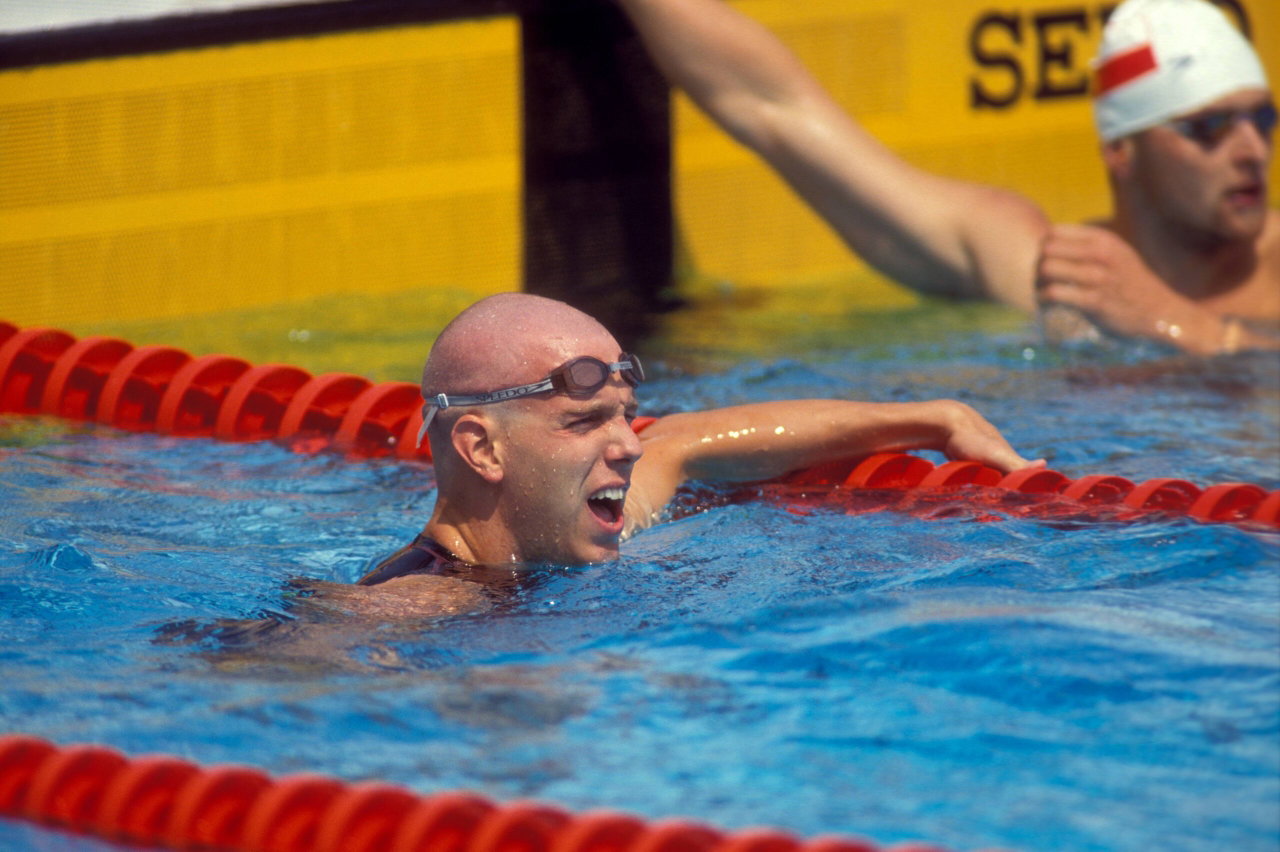
Doug Gjertsen spent much of his life in and around the water, first chasing Olympic glory and later helping generations of swimmers find their own path. The two-time Olympic champion died on November 28, aged 59, after battling cancer for two years. Even during that fight, he returned to the pool in master’s events in 2026.
Watch What’s Trending Now!
Born in Phillipsburg, New Jersey, on July 31, 1967, Gjertsen starred at the University of Texas at Austin. Competing under coach Eddie Reese, he won three individual NCAA titles: the 200-yard backstroke in 1987 and the 200-yard freestyle in 1988 and 1990.
He also contributed to nine NCAA championship-winning relays, earning 12 NCAA titles overall. He entered the Longhorn Hall of Honor in 2006.
His college success carried onto the international stage. Gjertsen made his Olympic debut at the 1988 Seoul Games, where he helped the United States win gold in both the 4x100m and 4x200m freestyle relays. The 4x200m quartet of Troy Dalbey, Matt Cetlinski, Gjertsen, and Matt Biondi set a world record of 7:12.51, a mark that stood for four years. At the 1992 Barcelona Games, he added 4x200m freestyle relay bronze and finished eighth in the 200m freestyle.
Yet the Seoul Olympics, which brought Gjertsen two of the biggest moments of his career, also carried a controversy that followed him long after the Games.
The controversy behind his golden Seoul Games
In September 1988, Gjertsen and fellow American swimmer Troy Dalbey were questioned by South Korean police after an incident involving a decorative marble lion’s head at the Hyatt hotel, where the U.S. team was based. Reports at the time said the pair had taken the sculpture from a hotel bar and carried it to another bar.
The United States Olympic Committee ordered both swimmers to leave the team and return home once authorities allowed them to do so. They were also handed 18-month suspensions by USA Swimming.
The swimmers were detained and questioned, but the hotel manager ultimately declined to press charges, and they were released. Dalbey later described the episode as a prank that had spiraled out of control. “This is a case of a molehill turning into a mountain,” he said, according to a United Press International report. He acknowledged that their actions were wrong but insisted they had not intended to steal the sculpture and wanted the record to reflect what had happened.
The episode overshadowed his medals but did not define his life in swimming. After his competitive career, he turned toward coaching, beginning with SwimAtlanta in 1993. He spent more than 26 years with the program, including a long spell leading its Georgia Tech location. He guided swimmers to Olympic Trials in 1996, 2000, 2008, 2012, and 2016.
His impact reached beyond the Olympic pathway. Gjertsen coached 2008 Latvian Olympian Andrejs Dūda, U.S. Paralympian Ashley Owens, and Amanda Weir, a three-time U.S. Olympian. More than 150 of his swimmers went on to compete at the Division I, II or III college level. His coaching group also included Olympic Trials semifinalists in 2016. He also developed state, junior national, and national champions.
In 2019, Gjertsen moved to San Antonio to lead Alamo Area Aquatics Association Northeast. He led a program of around 350 members and families, including a 25-athlete national team. Over two years, he helped 26 swimmers earn USA Swimming Scholastic All-American recognition while also guiding Olympic Trials qualifiers in 2021 and 2024 and a 2023 Pan American Games qualifier. Among those he coached was Carli Cronk, who won 12 gold medals at the 2022 Deaflympics. He also helped swimmers reach Futures-level standards and earned recognition for developing academic as well as athletic talent. In October 2023, USA Swimming named him an assistant coach for its Girls’ Select Camp at the Olympic Training Center.
Gjertsen returned to Austin in March 2026 to become head coach of Hill Country Aquatics. Away from coaching, he had also helped launch Atlanta’s Swim Across America event in 2015 and remained a driving force behind it. The event has raised more than $3 million for cancer research, a cause that had become deeply personal. The fundraiser brought swimmers, families, and supporters together around a shared purpose.
From Olympic podiums to pool decks, Gjertsen’s influence traveled far beyond his own medals. He leaves behind a legacy built not only on records and titles but also on the swimmers he guided and the community he helped strengthen.