
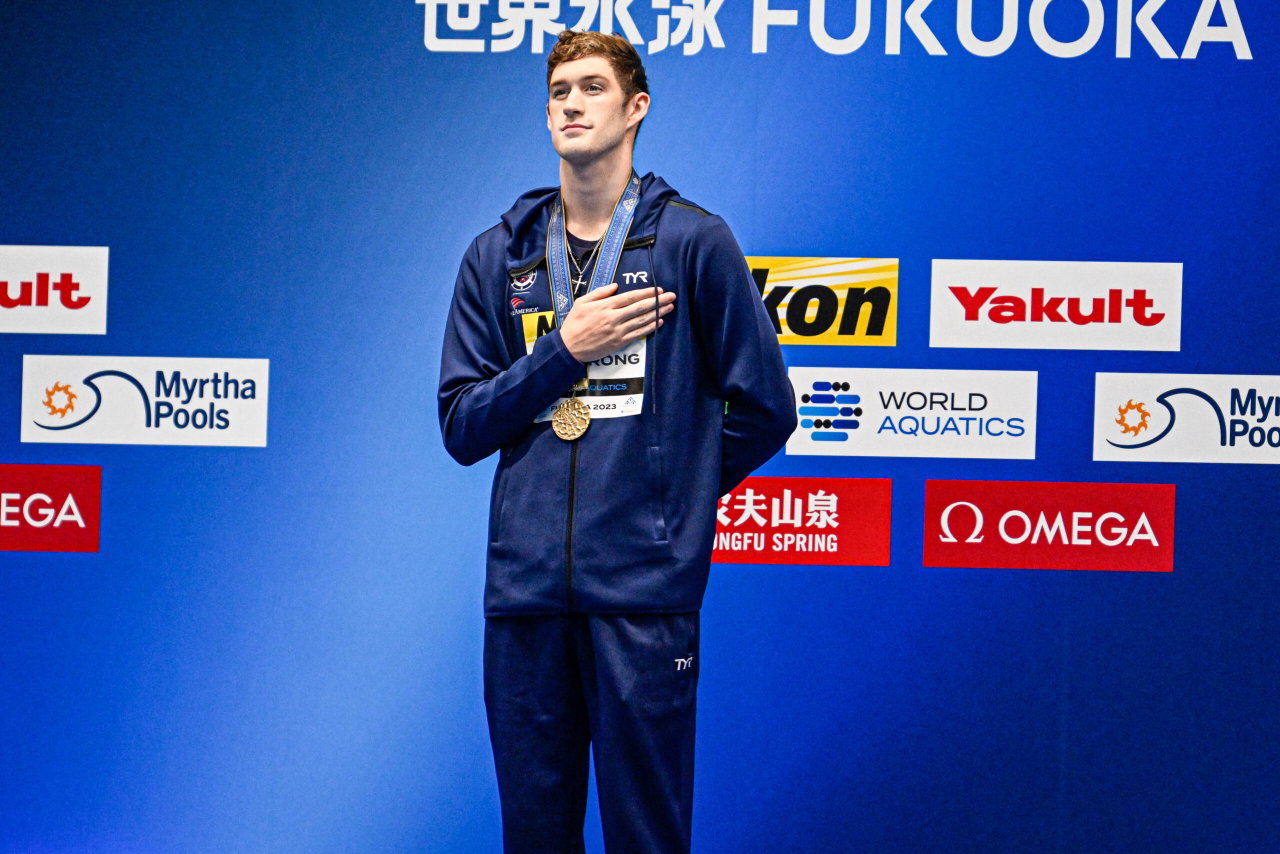
Hunter Armstrong once stood behind the blocks chasing Olympic gold. Now, at 25, the American swimmer is turning toward a very different kind of competition – and leaving his Los Angeles dream hanging in the balance.
Watch What’s Trending Now!
In an Instagram post announcing his retirement, Armstrong reflected on his career. He thanked the New York Athletic Club, USA Swimming, and World Aquatics, writing, “There are few things harder than saying goodbye to something that has been your entire life.”
He called it the end of a chapter filled with gratitude, pride, and memories, while making one point clear: “This isn’t goodbye to swimming. I’ll continue racing, but my focus is shifting as I begin a new chapter.”
That shift is significant. Armstrong is only 25, but he has already lived a career many swimmers spend a lifetime chasing.
He won three Olympic medals across Tokyo and Paris: two gold, one silver. World Aquatics credits him with 20 major medals, 15 from World Championships
The move also changes the picture around LA28. Earlier this year, Armstrong entered the inaugural Enhanced Games as a “clean” athlete, choosing to remain in the WADA and USADA testing pools despite competing in an event where performance-enhancing substances are permitted.
At the time, he insisted his Olympic ambition had not disappeared: “I WILL be continuing my path to win gold on home soil in LA.” His latest announcement makes that path far less certain.
He has now confirmed to SwimSwam that he will be focusing 100% on the Enhanced Games moving forward.
What really pushed Hunter Armstrong into the Enhanced Games?
The answer goes beyond medals. For Armstrong, it was about keeping swimming as a full-time career.
Despite his Olympic résumé, the economics of elite swimming had become difficult. Armstrong previously said joining Enhanced was his only realistic way to continue swimming full-time after losing a major sponsor. “If I don’t join Enhanced, I lose everything. If I do join Enhanced, I have a chance at not losing everything,” he said.
The Enhanced Games offered a stark financial alternative. Individual winners could earn $250,000, while certain world-record performances carried bonuses of up to $1 million. Armstrong chose the 50m backstroke and 100m freestyle, and at the inaugural Games in Las Vegas, he won the 50 back and finished second in the 100 free, collecting $375,000.
Yet Armstrong deliberately kept one foot inside the traditional anti-doping system. Enhanced announced him as a non-enhanced athlete, and Armstrong said he would race naturally while continuing to meet international testing standards. After the Games, he said he had undergone repeated drug testing and argued that staying clean preserved a possible route back to Olympic swimming.
“If I really just wanted money and didn’t care for the Olympics or Team USA or anything like that, I would have just retired,” Armstrong told SwimSwam. “The whole reason that I did the Enhanced Games clean was so that I could continue.”
That calculation now appears to have changed.
Armstrong still raced at the U.S. Nationals in July, placing 30th in the 50m butterfly and 10th in the 50m freestyle. But he has now confirmed that his focus will be 100% on the Enhanced Games moving forward. That decision matters because World Aquatics has rules addressing athletes who participate in or support competitions built around scientific enhancement. The federation has said eligibility can be considered on a case-by-case basis, leaving Armstrong’s long-term standing in traditional international swimming unclear.
For someone who once said the Olympics “was never really on my radar,” the journey to two Games and three Olympic medals was already an exceptional one.
Armstrong grew up with interests ranging from musical theatre and choir to football before swimming became his full-time pursuit. He eventually became a world-record holder in the 50m backstroke, stopping the clock at 23.71 in 2022 before Kliment Kolesnikov lowered it to 23.55 the following year.
His Olympic story followed the same unexpected script with multiple medals. Those achievements once pointed naturally toward another Olympic chapter in Los Angeles, especially after the 50m strokes were added to the LA28 program.
But Armstrong is now choosing a different lane.
His retirement announcement does not explicitly close the door on the Olympics. It does, however, move him away from the conventional route to LA28 and toward a competition built on a fundamentally different model of elite sport. For now, the swimmer who once hoped to chase Olympic gold on home soil is choosing to chase something else, and that makes his Los Angeles future one of the biggest unanswered questions surrounding his next chapter.