
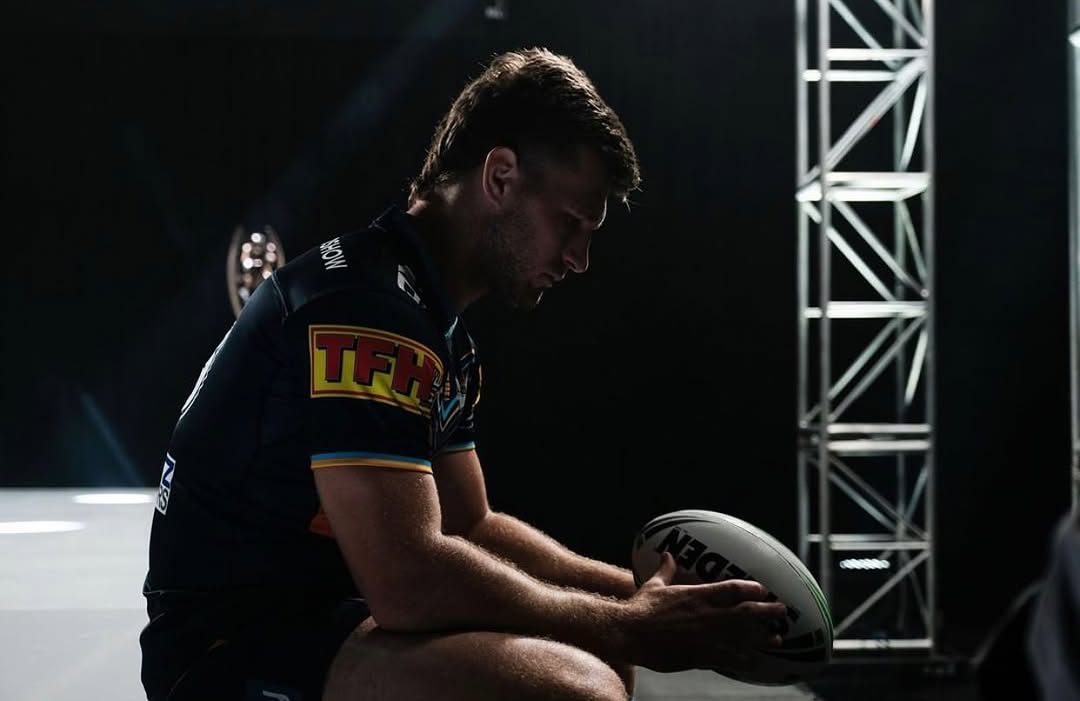
Imago
Source: Instagram/Jai Arrow
Imago
Source: Instagram/Jai Arrow
When he stepped up to pick up the George Piggins Medal in 2025, Jai Arrow had reached the pinnacle of his career at 30. A well-loved forward and now he was one of the best in the NRL, single-handedly keeping the Rabbitohs’ hopes alive. It’s why few anticipated the announcement that followed. Arrow broke down in a press conference, announcing his retirement because of a terminal illness.
Watch What’s Trending Now!
The 30-year-old Australian revealed that he had recently been diagnosed with Motor Neurone Disease (MND). However, Arrow wasn’t “in a position to speak” and instead, South Sydney’s chief executive, Blake Solly, read out his statement.
“After extensive medical testing and consultations regarding ongoing symptoms, I have recently received a diagnosis relating to a nerve and neurological condition,” Arrow said, according to The Guardian.
“Further tests, specialist reviews, and medical processes are still ongoing, and my doctors are continuing to assess my condition. Over recent months, my symptoms have affected different parts of my everyday life. On medical advice, I am not currently medically cleared to train or play at the required level, and I will be stepping away from those duties while I focus fully on my health, treatment, and rehabilitation.”
At only 20, Jai Arrow made his NRL debut in 2016 with the Burleigh Bears. He then signed for the Brisbane Broncos soon after and spent two seasons with them. However, it was with the Gold Coast Titans that the Australian truly made his mark, with 56 appearances across four seasons. He also played 12 games for Queensland between 2018 and 2023.
In fact, he helped the Maroons win the series in 2020, 2022, and 2023. Arrow then signed for the South Sydney Rabbitohs in 2021, reuniting with former coach Wayne Bennett. He stepped up his game for them, playing a key role as they reached the 2021 grand final. While they eventually lost, it set the tone for the 30-year-old, although injuries soon affected him.
An injured rotator cuff, along with a few other injuries, meant he made only 25 appearances across the 2023 and 2024 seasons. But Jai Arrow was back for the 2025 season and finished it with 24 appearances. Not only that, he won the George Piggins medal as the club’s best player alongside other accolades.
Jai Arrow Retires After Devastating Motor Neurone Disease (MND) Diagnosis
Today is a heartbreaking day for the Rabbitohs with Jai Arrow medically retiring following a shock Motor Neurone Disease diagnosis.
Souths CEO Blake Solly and coach Wayne Bennett spoke to the media at the… pic.twitter.com/SenrIQA6A6
— Bunnies TV (@Bunniestvau) May 20, 2026
Despite that, Arrow hadn’t played in the NRL in 2026 after an issue in pre-season that was reported as a shoulder injury. While that was the case, the 30-year-old underwent a lot of testing before eventually receiving the diagnosis for MND. It stunned Arrow so much that he laughed when he was told.
“I laughed,” Arrow told Danica Mason when asked what his reaction was. “Yeah. After that, I laughed, but my first question was, ‘All right, where do I go from now?'”
He then revealed that things have progressed rapidly since, saying, “I have progressed from November until now, speech is one of those things.”
For Wayne Bennett, though, the diagnosis brought back memories of far more than just Arrow’s final few months. It forced the legendary coach to reflect on the career of a player he believes gave everything to the sport until the very end.
Wayne Bennett reflects upon Jai Arrow’s rugby career
Around 2,750 people currently live with MND in Australia alone. For the unversed, the condition is a group of diseases that impact nerve cells that carry signals from the brain to the muscles via the spinal cord. Thus, early symptoms include slurred speech, weak grip, leg weakness, and more. It is life-threatening, and there is currently no cure, although the speed at which it affects each person varies.
Rugby has been hit hard by the disease, with several high-profile athletes succumbing to it in the past. That includes former Maroon Carl Webb, who passed away in 2023 at the age of 42. Diagnosed with MND in 2020, Webb had retired from the sport in 2011. Rob Burrow also tragically passed away in 2024, less than five years following his diagnosis with MND.
Going further back, Sydney icon Scott Gale tragically died in 2004 at the age of just 39, after being diagnosed with the disease following his retirement in 1993. It’s why Jai Arrow retired at only 30: the disease often progresses so quickly. In light of that, his former coach, Wayne Bennett, who gave him his start, had nothing but nice things to say.
“I’ve been in football all my life, and he’s a footballer,” Bennett said during the press conference. “He’s that type of bloke. He loves the fun, he loves a banta, he loves a mate ship. Drank a bit too often. A few times got too full. But that’s the DNA.”
He added, “This is a difficult time for Jai and his family; however, we want to pay tribute to him for everything he has given his teammates, his coaches, and his communities in Brisbane, the Gold Coast, the people of Queensland, and here in South Sydney.”
“Most importantly, we pay tribute to him for the family man he has become. He is a special guy, and we’re all very lucky to have him at our club and in our lives.”
Now, instead of preparing for another NRL season, Jai Arrow finds himself confronting a fight far bigger than rugby at just 30 years old. Yet, Wayne Bennett said it plainly; Arrow’s legacy was never just about football. It was about the man he became away from it.
Written by

Edited by

Pranav Venkatesh