
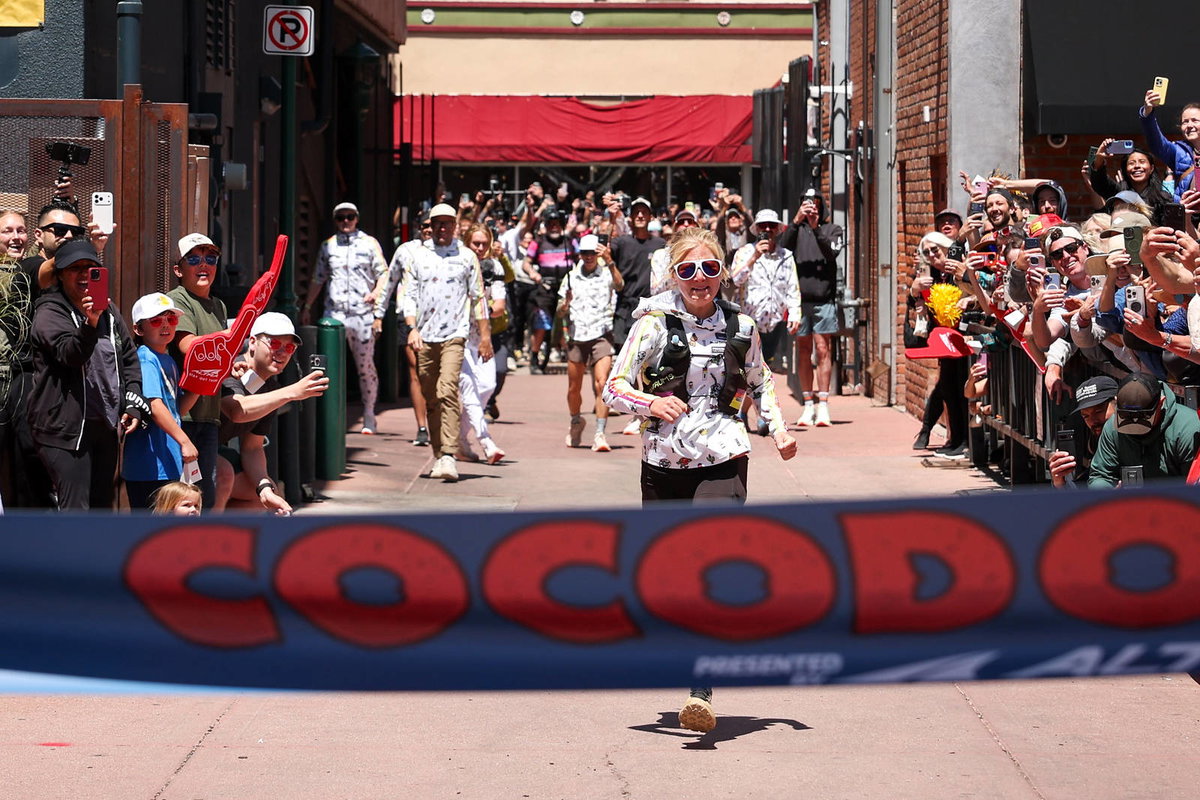
A 253-mile race so brutal that it takes nearly 3 days to complete. Yes, that’s the Arizona Cocodona 250, and this year, a woman made history here. She had already won the women’s race here twice. But this time, the 34-year-old American runner beat everyone in the field, men and women alike. And somehow she still found the time to stop to pet dogs in between and take “dirt naps.” Sounds unbelievable, right?
Watch What’s Trending Now!
On May 6, Rachel Entrekin made history by defeating an elite field of both men and women to win the Cocodona 250 overall. She finished in a new record time of 56 hours, 9 minutes, and 48 seconds, the fastest time ever recorded on the course. Entrekin beat the previous overall course record (58:47:18, set by Dan Green in 2025) by over two and a half hours.
Shortly after the finish, Entrekin became emotional while trying to process what she had just achieved. “So yeah, it’s pretty incredible,” she said through tears.
Interestingly, Entrekin’s previous best at this race was 63:50:55, but this year, “Somebody has to win, so why not… believe that it could be you,” was her mantra while running the race that no woman had ever won, overall. And just like that, she aced one of the world’s toughest ultramarathons.
Even though the Cocodona 250 climbs more than 38,000 feet through the deserts and rugged mountain trails of central Arizona before finishing in Flagstaff. It’s a race where exhaustion makes it hard to stay awake. But all that did not deter Entrekin from a plan that required the push to the extremes of her body.
Over 56 hours, Entrekin napped 19 minutes total, supported by six crew, including parents Carol and Robin.

This woman just made ultramarathon history in 56-hour, 250-mile run in Arizona. Rachel Entrekin won the Cocodona 250 outright in a 56-hour, 250+mile effort, beating the entire men’s field, setting a new course record, and marking a landmark moment in ultrarunning history.
“I was basically sleep running,” Rachel Entrekin explained. “Like I kept drifting into my pacer and just kept coming to when I ran into him.” That strategy became even more unbelievable once her sleep schedule during the race was revealed. Entrekin slept only three times during the entire event. Those naps were only five, seven, and seven minutes long. Even those few minutes were survived by way of what she called a “legendary” recovery method.
Yet fitness alone doesn’t win such races.
“So Everest is 29,000 feet, and this is 40,” Rachel Entrekin said while comparing the race’s elevation gain to Mount Everest. “Physical ability is certainly really important when it comes to races like this, but I don’t think it’s even the top three most important qualities. You have to be able to manage your stress. You have to be able to manage your time efficiently. Have a good understanding of how good your attitude has to be during the race.”
But behind Rachel Entrekin’s historic victory was something deeper than training plans or race strategy; it was an inspiration.
The inspiration behind Rachel Entrekin’s historic Cocodona 250 victory
Born in Birmingham, Rachel Entrekin once doubted whether she was even athletic enough for sports. She did not play team sports in high school because she believed she was not good enough. Then came a half-marathon in 2010, followed by a full marathon in 2011. And slowly her entire life changed through running in 2012 while studying exercise science in college.
“I figured out I was pretty good at the races and just gradually increased the mileage and soon made the descent into insanity,” she once joked in an interview. From 2013 onward, she entered ultrarunning events, beginning with 50K races before eventually stepping into some of the hardest endurance races in the world. But even after becoming one of the top ultrarunners in America, Entrekin still looked toward other women for belief and inspiration.
“I think the more and more that we have these incredible women athletes showing us that, like no, but we can be here,” Rachel Entrekin said after winning the 2026 Cocodona 250 climbs. One of the women who inspired her most was Courtney Dauwalter, who also competed in this year’s Cocodona 250 and finished as the second woman overall. But long before this year’s race, Dauwalter had already changed the sport forever.
Back in 2017, Dauwalter won the Moab 240 outright, beating the entire field by nearly 10 hours. “Jasmin Paris finished Barkley Marathons two years ago. Tara Dower getting the overall FKT on the Appalachian,” Rachel Entrekin said while naming more women who inspired her.
Jasmin Paris made history in 2024 by becoming the first woman ever to finish the Barkley Marathons. Meanwhile, Tara Dower broke the overall Fastest Known Time on the Appalachian Trail in 2024. Those moments slowly changed the way Entrekin viewed herself.
“Like we’re showing up. I thought that these people were outliers and that they had something that I just didn’t possess,” Rachel Entrekin admitted. “I love the mantra that I happened to fall on during this race. It’s just like, why not you? Why not you? Why not now? Why not try?”
And by the end of the Cocodona 250, Rachel Entrekin had become the latest woman to inspire the next generation herself. “I think women can do anything, and I’m happy that this race has been able to kind of put an exclamation point behind that sentence!”