
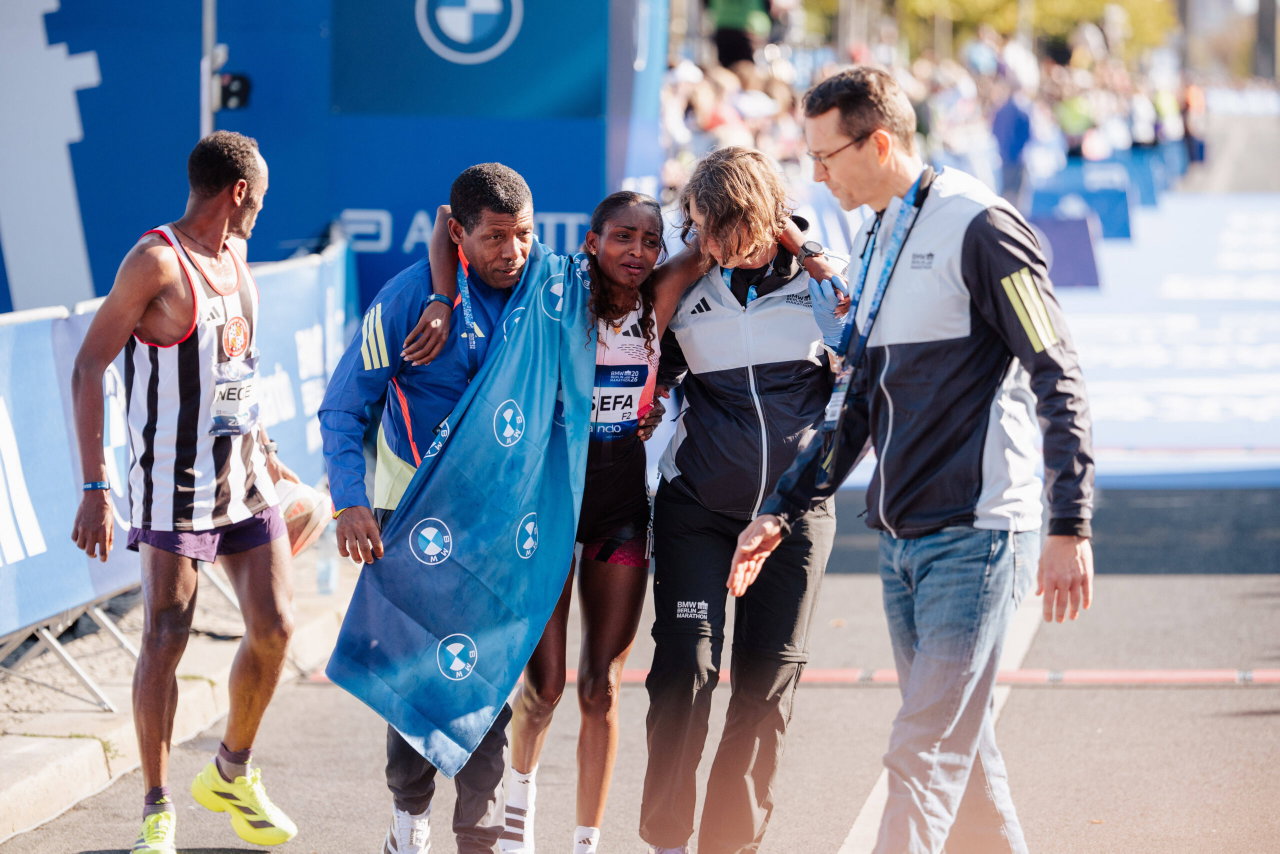
The finish line should have been a celebration. Instead, Tigst Assefa limped toward it, fighting through the final kilometers of a race that had already demanded everything from her. One day later, the Berlin Marathon champion was in Munich undergoing surgery for a completely ruptured Achilles tendon.
Watch What’s Trending Now!
Assefa had spent most of Sunday looking unstoppable. She stayed on world-record pace deep into the race, reaching 40 kilometers in 2:03:00. Then everything changed. Her stride shortened, the Ethiopian began limping, and the dream of breaking Ruth Chepngetich’s 2:09:56 world record disappeared. She still crossed the line in 2:11:04 – the third-fastest women’s marathon ever — before collapsing in pain.
The injury was initially unclear, but Assefa’s manager Gianni Demadonna has now confirmed the severity. She underwent successful surgery in Munich on Monday to repair a complete rupture of her right Achilles tendon. According to Demadonna, she had started feeling pain around the 31-kilometer mark before it intensified dramatically late in the race.
“The tendon was completely gone when she ran the last two kilometres,” Demadonna told AFP. He explained that the tendon gradually lost its fibers before completely tearing near the finish. Yet Assefa somehow continued, despite eventually being unable to properly push off with the injured leg.
The images from the final stretch told the story. The 29-year-old’s pace fell sharply as she limped toward the Brandenburg Gate, eventually needing help after crossing the finish line. Berlin race director Mark Milde admitted he had never seen anything quite like it.
And yet, amid the pain, Assefa had still produced something extraordinary. Her 2:11:04 shattered her own Berlin course record of 2:11:53 from 2023 and gave her a third victory in the German capital. She also finished nearly six minutes ahead of compatriot Bedatu Hirpa, with Dera Dida completing an Ethiopian sweep of the podium.
Assefa’s latest Berlin triumph therefore came with a cost far greater than the missed world record. With surgery now behind her, the focus shifts from what she achieved on Sunday to the long rehabilitation that awaits – and how soon she might be able to run again.
How long will Tigst Assefa be out?
The next chapter will be far slower than the 42.195 kilometers she raced on Sunday. Demadonna said Assefa could be sidelined for around seven months, although her team has not set a firm return date.
The early stages of recovery will demand patience. Demadonna said Assefa is expected to spend around two months without walking, followed by another month of walking and cycling before she can gradually begin running again. Her return to competition will ultimately depend on how the tendon heals.
There is a recent example that offers some perspective, although the injuries are not identical. Jakob Ingebrigtsen underwent surgery in February for an Achilles-related problem and returned to competition six months later. He went on to win the European Championships 5,000m in Birmingham in August, before adding another 5,000m victory at the World Athletics Ultimate Championship in September.
Ingebrigtsen’s injury, however, involved damage to the sheath surrounding his Achilles rather than a complete rupture of the tendon itself. Assefa’s injury therefore presents a different rehabilitation challenge, and her team has not suggested that she will follow the same timeline.
That distinction matters as Assefa begins what could be a long road back. The 29-year-old had entered Berlin in remarkable form after winning the London Marathon in 2:15:41 earlier this year, lowering the women-only world record she had previously set there.
She then returned to Berlin chasing the outright marathon world record and stayed ahead of the record pace deep into Sunday’s race. Instead of another record, however, she leaves Germany with a course record, a third Berlin victory and an injury that will now force her away from competition.
For now, the stopwatch can wait. Assefa’s biggest race is the recovery ahead.