
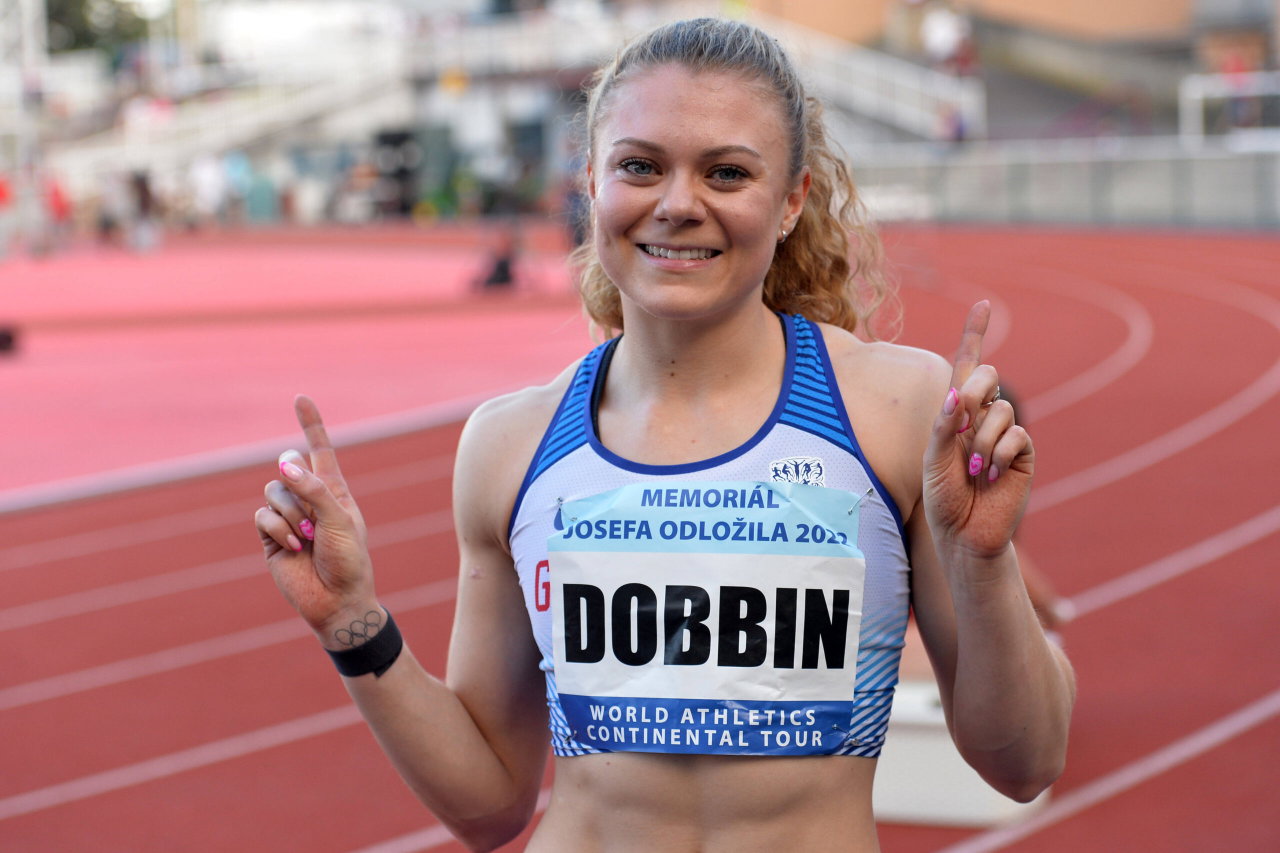
Beth Dobbin was 13 when she suffered an epileptic seizure that left her unable to walk. It was an episode so bad that she suffered from severe anxiety and post-traumatic stress disorder (PTSD) for years. Somehow, that didn’t stop her; she bounced back, won the British Championships in 2018, and broke a 34-year-old record four times to become Scotland’s fastest woman. However, in April 2026, after a three-year absence from the track, she was forced to retire because of myalgic encephalomyelitis (ME). Now, life looks very different, with the former Olympian spending more than 22 hours a day in bed.
Watch What’s Trending Now!
Yet, despite knowing that speaking publicly could worsen her symptoms, the 32-year-old has chosen to share her experience. For the former Olympian, raising awareness was worth risking the consequences. Speaking to BBC Sport, Dobbin revealed that she has left her home only five times this year, largely for medical appointments.
“I’ve done little things like attend a blood test at the doctors and been in bed for months after,” Dobbins explained. “So doing this interview, chatting away for 30 minutes, that could have an impact on me in 2027.”
The consequences have reshaped how she sees her life. “It’s life-decimating like I can’t even put into words,” Dobbin said. “I feel like I’ve lost everything.”
She added, “I have still got my family, but I’ve lost my independence, my health, the ability to work, the ability to exercise.”
Still, she decided that the message needed to reach people beyond her own home because she “felt like it was really important to do that to get the message out.”
For an athlete once accustomed to demanding training sessions and international competition, the restrictions have been devastating. She now gets out of bed only to eat or use the bathroom, while conversations, bright lights, and loud noises can trigger what patients describe as a “crash.”
The decline initially began after back-to-back COVID-19 and glandular fever infections during the winter of 2021-22. Dobbin had not realized she had contracted either virus until retrospective tests revealed the infections. Initially, she noticed only subtle changes, including increased sleep, slower running times, and soreness around the glands in her neck and armpits.
With early tests offering no clear answers, she continued competing, believing the symptoms would eventually pass. That season brought a demanding schedule, with the World Championships, Commonwealth Games and European Championships packed into a short period.
However, her condition worsened as the competitions progressed. She struggled with a painful throat at the World Championships, experienced dizziness while running at the Commonwealth Games, and felt unusually sore. At the European Championships, she false-started after losing sensation in her legs while waiting in the blocks.
The experience became what she later described as her “year of hell.” Rest brought little relief. After six weeks away from training, she attempted a comeback but managed only three weeks before her symptoms overwhelmed her again.
Doctors eventually referred her to several specialists because her symptoms affected multiple body systems. Their conclusion was ME, a diagnosis they had hoped to rule out because treatment options remain limited.
Dobbin announced her retirement in April 2026 after a three-year struggle with a serious, life-changing health issue. The decision ended a career that included reaching the 200m semi-finals at Tokyo 2020 and winning relay bronze for Scotland at the 2022 Commonwealth Games.
She had also broken a Scottish record that had stood for 34 years, claimed a British title, and clocked a personal best of 22.50 seconds in 2019. Those achievements now belong to a sporting life she cannot return to, at least for the foreseeable future.
Why is ME more than just a chronic fatigue?
ME can cause severe, persistent fatigue that rest does not relieve, alongside pain, sleep disturbances, and difficulties with memory and concentration. Physical or mental exertion can trigger post-exertional symptom exacerbation, leaving patients significantly worse after even minor activities. There is currently no established cure.
For Dobbin, calling the condition chronic fatigue syndrome fails to capture what she experiences. As a former athlete who once combined eight-hour work shifts with training, she knows what ordinary exhaustion feels like.
“I wish it was just fatigue, that would be a walk in the park,” she said. “It’s so much more than that. If I thought of fatigue in my top 20 symptoms, it might just make the cut.”
She has described the sensation as her entire body “shutting down,” while even sitting upright for too long can aggravate her symptoms. Although she sometimes needs medication to sleep, spending hours in bed does not make her feel well.
Her family has witnessed the toll firsthand. Her father, Jim, said he desperately wanted to find help, even offering to take her to America if it meant finding treatment. Her mother, Jean, worries about how Dobbin will manage in the future, while her younger sister, Faye, plans to run the Yorkshire Marathon to raise money for ME Research UK.
Despite the uncertainty, Dobbin hopes growing awareness and research will eventually bring progress. She also recognizes that her profile as an Olympian gives her an opportunity that many people with the illness lack.
“People think I’m lazy,” she said of the experiences shared by other patients. “I’ve never experienced one person that doesn’t believe me and that’s because, why would an athlete just suddenly stop after 20 years?”
For Dobbin, speaking out is not about returning to the spotlight she once knew. It is about making sure people living with the same illness are heard. “I’ve got a slight platform,” she said. “If this happened to most people they wouldn’t be able to speak about it, so I do feel like I’ve got a bit of a duty to do that.”
According to her, the fight now extends far beyond the finish line, as she hopes her story will help bring greater understanding, better research, and hope to thousands of people living with ME.