
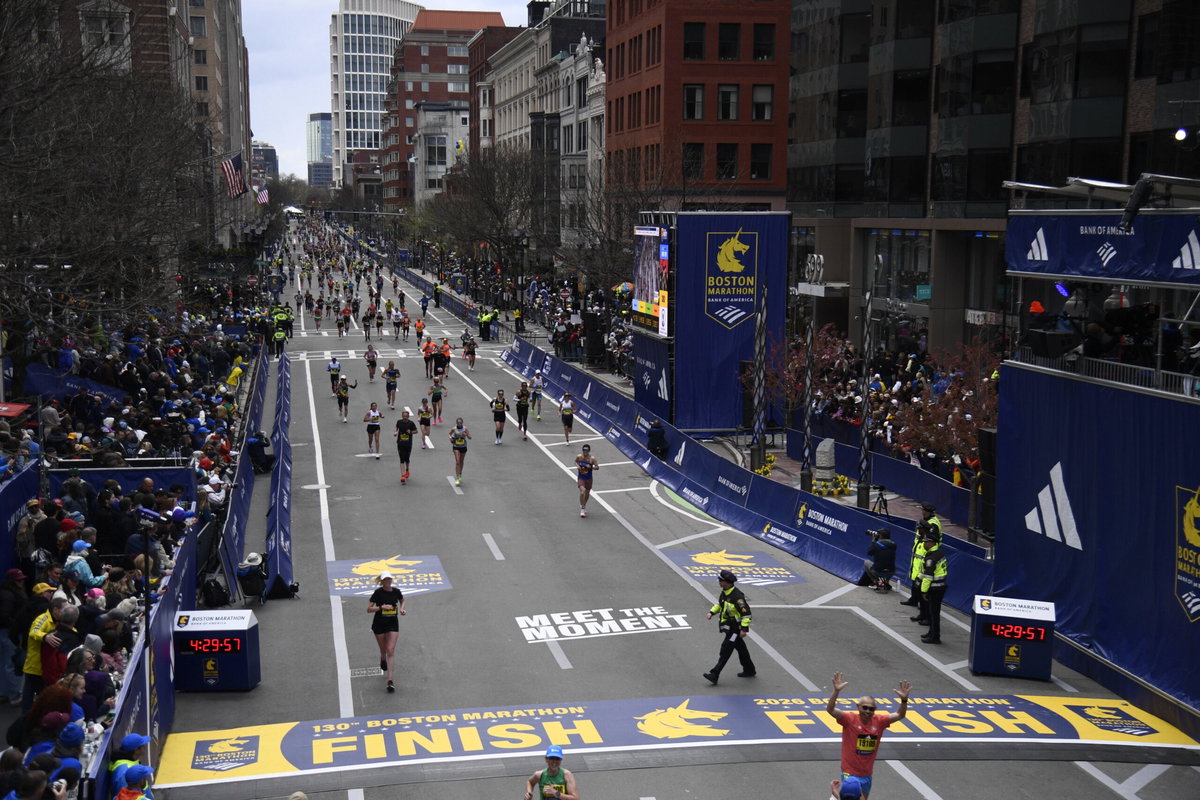
For thousands of runners, Boston qualifying day ended with a number they never wanted to see. The Boston Athletic Association has set the cutoff for the 2027 Boston Marathon at 5 minutes and 17 seconds faster than each runner’s age- and gender-group qualifying standard, leaving 8,019 qualified applicants outside the field for now.
Watch What’s Trending Now!
The 131st Boston Marathon will take place on April 19, 2027, but earning the qualifying time was not enough this time.
Of the 33,649 qualifier applications received during registration week, only those who beat their respective standards by at least 5:17 secured automatic entry, while another 1,000 runners will now get a second chance through a new random drawing.
That makes the latest cutoff 43 seconds stricter than the 2026 mark of 4:34. It also shows just how competitive the road to Boston has become, with marathon participation continuing to grow and the race’s 30,000-person field unable to accommodate every qualified runner.
But this year, the B.A.A. has given the runners who fell short of the cutoff something they have never had before. The B.A.A. has introduced the Boston Qualifier Selection, a new random-selection pathway specifically for athletes who achieved their qualifying standard but did not beat it by the required 5:17. A total of 1,000 runners will be selected, giving those who missed the cutoff roughly a 12.5% chance of entering the race.
Those selected will be notified in the coming days, creating one final piece of suspense for runners who had already watched their Boston hopes disappear.
The president of B.A.A. sends a message to the runners
B.A.A. President and CEO Jack Fleming acknowledged how difficult that process can be while recognizing the work behind every qualifying attempt.
“The Boston Athletic Association looks forward to welcoming thousands of qualifiers who are officially now entrants into the Boston Marathon presented by Bank of America on Monday, April 19,” Fleming said. “To earn a spot into this race takes dedication and resiliency, and the number of marathoners world-wide only continues to grow. Although we are unable to accept all applicants, we want to recognize each and every athlete who trains and aspires to participate in the Boston Marathon.”
Even with the higher barrier to entry, Boston is set to welcome an unprecedented number of qualifiers in 2027. So far, the accepted field includes 13,898 men, 10,641 women and 91 non-binary runners, with athletes representing 120 countries and every U.S. state.
Among those making the trip to Boston in 2027, around 10,745 runners will be lining up for the race for the first time.
The field will also feature 215 athletes who met Para Athletics qualifying standards, while 849 runners earned their places through either 10 consecutive Boston Marathon finishes or the B.A.A. Running Club.
The B.A.A. now accounts for downhill courses differently when evaluating qualifying times. Beginning with the 2027 race, its new downhill index accounts for marathons with significant net elevation loss. Depending on the course, such races can either be excluded from Boston qualifying or have a time penalty added to finishing performances.
That adjustment comes as the pressure on Boston qualifying continues to build. Major American races such as Boston, Chicago, and New York have grown increasingly difficult to enter, while races including Philadelphia, the California International Marathon, and Grandma’s Marathon have also experienced strong demand.
The numbers behind Boston tell the story. The 2026 Boston Marathon produced the most qualifying performances among the accepted runners, followed by the 2025 Chicago Marathon, 2025 New York City Marathon, 2025 California International Marathon, and 2026 London Marathon.
Still, qualifying is only one part of the Boston equation. Roughly 80% of the field comes through time qualifiers, while the remaining places go to charity runners, invited athletes, professionals, and para athletes. The overall field remains capped at 30,000.
For the 8,019 runners who met their qualifying standards but missed the 5:17 cutoff, the Boston dream is not completely over. The new drawing offers 1,000 of them another opportunity to make the starting line.
For everyone else, the message from Boston is becoming increasingly clear: running fast enough to qualify may no longer be enough. Runners now have to be faster than thousands of others chasing the same iconic finish line.