
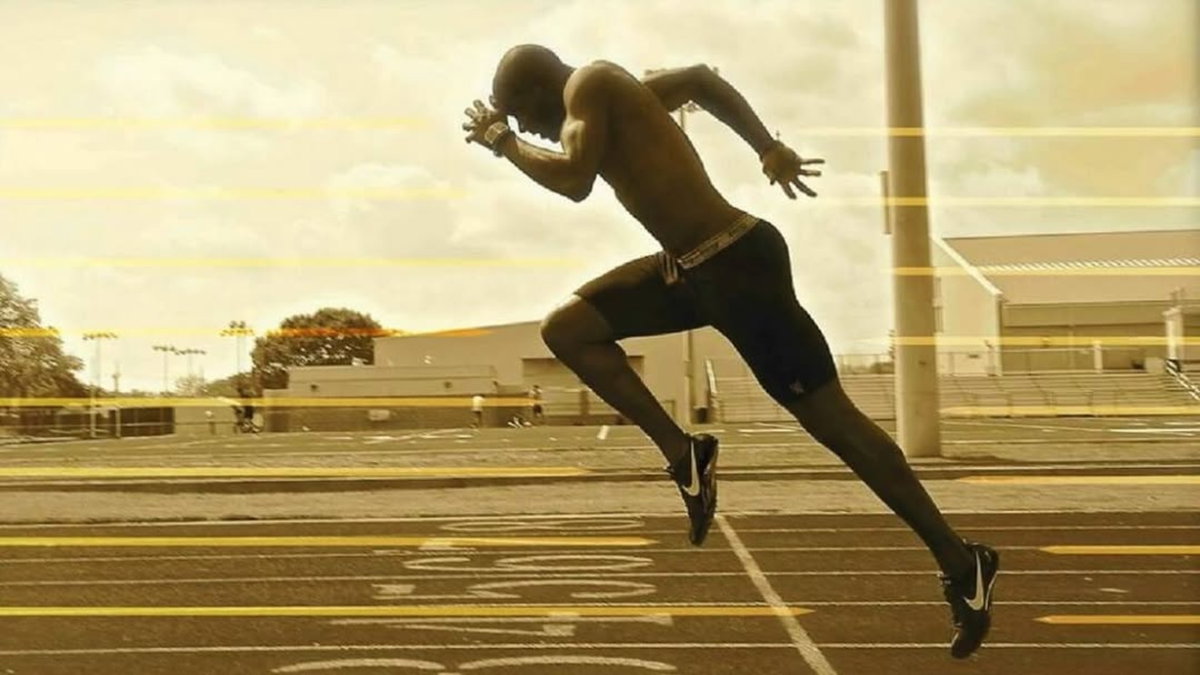
Most anti-doping bans involve athletes who test positive for a prohibited substance, miss tests, or refuse to provide samples. Earlier this year, Kenyan marathoner Albert Korir was suspended for 5 years after testing positive for a banned substance, while Kibiwott Kandie was banned for 7 years after refusing to submit to testing. However, former American sprinter Monzavous Edwards has accepted a 2-year suspension from the USADA despite never failing a drug test himself. So, what did he do wrong?
Watch What’s Trending Now!
On June 29, USADA announced that Edwards, who served as a U.S. Olympic Team Alternate in 2004 and 2008, accepted two years of ineligibility for a complicity violation. According to the agency, Edwards introduced fellow American sprinter Marvin Bracy-Williams to an individual he believed to be a doctor for the purpose of obtaining the banned substance in 2023. The case began in early 2024 when a whistleblower informed USADA of Bracy-Williams’ alleged banned substance use.
The tip led the agency to conduct out-of-competition testing on Bracy-Williams. He tested positive and was slapped with an anti-doping rule violation. So, federal investigators launched a criminal investigation that revealed an individual from Florida, Paul Askew, eventually provided Bracy-Williams with the prohibited substance. That investigation ended in Askew pleading guilty under the Rodchenkov Anti-Doping Act on May 26, 2026. But why did Edwards receive only a two-year ban when it was supposed to be for 4 years under WADA rules?

The United States Anti-Doping Agency has announced Monzavous “Rae” Edwards, the 45-year-old former 10.00 100m sprinter and YouTuber, has accepted a two-year suspension after being found to have committed a complicity violation. He introduced sprinter Marvin Bracy-Williams to an Show more

“Under Article 10.8.1 of the Code, a person facing an anti-doping rule violation that carries a period of ineligibility of four or more years may receive a one-year reduction in the sanction if they admit the violation and accept the asserted sanction within 20 days of being notified of the charge,” and that’s what Edwards did. He also earned an additional year of reduction for assisting in the investigation of Askew.
USADA had already “provisionally suspended” him, and his ineligibility actually began on November 15, 2024. However, USADA didn’t finalize the reduced two-year suspension until Askew’s case concluded in May of this year. Besides that ban, USADA has retroactively disqualified Monzavous Edwards’s competitive results from July 11, 2023 onward. Edwards had already been retired from top-level sprinting before the disqualification period started, but that doesn’t mean the sanction doesn’t affect him.
How the ban still impacts Monzavous Edwards after retirement
Monzavous Edwards first emerged as one of America’s top sprint prospects in 2000, winning both the USA Junior Championships and the Junior College Championships in the 100m and 200m. In 2004, Edwards competed at the U.S. Olympic Trials but failed to qualify. Edwards’ biggest international breakthrough came in 2007 when he helped Team USA claim bronze in the 4×100m relay at the Pan American Games in Rio de Janeiro.
He then went on to record the fastest legal 100m of his career in 2010, clocking 10.00 seconds in New York. It was his career-high mark. However, after that, Edwards retired in the 2022 season. However, his connection to the sport didn’t end after retiring from competitive racing. The 45-year-old transitioned into coaching after retirement. He is currently based out of Lewisville, Texas.
However, the sanctions mean he won’t be able to coach, train, or otherwise be involved in events and activities regulated by World Anti-Doping Code-compliant organizations for the duration of his ineligibility. So despite being retired, the former track and field athlete is set to feel the effects of the sanction. Meanwhile, USADA CEO Travis T. Tygart has called the case a success.
“This is yet another case that demonstrates RADA’s power to eliminate the organized doping schemes that have the most impact on clean athletes and fair sport,” said Tygart. “The cooperation between whistleblowers, law enforcement, and others committed to integrity helps ensure that all those who enable doping are held accountable, both under anti-doping rules and the law,” he added.