Imago
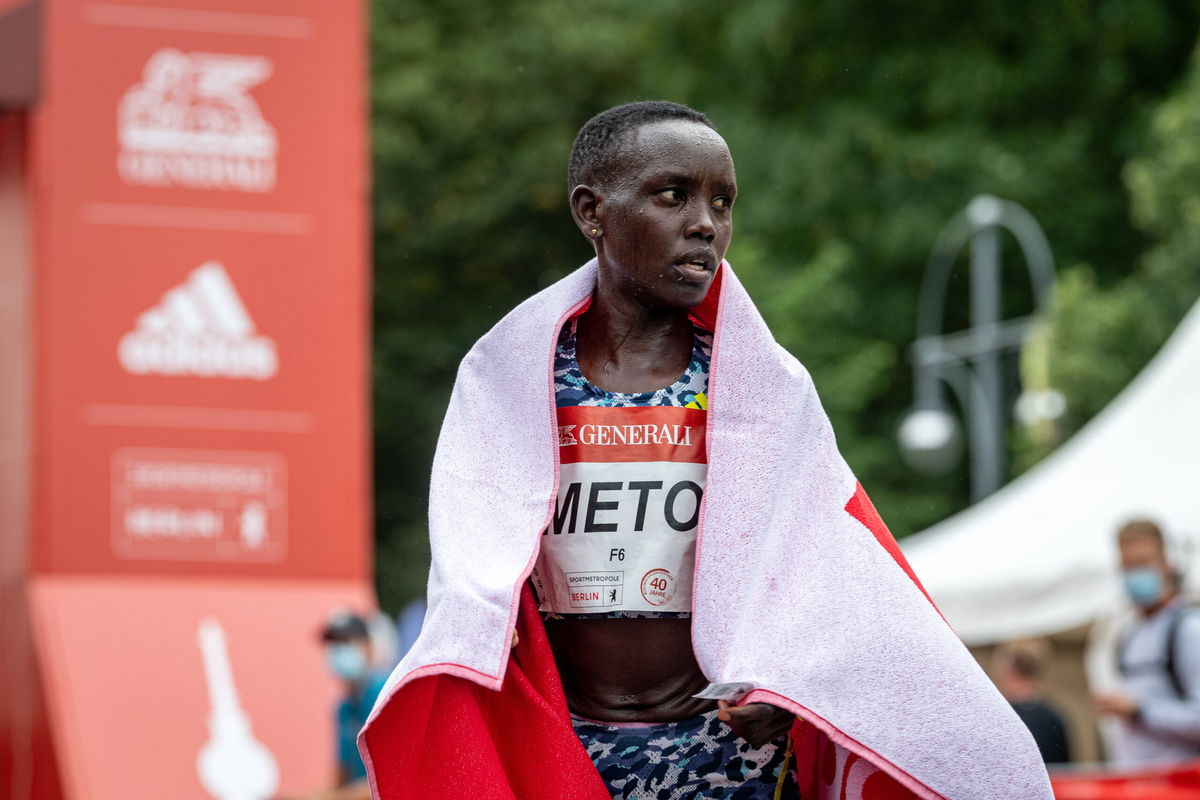
Leichtathletik Berlin 22.08.2021 Generali Berliner Halbmarathon 2. Platz Nancy Jelagat Meto KEN *** Athletics Berlin 22 08 2021 Generali Berlin Half Marathon 2 Place Nancy Jelagat Meto KEN
Imago
Leichtathletik Berlin 22.08.2021 Generali Berliner Halbmarathon 2. Platz Nancy Jelagat Meto KEN *** Athletics Berlin 22 08 2021 Generali Berlin Half Marathon 2 Place Nancy Jelagat Meto KEN
The Athletics Integrity Unit is taking a hard line with track and field athletes lately. Weeks after Fred Kerley was handed a two-year ban for a whereabouts failure, it now seems to be the turn of a 40-year-old athlete. This time, it’s a renowned marathon runner who has been handed the same sanction for testing positive for a prohibited substance.


On March 17, the AIU announced that Nancy Jelagat Meto will be banned for 2 years, effective from February 5, 2026. The athlete in question is a Kenyan marathon runner who clocked 1:05:21 to become the runner-up at the Berlin Half Marathon.
Since this is her first violation and there was no evidence of intentional doping, a standard 2-year sanction is applied. While her ban decision is appealable, all her track and field results from 12 June 2024 onwards have been disqualified as of now.
However, the complicated part of the case is that it “took nearly two years to resolve due to a jurisdictional battle between Kenyan and international authorities…” as reported by Citius Mag.
The case started when Meto provided a sample on June 12, 2024, in Iten, Kenya, during an out-of-competition test. Next month, the sample was analyzed at a World Anti-Doping Agency-accredited laboratory in Switzerland, which confirmed the presence of “Furosemide” (a banned diuretic and masking agent).
Given that Meto did not have a “Therapeutic Use Exemption,” and there were no procedural errors in testing, she was formally notified of the violation on July 22, 2024. She was then provisionally suspended as of August 11, 2024.
But what followed was a complicated legal back-and-forth.
The Athletics Integrity Unit has issued a two-year ban to 40-year-old Nancy Jelagat Meto 🇰🇪 after she tested positive for Furosemide, a prohibited diuretic and masking agent, in an out-of-competition test in June 2024.
Meto provided a urine sample in Iten, Kenya on June 12th,… pic.twitter.com/BnpSashvIa
— CITIUS MAG (@CitiusMag) March 17, 2026
Because Meto was an international-level track and field athlete, the Anti-Doping Agency of Kenya (ADAK) delegated results management to the AIU. Meanwhile, as the athlete had not responded to the anti-doping violation notice, AIU sent her a “Notice of charge.” The athlete then replied, denying that she received the Anti-doping violation notice from the ADAK and that she had been “denied procedural fairness” and been “prejudiced.”
The dispute then moved through multiple levels, including Kenya’s Sports Disputes Tribunal and even the High Court in Nairobi.
In fact, the case remained unresolved for months until January 2026, when WADA stepped in and directed the AIU to conduct Results Management in this matter.
From there, the process moved quickly. Within no time, AIU reissued the charges and gave Meto another chance to respond, and offered options, including a hearing or acceptance of consequences.
But then, on March 13, 2026, Meto signed an Admission of Anti-Doping Rule Violations and Acceptance of Consequences, hence bringing the case to a close.
By the time the decision was finalized, Meto had already stepped away from competition. But at the same time, her case does not exist in isolation. Kenyan athletics continues to face growing scrutiny over doping violations.
System Failures had put Kenyan Track and Field under watch
Kenyan athletics remained under global scrutiny, especially after WADA was led to considering the country’s anti-doping system non-compliant in September 2025. This came after an audit was conducted in May 2024.
WADA’s findings showed several gaps. Testing programs and whereabouts systems were not strong enough. There were also clear shortages in staffing and funding, which affected how effectively anti-doping efforts could be carried out. Moreover, problems in results management were not handled smoothly, leading to delays.
So WADA referred to these as being “critical requirements” that were not dealt with adequately following the audit.
When Kenya was declared non-compliant, the consequences could have been serious. International competitions, major event hosting, and prohibition of officials from international positions were at risk.
But in October 2025, there was certain progress. Kenya was moved to a monitoring phase, often called a watchlist, which showed improvement but also made it clear that more work was needed.
From late 2025 into early 2026, reforms began to take shape. Programs on testing were enhanced, funding was enhanced, and an effort was made to make case handling stronger. And now, in 2026, there was an update which revealed that WADA has now shut down the compliance case and dropped Kenya off the watchlist.
Though this is an improvement, the questioning has not eased, as Kenyan track and field athletes continue to remain in the news due to such bans.