
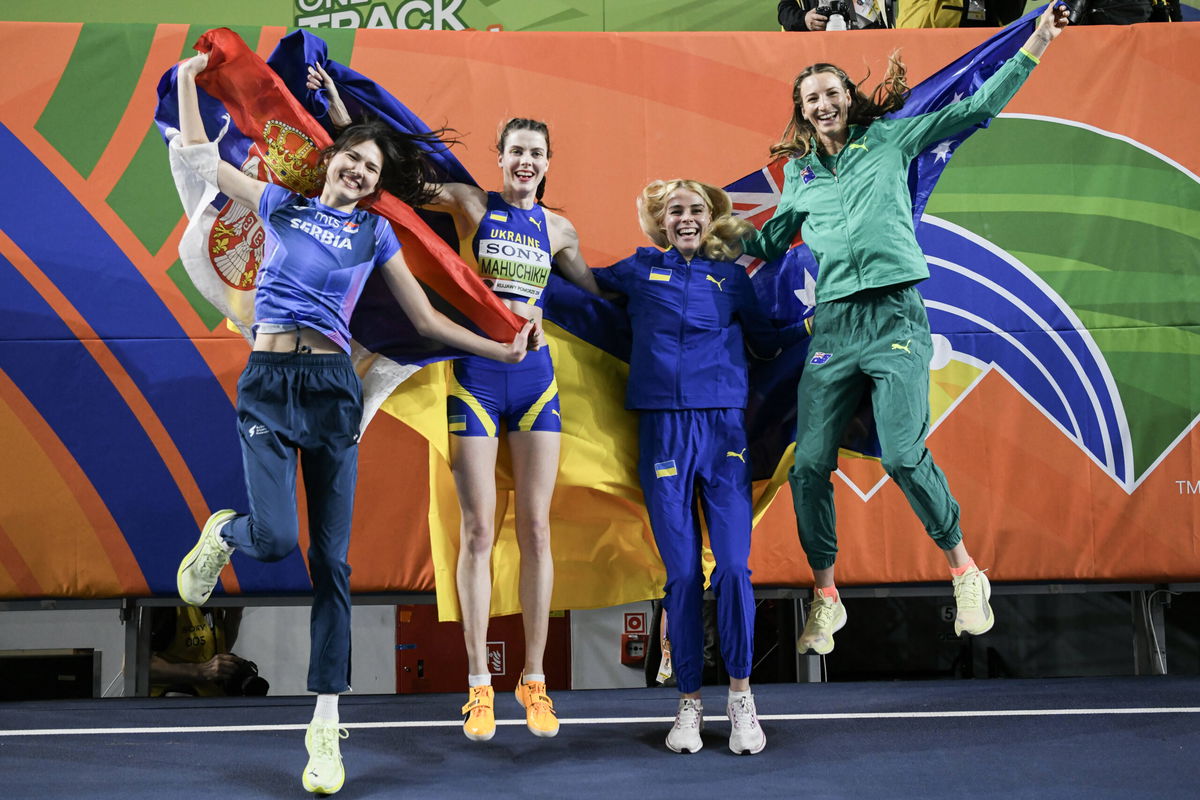
The women’s high jump final at the World Indoor Championships in Toruń delivered one of the most surprising finishes of the meet. On March 20, Ukraine’s Yaroslava Mahuchikh soared to gold, but the real shock came when there was a battle for the silver spot next to her on the podium.
Watch What’s Trending Now!
Mahuchikh, the Olympic medallist and former world indoor champion, regained her world indoor title with an unmatched height of 2.01m. However, when it was time to award the silver medalist, not one, three people were in contention.
Alongside Mahuchikh were Australia’s Nicola Olyslagers, Serbia’s Angelina Topic, and Ukraine’s Yuliia Levchenko, all with no misses through all five heights up to the 1.99m mark.
When the bar was raised to 2.01 m, Mahuchikh cleared it on her first attempt to get gold. But the other three jumpers each had three attempts at that height, yet could not get over the bar.
However, because all three had identical performances up to the 1.99m mark, they were all awarded the silver medal, hence producing a rare four‑athlete podium.
No bronze medal was given, as no athlete was left to take the third position.
Looking back on her performance, Olyslagers, who was one of the three silver medalists, said: “Clearing 1.99 m was probably a bigger surprise to me than to anyone else, and it feels great to share this medal with two other girls.”
“I cannot remember the last time we had something like that, with four girls clearing 1.99 m on their first attempt. Being in a situation like this gives me a sense of excitement, it does not scare me. It reminds me to stay motivated to jump well.”
But what does the World Athletics rule say?

A three-way tie?! 🥈🥈🥈 The high jump podium in Poland will feature an unusual four athletes, as three women all earn silver with leaps of 1.99m. Nicola Olyslagers 🇦🇺, Angelina Topić 🇷🇸, and Yuliia Levchenko 🇺🇦 all had no misses through five heights, so they all get to share Show more

While triple silver finishes are rare in world championships, the ties in athletics are not unheard of.
As per the high jump countback rule, in case of a tie, athletes are ranked by the fewest failed attempts at the last cleared height. But if the tie is for a position other than first, the athletes share the same ranking.
Thus, countback rules often separate athletes tied at the same height, but sometimes multiple competitors end up sharing a medal, a scenario more familiar when looking back at Olympic history.
Tokyo Olympics high jump ends in unforgettable double victory
Take the Tokyo 2020 Olympics as an example! Mutaz Essa Barshim of Qatar and Gianmarco Tamberi of Italy created memorable moments in men’s high jump history. Both men on each side leaped 2.37m without failure and were tied for the following height, 2.39m, which would have been an Olympic record.
Neither of them passed on any of the three attempts at that height, which left them in the same place on the leaderboard.
Officials offered a jump‑off to determine a single gold medallist. Instead, Barshim asked, “Can we have two golds?” The official agreed, and both men were awarded gold medals, clasped hands, hugged, and celebrated together.
Barshim later explained why sharing the gold felt right for him, saying, “I look at him, he looks at me, and we know it. We just look at each other and we know, that is it, it is done. There is no need. He is one of my best friends, not only on the track, but outside the track. We work together. This is a dream come true. It is the true spirit, the sportsman spirit, and we are here delivering this message.”
The bronze medal in that event went to Maksim Nedasekau of Belarus, who also cleared 2.37 m but placed third on countback due to more earlier misses.
These examples show how rare and dramatic ties can be in athletics, especially when multiple athletes perform flawlessly at the highest levels.