
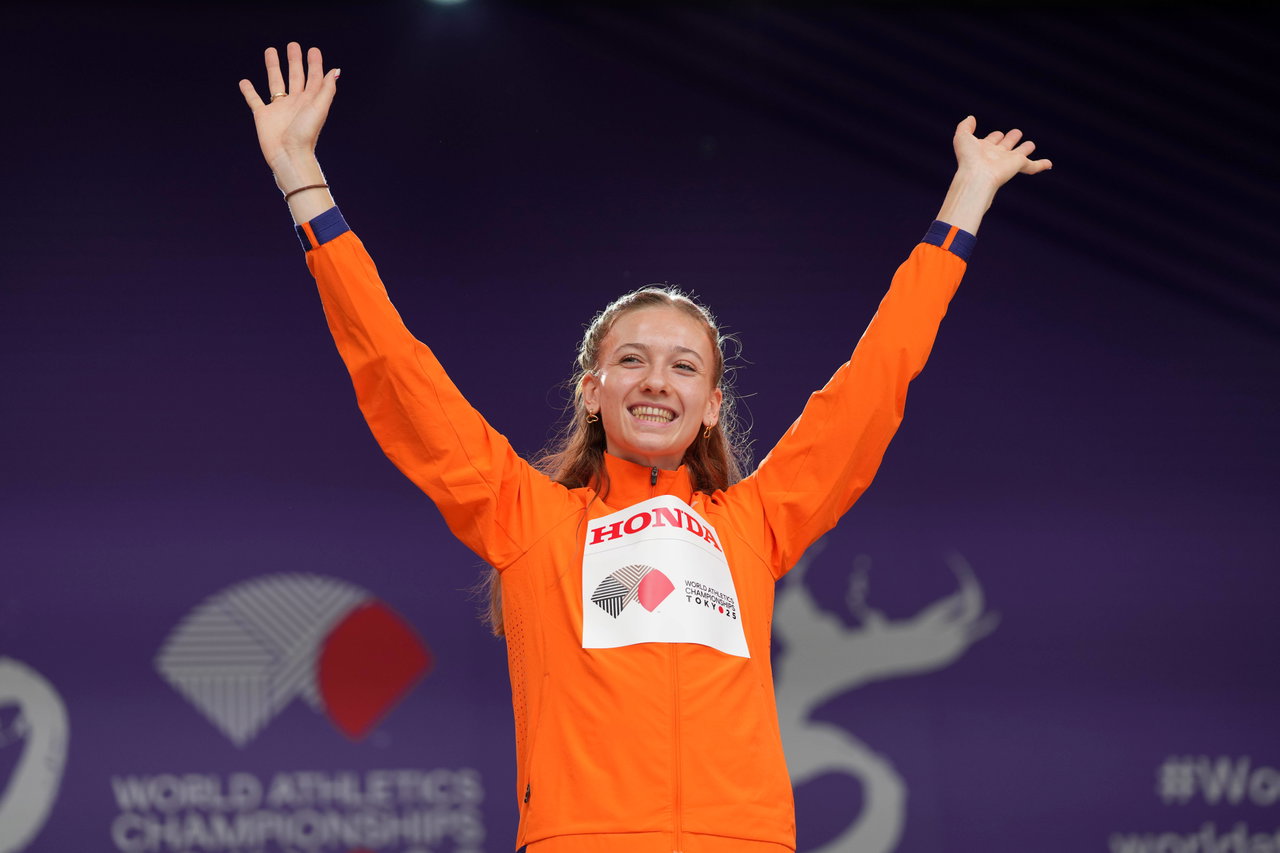
Back in 2025, Femke Bol announced a surprising decision. After years of dominating the 400mH, the Dutch track and field star revealed that she would shift her focus to the 800m beginning in 2026. Even Bol tried to temper expectations, saying, “Don’t expect me to run a world record in my first race.” So when she stepped onto the track for her outdoor 800m debut, expectations were low. After all, Audrey Werro, Eloisa Coiro, Gabriela Gajanová and several others were part of the event. Yet by the end of the evening, when Femke Broeders-Bol left Ostrava, she had earned a place in Dutch athletics history.
Watch What’s Trending Now!
At the Ostrava Golden Spike on June 16, Bol clocked 1:57.13 in the women’s 800m to finish second behind Switzerland’s Audrey Werro. Werro won the race in a meeting record of 1:54.45. Italy’s Eloisa Coiro finished in third with a time of 1:58.59.
While Bol was almost three seconds behind Werro, it was still a fantastic achievement. With a time of 1:57.13, she has moved to No. 3 on the Dutch all-time outdoor 800m list, behind 1992 Olympic gold medalist Ellen van Langen and Olympic champion Sifan Hassan. Bol is now just over 1.5 seconds shy of the national record of 1:55.54 held by Van Langen.
Meanwhile, in the Ostrava race, the eight women broke the two-minute mark, with Pavla Stoudkova finishing in eighth with 1:59.72. Emma Moore (2:00.71) and Aleksandra Formella (2:01.80) were the only ones to cross the finish line above two minutes.

Yesterday Femke Bol finished second in the 800m at Ostrava. 3 seconds off the winner. She is a multiple time world champion in 400m hurdles. And she looked completely at peace. And that stood out for me! She voluntarily walked away from an event she dominated to start over. New Show more
For Bol, however, the biggest takeaway was the experience of competing against some of the world’s best 800m runners. “It was so cool,” she said after the race. Speaking about racing against Werro, she added, “It was tough, but I enjoyed it.” The performance was particularly impressive given her limited experience in the event.
Earlier this year, on February 8, Bol ran her first-ever 800m at the Meeting Metz Moselle Athlelor in France, winning in 1:59.07 and breaking a Dutch indoor record that had stood since 2001. Just four months later, she has lowered her personal best by nearly two seconds. But for many fans, the biggest question remains: Why would an athlete at the top of her sport walk away from a 400MH event she had already dominated?
The reason behind Femke Bol’s bold career move
After all, Bol is a multiple-time world champion and Olympic medalist in the 400m hurdles. Yet in 2025, she decided to trade the event. But the challenge is far greater than it may seem. While both races require speed and endurance, the 400m hurdles and 800m are built very differently. The hurdles demand explosive power and rhythm over barriers. The 800m, meanwhile, places a much greater emphasis on endurance, pacing, race tactics, and aerobic strength.
Bol admitted that adapting to those demands has not been easy. “I do like the long running, but in the beginning it was quite hard for me to understand how this works, to not get so high in lactic, to look at heart rate, things like this,” she said before the Ostrava Golden Spike.
Yet the Dutch star has embraced the challenge. “I also like it when it’s sometimes uncomfortable and when you get into new places, because you can push yourself,” she explained. “I think the tactics I will really need to learn throughout the season. I’ve been watching a lot of 800m races to see how people deal with different tactics.”
Now, Bol spends a lot more time developing endurance. “I now run 40 to 55 km a week,” she said from her training camp in Stellenbosch. A major motivation behind the transition is the need for a challenge. Bol wanted a long career on the track, but one of the most challenging events in athletics is the 400m hurdles, and it is hard to compete at the highest level for many years in this event. Instead of waiting for her performances in 400mH to diminish, she decided to make the transition while still at her peak. After all, her ultimate goal has always been the 2028 Los Angeles Olympics.
“I just hope people don’t expect me to run a world record in my first race because that’s impossible. The goal is to peak at the Los Angeles Olympics in 2028.” If Ostrava is any indication, that trip could get off to a good start.