
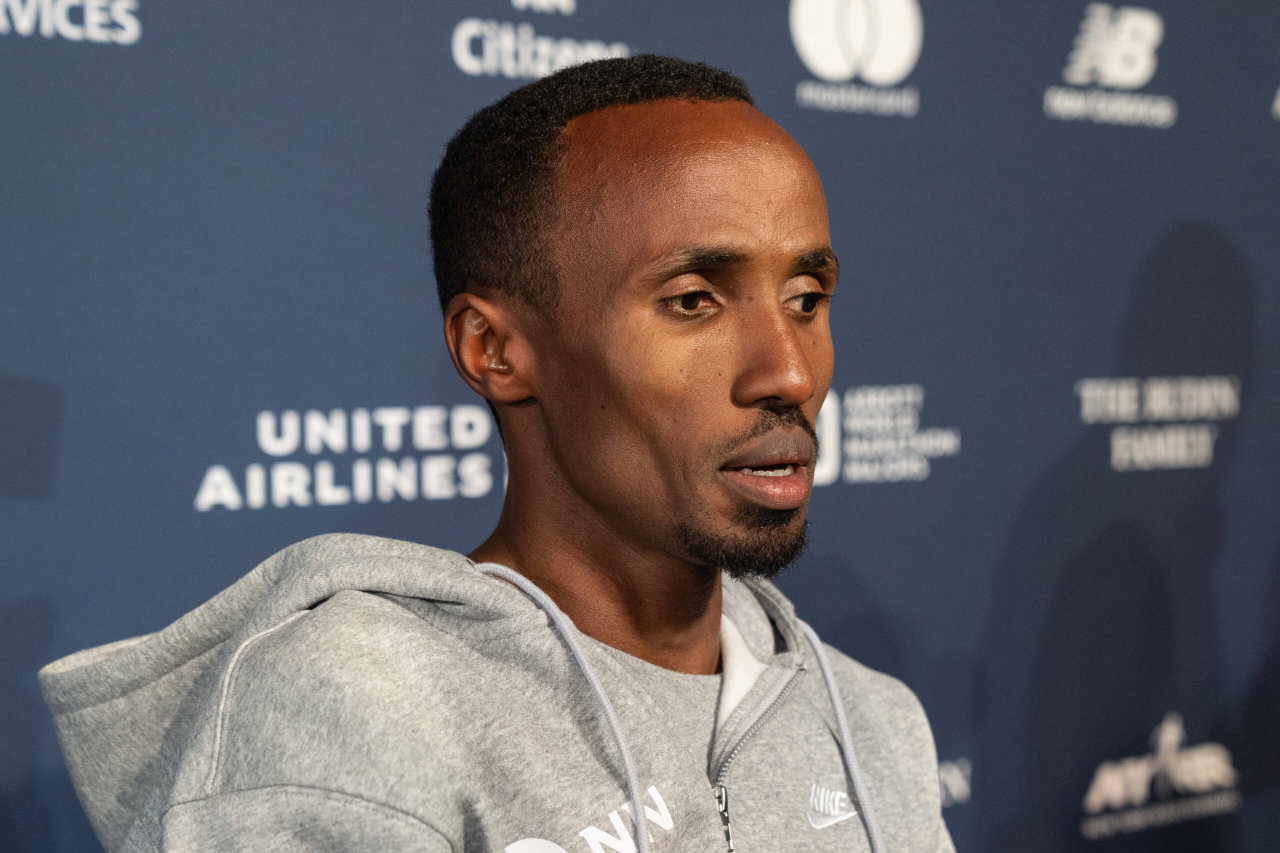
Kenyan athletics is already under scrutiny following a series of high-profile doping cases involving some of the country’s biggest distance-running stars. Amid growing attention on the state of athletics in the country, 2024 New York City Marathon champion Abdi Nageeye has raised another concern, this time about the lack of proper track facilities in Kenya’s Rift Valley. The Dutch marathoner believes the shortage of suitable training tracks affected his speed and speed endurance, making it difficult for him to compete with the leading runners at the November 1 New York City Marathon.
Watch What’s Trending Now!
On November 2, athletics journalist Katami Michelle shared a video of Nageeye explaining the difficulties he faced in preparing for the race. He admitted that although his endurance training had gone well, he knew he was short of the speed needed to compete at the highest level.
“I expected that I would have a good race, but I knew I was missing speed, speed endurance. That is because I didn’t do almost any good track session,” Nageeye explained. His concerns were reflected in his performance on race day. Nageeye struggled to keep up with the leading group and eventually finished 13th in 2:07:58. His time was just 19 seconds slower than the 2:07:39 he clocked to win the race in 2024.
Sweden’s Andreas Almgren claimed the men’s title in 2:06:01, becoming the first Swedish man to win the New York City Marathon. Italy’s Yemaneberhan Crippa finished second in 2:06:14, while Lesotho’s Kamohelo Mofolo took third in 2:06:26.
Nageeye then pointed to the lack of suitable training tracks in the Rift Valley, a region renowned for producing some of the world’s greatest distance runners, including Eliud Kipchoge, Faith Kipyegon and Mary Keitany. Despite its reputation as a home of champions, Nageeye believes the area lacks suitable facilities for athletes to work on their speed. “The reason is that now in Rift Valley, you don’t have any track anymore. There is no proper track where you can do nice speed work,” he said. He acknowledged that the Lorna Kiplagat track in Iten was one available option, but argued that its 2,400-meter altitude and challenging wind conditions made it difficult to complete the speed-endurance sessions he needed.
The Dutch runner explained that his endurance training had gone according to plan. His long runs and training blocks were strong, but he knew the lack of speed work could become a problem during the marathon. With the New York Marathon approaching, Nageeye eventually decided to travel to Flagstaff, Arizona, to complete some speed sessions. However, the decision came only three weeks before the race, leaving him with little time to make up for the training he had missed.
His plans were also affected by bad weather. Shortly after arriving in Flagstaff, he received tornado warnings on his phone and faced strong winds, cold temperatures, and rain for three to four days. Despite the conditions, he managed to complete two or three good track workouts before travelling to New York. However, those sessions were not enough to address the problem he had identified during his preparation.
Explaining what happened during the race, Nageeye said he initially felt encouraged when he closed a gap of around 20 seconds to the leading group at about 25 kilometres. But the repeated changes in pace became increasingly difficult to handle. “Every surge, I was not able to close, I was not able to react. That was killing me,” he said.
Nageeye explained that whenever the pace increased, he felt as though he was sprinting. Although he could respond to some moves, he struggled to repeat those efforts throughout the race. The experience also left him questioning why he had not travelled abroad earlier to work on his speed. He pointed to Italian marathon runner Yemaneberhan Crippa, who had traveled to Europe ahead of the Copenhagen race to complete speed training.
However, he also acknowledged that living and training in the region had influenced his decision to stay in Kenya rather than travel elsewhere earlier. The discussion then turned to a wider problem affecting athletes in the Rift Valley. Nageeye said the lack of proper tracks was not just an issue for him but a challenge for many runners based in the region.
He specifically mentioned Iten, Kaptagat and Eldoret, arguing that athletes from the area were struggling across different distances, from the 800 metres to the marathon. “Especially when you see the athletes that are from that area, Iten, Kaptagat, Eldoret in that whole area, nobody’s performing well, from 800m to the marathon, nobody. Everyone have hamstring issues, everyone is struggling. We really need a track,” he said.
Nageeye also revealed that he had started discussing the issue with his team manager and sponsors, as they wanted to see proper track facilities developed in the region as soon as possible. He added that work was being done to address the problem and expressed hope that better facilities would become available soon. However, Nageeye’s comments come at a time when Kenyan athletics is already facing renewed scrutiny following a series of high-profile doping cases.
Kenyan distance running faces fresh doping scrutiny
The latest controversy surrounds former Olympic champion and reigning world marathon champion Peres Jepchirchir, who was provisionally suspended by the Athletics Integrity Unit on October 23 after an out-of-competition sample collected in Kenya tested positive for erythropoietin. The sample was taken before her victory at the 2026 Sydney Marathon. Her case is still pending, and the provisional suspension is not a final finding of an anti-doping violation.
She is not the only Kenyan distance runner to face anti-doping action in recent months. In October, marathoner Ronald Kipkoech Korir was provisionally suspended in an Athlete Biological Passport case. Earlier in the year, former New York City Marathon winner Albert Korir received a five-year ban after admitting to anti-doping violations involving CERA, an EPO-based blood-boosting substance. Former half-marathon world record holder Kibiwott Kandie was also handed a seven-year ban in June for refusing to provide a doping-control sample and tampering with the testing process.
These cases have added to concerns about doping in Kenyan distance running. According to Reuters, more than 140 Kenyan athletes have been sanctioned since the AIU was established in 2017. While the doping cases and the shortage of proper training facilities are separate issues, both have brought renewed attention to the challenges facing Kenyan athletics.