
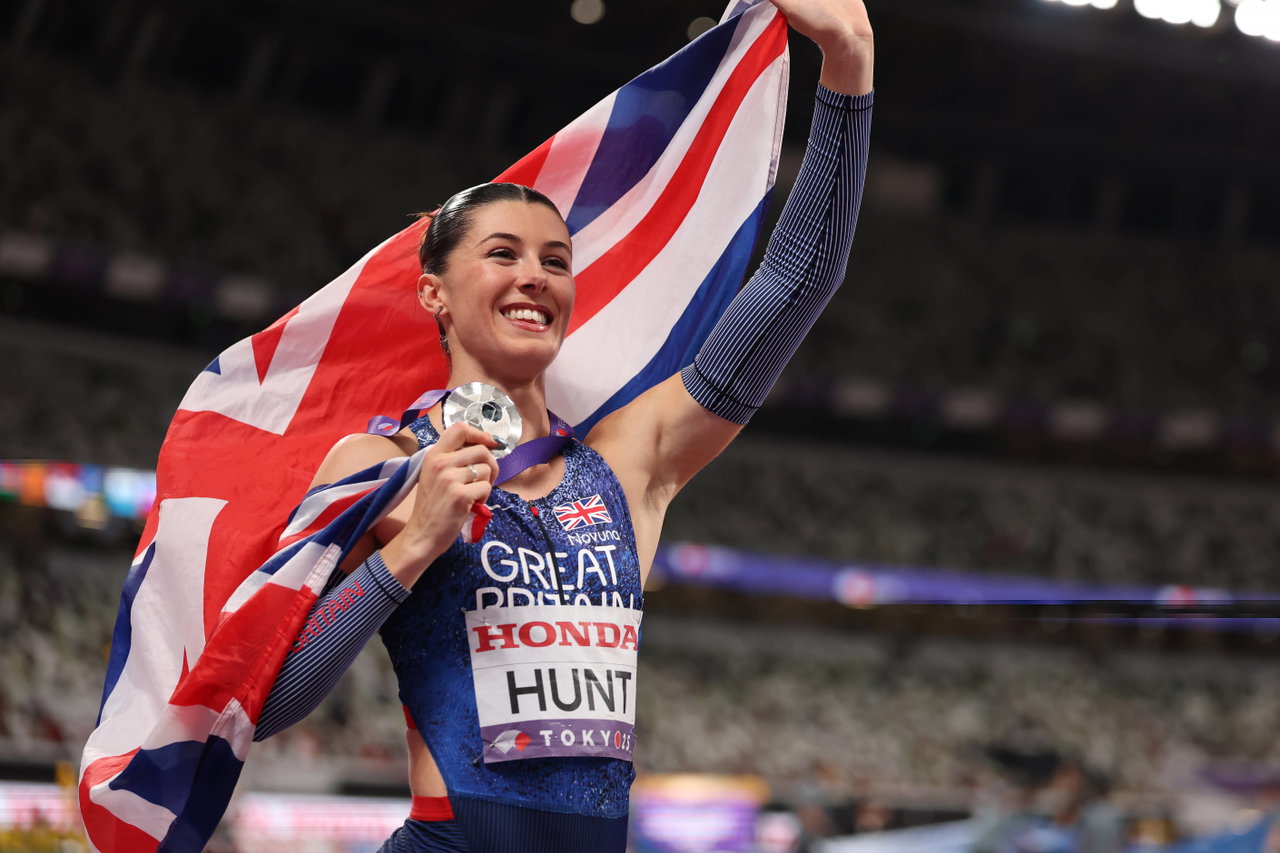
When Amy Hunt first dipped below 12 seconds in the 100m, she was only 14 years old! At the English Schools Championships in 2016, she ran 11.96 seconds. Even then, the young Brit said, “I am more confident I can perform well.” Over the next decade, she achieved European U20 gold, Olympic silver with Great Britain, and also lowered her personal best to 11.02. But one thing remained missing: breaking the 11-second barrier. Then, exactly 10 years after her first sub-12 run, Hunt finally did it.
Watch What’s Trending Now!
That moment arrived on June 7 at the Stockholm Diamond League. Although Melissa Jefferson-Wooden won the race with 10.84 seconds, Hunt also produced what she always dreamt of and finished second. The 24-year-old finished second in 10.97 seconds, making her a sub-11 runner for the first time. When her name was displayed on the stadium scoreboard, it was a reaction that told the tale!
She began jumping with excitement, celebrating a milestone that had taken 10 years to achieve. A day later, Hunt reflected on the breakthrough on X. “10.97 !!! I first ran a sub-12 100m in 2016. It took me ten years to drop one second.”
That single second leap, from 11.96 to 10.97, represents ten years of incremental gains, each hundredth harder than the last.

10.97 !!! i first ran a sub 12 100m in 2016. it took me ten years to drop one second.

After her first sub-12 run in 2016, Hunt improved to 11.53 at the Newham Network Open Series in 2017. But then she was unable to better that mark in 2018 before lowering it to 11.41 at the BUCS Trials & Open in Loughborough in 2019.
Another personal best followed in 2020 when she clocked 11.35 at the British Championships in Manchester. Progress then slowed. Hunt raced sparingly in the 100m in 2021 as she raced in the 200m and did not register a major improvement in 2022.
She came back in 2023, when she ran 11.13 in the Newham & Essex Beagles Summer Series in London. The next year, she knocked another hundredth off her previous mark, finishing with an 11.12 at the PURE Athletics Elite Invitational in Florida.
By 2025, she was nearer than ever. Hunt competed at the UK Championships in Birmingham, where she won the national title and broke her own personal best by 0.02s. The race set her as the fastest woman of the day in Britain, but she was unable to touch the sub-11 mark.
Just eight hundredths of a second still separated her from the milestone she had been chasing for years. That finally changed in Stockholm.
“Sub-11 has been a work in progress for many years, so I am super excited that it has finally happened,” Hunt said after the race. “Every single day in training I run sub-11, but I needed the conditions to be right in a race. I take confidence from my training, and today the conditions were perfect.”
She will now be aiming to improve even further and break her fellow Brit, Dina Asher-Smith’s 10.83 record. But a slight improvement on her 10.97 will be enough to overtake her compatriot Daryll Neita’s 10.96.
The achievement carried extra meaning for Hunt because Stockholm was also the site of her first Diamond League appearance. With another 100m race awaiting her in Oslo, Hunt is already looking ahead. But Hunt could have broken the 11-second barrier years earlier had her career followed the path many expected.
The obstacles that stood between Amy Hunt and the sub-11 barrier
Hunt was born in Newark, Nottinghamshire, and began her athletic career as a competitively-minded schoolyard champion. After discovering she could outrun the boys, she fell in love with running. It quickly turned her into one of the brightest young talents in British athletics. The then 17-year-old made the sport sit up and take notice with her performance in 2019.
Hunt broke the World Under-18 record in the 200m to become the fastest U18 female 200m runner in history, running 22.42s. She followed it up by winning European U20 gold in the 200m and 4x100m relay.
The teen sensation was seen as the next big thing in Britain to become a superstar in the sprint events, and a future medal winner on the global stage. However, her career went down a different route.
While continuing to compete internationally, Hunt enrolled at Corpus Christi College, Cambridge University, to study English Literature. For three years, she played at the highest level of sport and was also studying at one of the world’s most rigorous academic colleges. However, during an indoor race in 2022, Hunt tore her quadriceps tendon.
It was the most severe injury the sprinter could have suffered and had to be operated. At one point, she revealed that her mother had to help her get in and out of the shower because she could barely bend her knee. The injury brought her career to a standstill.
Hunt refused to give up. She then graduated from Cambridge in 2023 and moved to Italy, where she started to rebuild her career under coach Marco Airale. Gradually, the results followed.
She won Olympic silver for Great Britain in the women’s 4x100m relay at Paris 2024, World Relays gold and the British 100m title, and World Championship silver in the 200m. But in all that success, the sub-11 mark was not broken. Until Stockholm.