
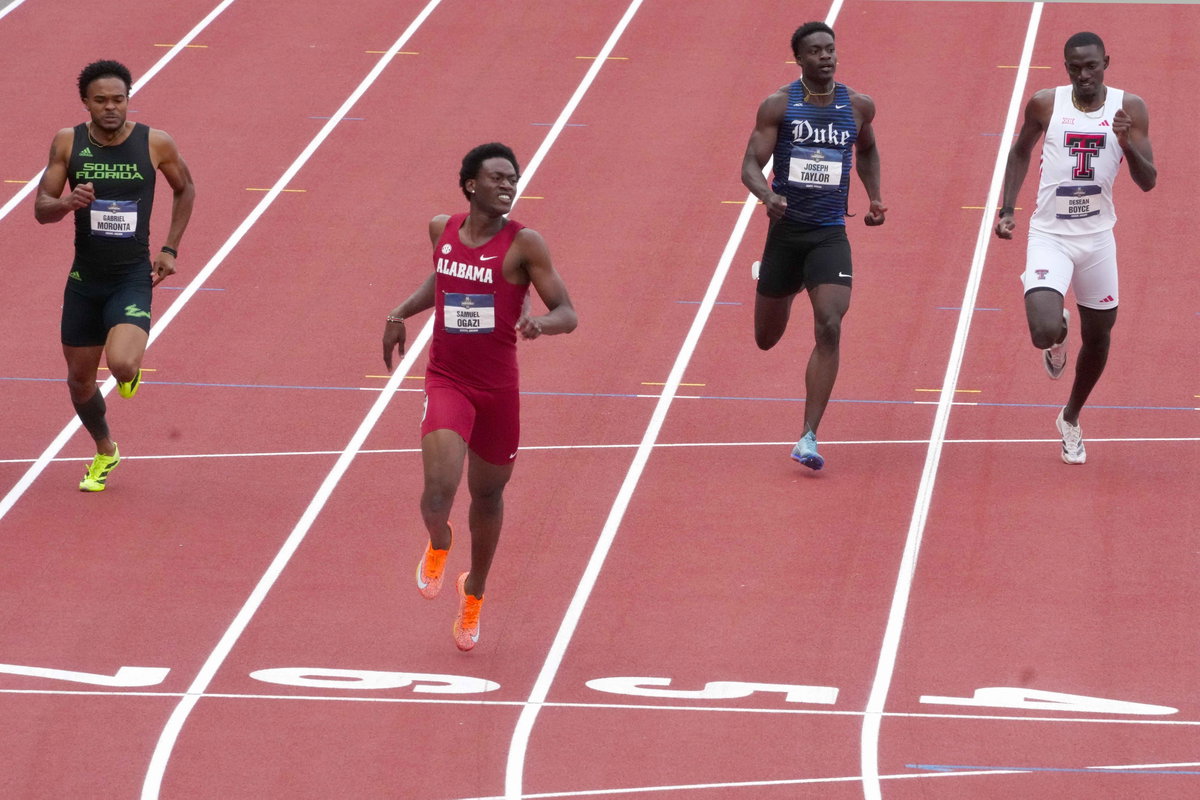
He arrived at the University of Alabama, rewrote the record books, and has now decided it is time to move on.
Watch What’s Trending Now!
In his third year of eligibility, Samuel Ogazi went beyond expectations, setting new levels for himself. The Nigerian leaves as the fourth-fastest man in history after clocking 43.48 seconds in the 400 meters. Only Wayde van Niekerk (43.03), Michael Johnson (43.18), and Butch Reynolds (43.29) have run faster.
As if that wasn’t enough, he also won back-to-back NCAA Outdoor 400m titles, back-to-back SEC Outdoor 400m titles, and the 2026 NCAA Indoor 400m title. That’s alongside setting collegiate records in the 400m outdoor and an African national record in the 400m indoor. The list does go on, as he also broke Innocent Egbunike’s long-standing 400m record (44.17), set in 1987, in May 2026.
Since then, Ogazi has lowered it three times (43.95, 43.82, and 43.38) to ensure his place in history. And now that he has decided to forgo his remaining NCAA eligibility, the world cannot wait to see what he has in store.
“We are absolutely delighted with Samuel Ogazi’s decision to turn professional. He has conquered the collegiate ranks and leaves as arguably the greatest 400m athlete in NCAA history,” Athletics Station, a leading stakeholder in Nigerian track and field, said. “There is little left for him to prove at that level, and this is the natural next step in his journey.”

Samuel Ogazi 🇳🇬 is officially turning professional! After three outstanding seasons with the University of Alabama, the Nigerian quarter-miler has chosen to forgo his remaining NCAA eligibility. Two weeks ago, he became the 4th fastest man in history with 43.38s! His NCAA Show more

“This is a proud moment for Nigerian athletics. Samuel Ogazi represents the future of the sport in our country. As he embarks on this new chapter, he deserves the full support of the athletics community, sponsors, and fans. We have every reason to believe that even greater achievements lie ahead.”
His departure, though, comes at a time when the NCAA has a rule change on the horizon. As per RunnersWorld.com, the NCAA Division 1 approved a rule that will change the entire system.
Under the new rule, athletes’ eligibility clock starts when they turn 19 or when they enroll in college, whichever comes first. Under the current rule, there is no age cap. Instead, athletes have five years to use four seasons of eligibility. As a result, more than a handful of athletes in their mid-to-late 20s have been recruited into the system, creating challenges.
Aside from being physically mature and at their athletic peak, colleges and programs have come under immense criticism for bringing them into the fold. That hasn’t stopped the process, though, as the likes of Solomon Kipchoge (30) and Dismus Lokira (27) are all currently in the NCAA.
In fact, Kipchoge even won a bronze at the 2025 NCAA Cross Country Championships. That’s even though he was significantly older than the rest of the field. Now, Samuel Ogazi’s departure from the NCAA circuit to turn professional offers other stars in their early twenties another path forward.
Whether that change solves the issue remains a point of debate, with coaches and athletes divided over what it means for the future. Among those who weighed in was Philipp Baar, head of track and field at Scholarbook Premier.
Philipp Baar opens up on the NCAA’s policy change
The summer of 2024 was arguably the biggest moment in recent history when an athlete’s age became a major talking point. That came after Texas Tech signed Kipchoge, a 28-year-old long-distance runner who was already faster in the half-marathon than any American had ever been. Despite being closer to 30 than 20, the Kenyan enrolled as a freshman, competed, and faced a wave of criticism on social media.
He wasn’t the only one, as Texas Tech also targeted other older athletes like Lokira, Cheruiyot, and several others. While Kipchoge has since transferred, the debate continues to rage, with coaches concerned about what the current rule means for the future of athletics.
That debate has since led to a policy change, which will take effect in 2027. So far, fans have responded positively to the change, and Philipp Baar believes it’s a step in the right direction.
“I do think that collegiate athletics should be about developing or bridging the gap from high school sports or junior sports to pro sports. It shouldn’t be the pro sports,” Baar told RunnersWorld.com. “So I think it’s a good thing.”
Samuel Ogazi’s decision marks the end of a remarkable collegiate career that saw him rise to new heights. Now, the focus shifts to what comes next.