
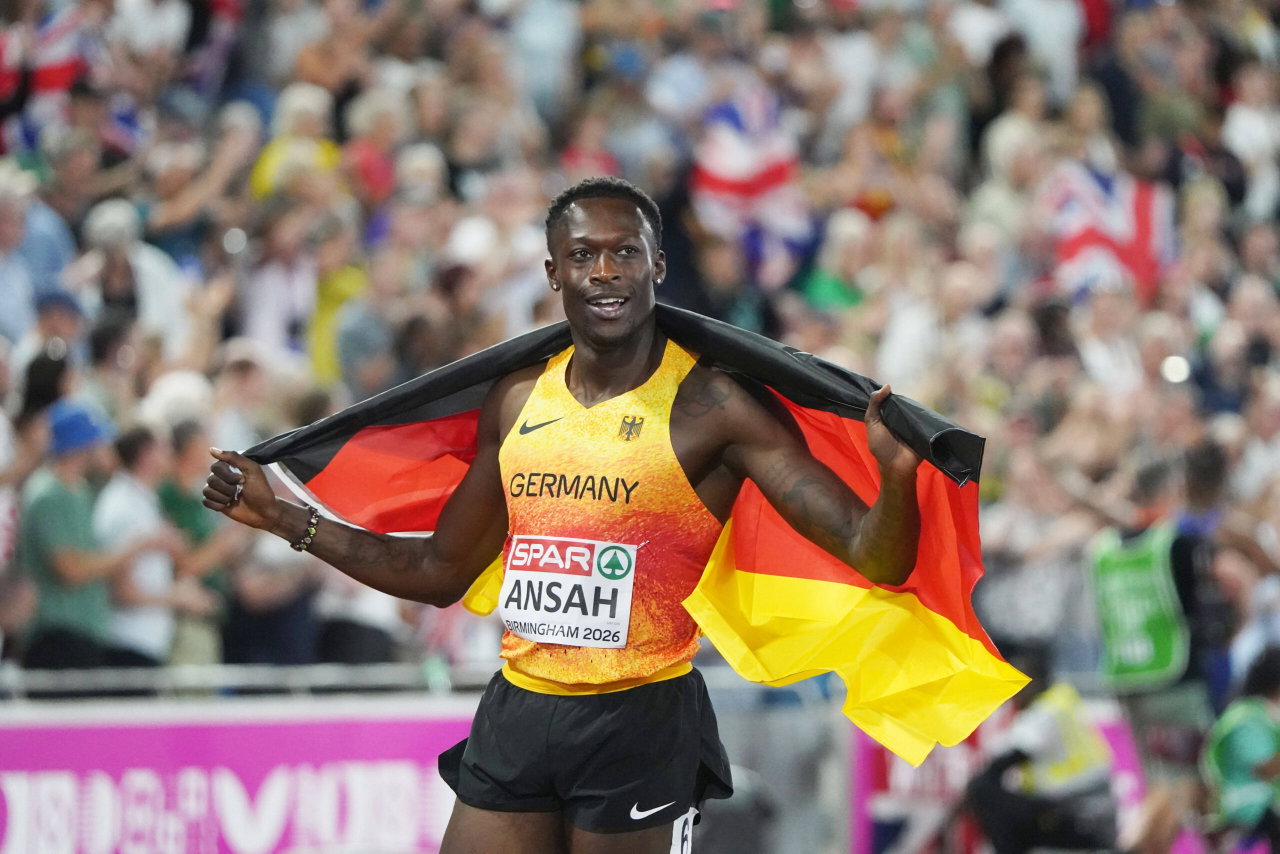
Anti-doping rules are not suggestions, and athletes know that. That is why Owen Ansah’s case is so hard to ignore. His 200m triumph in Europe is now being dragged into a controversy that began on July 9, when a NADA tester showed up as the German sprinter was preparing to leave for Monaco.
Watch What’s Trending Now!
Ansah insists he never deliberately refused the test, but NADA Germany sees it differently, accusing him of refusing or failing to provide a sample. The agency responded with a proposed four-year ban. Ansah, instead of accepting the punishment, has chosen to fight it.
On August 28, he rejected NADA Germany’s proposed four-year ban and asked for a hearing before the German Court of Arbitration for Sport. The sprinter had 20 days to either accept the agency’s findings or challenge them, with an acceptance potentially cutting the suspension to three years.
The whole mess traces back to July, when Ansah was preparing to fly to Monaco for the Diamond League.
According to the sprinter, a NADA doping-control officer showed up at his home just as he was getting ready to leave. Ansah says he was already running late and had just used the bathroom, making it difficult to provide a sample on the spot.
But Ansah’s version makes the situation even messier. He claims the officer never offered to go with him to the airport so he could provide the sample there, and never warned him that leaving without doing so could trigger a serious anti-doping violation. Instead, Ansah says the officer simply wished him luck for Monaco and left, a detail that now sits at the center of his defense.
Ansah still went to Monaco and raced on July 10, then leaned on what happened next as part of his defense. He says he was tested that same day in Monaco and again by NADA the following Monday.
His argument is pretty clear because if he was really trying to dodge the anti-doping system, it raises the question of why he agreed to two tests almost immediately afterward.
That defense, however, does not erase July 9.
NADA’s case is focused on that specific missed sample, not the tests Ansah took afterward. Under Article 2.3 of the National Anti-Doping Code, refusing or failing to provide a sample when required can itself count as an anti-doping violation. After reviewing the incident, NADA Germany announced its findings on August 7 and proposed a four-year ban over Ansah’s alleged failure to complete the test.
That is exactly why attention to detail matters so much in anti-doping cases. In 2019, U.S. track and field athlete Todd Davis refused to provide a urine sample during an in-competition test at the USA Track & Field Masters Outdoor Championships, and USADA handed him a four-year suspension. His results from the date of the refusal were also disqualified, meaning any medals, points and prizes earned afterward were wiped out.
The biggest twist, however, is what NADA is actually accusing him of.
Ansah never tested positive for a banned substance. NADA’s case is instead built around his failure to provide the July 9 sample. That distinction matters because the disputed test came just weeks before the biggest breakthrough of his career, putting everything he achieved afterward under a cloud.
Why could Ansah’s European medals be at stake?
And the timing could hardly be worse for Ansah. After years of chasing a major breakthrough, the German sprinter finally delivered at the 2026 European Athletics Championships in Birmingham, storming to 200m gold in 19.95 seconds. He beat Great Britain’s Zharnel Hughes, who clocked 20.16, by 0.21 seconds and delivered Germany its first European men’s 200m title in 44 years. But Ansah’s Birmingham success did not start with that gold medal.
Before the 200m gold, Ansah had already grabbed bronze in the 100m behind Britain’s Romell Glave and Jeremiah Azu. Two individual medals made Birmingham the biggest championship haul of his senior career. Now, the July 9 dispute threatens to put both results under the microscope.
And this is where the stakes get brutal.
NADA’s proposed sanction would cover Ansah’s results from July 9 onward until any provisional suspension or period of ineligibility begins. If the ruling stands, those results could be wiped out, along with the medals, points and prize money that came with them. In other words, Ansah was allowed to race in Birmingham, but the achievements he earned there may still not be safe.