
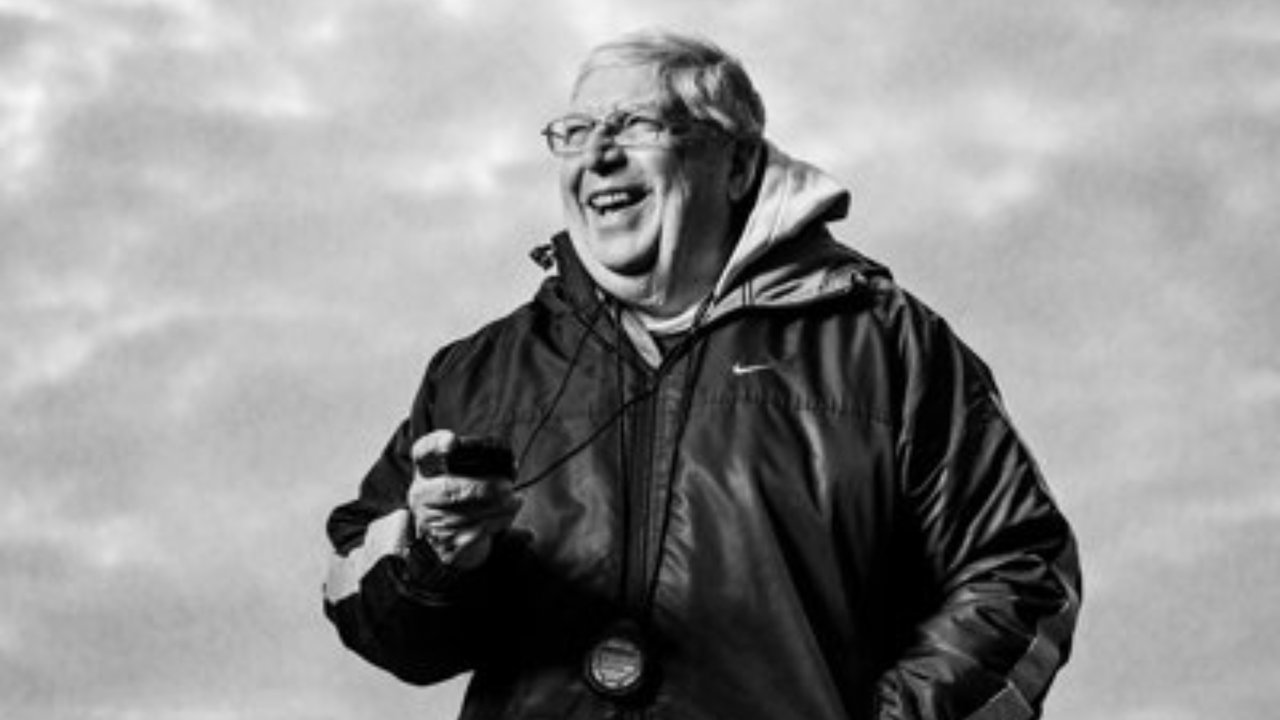
Remember June 28, 2012, when Julie Culley stunned the crowd at the U.S. Olympic Trials by winning the women’s 5,000 meters? Culley was not the favorite to win. But with roughly 100 meters remaining, Culley found another gear. Her coach, Frank “Gags” Gagliano, shouted from the sidelines, “Hit it!” His words gave her the push she needed as she accelerated down the final stretch, crossing the finish line in 15:13.77 to secure her place on the U.S. Olympic team for the London Games. Fast-forward 14 years, and the man who stood trackside, motivating his athletes to chase their dreams, has passed away at the age of 89, leaving behind a legacy built over six decades of coaching.
Citius Mag reported Gagliano’s death on October 26, 2026, saying he died on Sunday night, October 25. The cause of death has not been publicly disclosed.
Born in the Bronx, New York, Gagliano did not initially imagine a future in track and field. He played quarterback at the University of Richmond from 1956 to 1959 and briefly pursued professional football in Canada with the Hamilton Tiger-Cats and the minor-league London Lords. In 1960, he accepted a coaching job at Roselle Catholic High School in New Jersey, believing the position would also involve starting a football team. That plan never materialized, and he was asked instead to coach track, a sport he admitted knowing little about.
But then in 1965, Roselle Catholic became the first high school to win both the distance medley relay and the two-mile relay at the Penn Relays. In 1969, Gagliano joined Manhattan College as an assistant coach under Fred Dwyer. He taught driver’s education in the mornings and spent his afternoons recruiting runners and developing the team. His work helped Manhattan win the 1973 NCAA indoor team championship despite scoring in only four events.
He moved to Rutgers University in 1974 and became head coach in 1982. During his time there, he coached steeplechaser Mike Roche, who qualified for the 1976 U.S. Olympic team, and sprinter Elliott Quow, who won silver in the 200 meters at the 1983 World Championships in Helsinki. Georgetown University hired Gagliano in 1984, beginning an 18-year tenure that became one of the defining periods of his career.
His teams won 23 Big East championships and produced 140 All-Americans. He was named national coach of the year twice and became a leading figure in American collegiate distance running. In 2003, he was inducted into the U.S. Track & Field and Cross Country Coaches Association Hall of Fame.
His influence extended far beyond college competition. Gagliano coached several elite professional training groups, including the Reebok Enclave, the Nike Farm Team, Oregon Track Club Elite and the New Jersey-New York Track Club, which he began leading in 2010. Across his career, he worked with numerous Olympians, including John Trautmann, Steve Holman, Nicole Teter, Jonathon Riley, Nick Symmonds, Christian Smith, Julie Culley and Donn Cabral.
Gagliano was known for his direct approach and his belief that successful distance runners needed both strength and speed. His instruction to “Hit it!” on the final turn became a fitting expression of his coaching style: trust your preparation, find another gear and give everything you have when the moment arrives. In July 2026, USA Track & Field named the men’s 800 meters at its national championships in his honour.
But Gagliano’s life was not defined by achievements alone. Behind the championships, Olympic runners and decades spent on the track were professional setbacks and personal heartbreaks that tested his resolve.
Repeated setbacks tested Gagliano’s resilience
In 1992, Gagliano founded the Reebok Enclave, a professional training group that went on to produce 11 Olympians and included runners such as Steve Holman, Rich Kenah and Bryan Woodward. The programme gave elite middle-distance runners the coaching and support they needed to compete at the highest level. But in November 2000, Reebok announced that it would withdraw its financial backing, leaving Gagliano with just eight weeks to find a replacement sponsor. The funding, worth more than $100,000 a year, helped cover athletes’ travel expenses, training support and coaching stipends.
Despite efforts to secure new backing, no replacement sponsor came forward, and the Reebok Enclave folded in May 2001. Gagliano moved to California to coach the Nike Farm Team. Some athletes followed him, while others stayed behind. Two of the group’s best-known runners, Holman and Kenah, were preparing to retire. For Gagliano, the closure meant losing more than a source of income.
Nearly two decades later, he faced a similar challenge with the New Jersey-New York Track Club, which he founded in 2010. HOKA had sponsored the group since 2016, helping their athletes train and compete. In December 2020, however, the company announced that it would not renew its sponsorship. The timing was difficult: the COVID-19 pandemic had disrupted competition, and athletes were preparing for the postponed 2021 U.S. Olympic Trials. Without a sponsor, runners faced uncertainty over the support they would receive as they chased Olympic qualification.
“HOKA’s decision to end the sponsorship for the HOKA New Jersey-New York Track Club is very disappointing to me,” Gagliano told Runner’s World. He also expressed concern for the athletes who were left wondering what would happen to their careers. The club continued, but assistant coaches Tom Nohilly and John Trautmann went on to establish Empire Elite Track Club. Gagliano remained with his own group, once again having to contend with the loss of financial backing and the uncertainty it created for the runners who depended on him.
His greatest personal hardship, however, came in 2009, when his daughter-in-law, Meighan, was diagnosed with stage IV cancer. Gagliano was coaching in Oregon at the time, but he returned to New York to be with his son, David, and help care for his two young granddaughters. Meighan died at just 40, leaving the family devastated. Gagliano and his wife, Roberta, moved into a house across the street from their son’s home so they could help raise the children.
These setbacks revealed another side of Gagliano’s story. The man remembered for urging runners to find another gear also had to find ways forward when the future of his teams was uncertain and his family was grieving. He rebuilt training groups, continued working with athletes and returned to coaching after profound personal loss.