
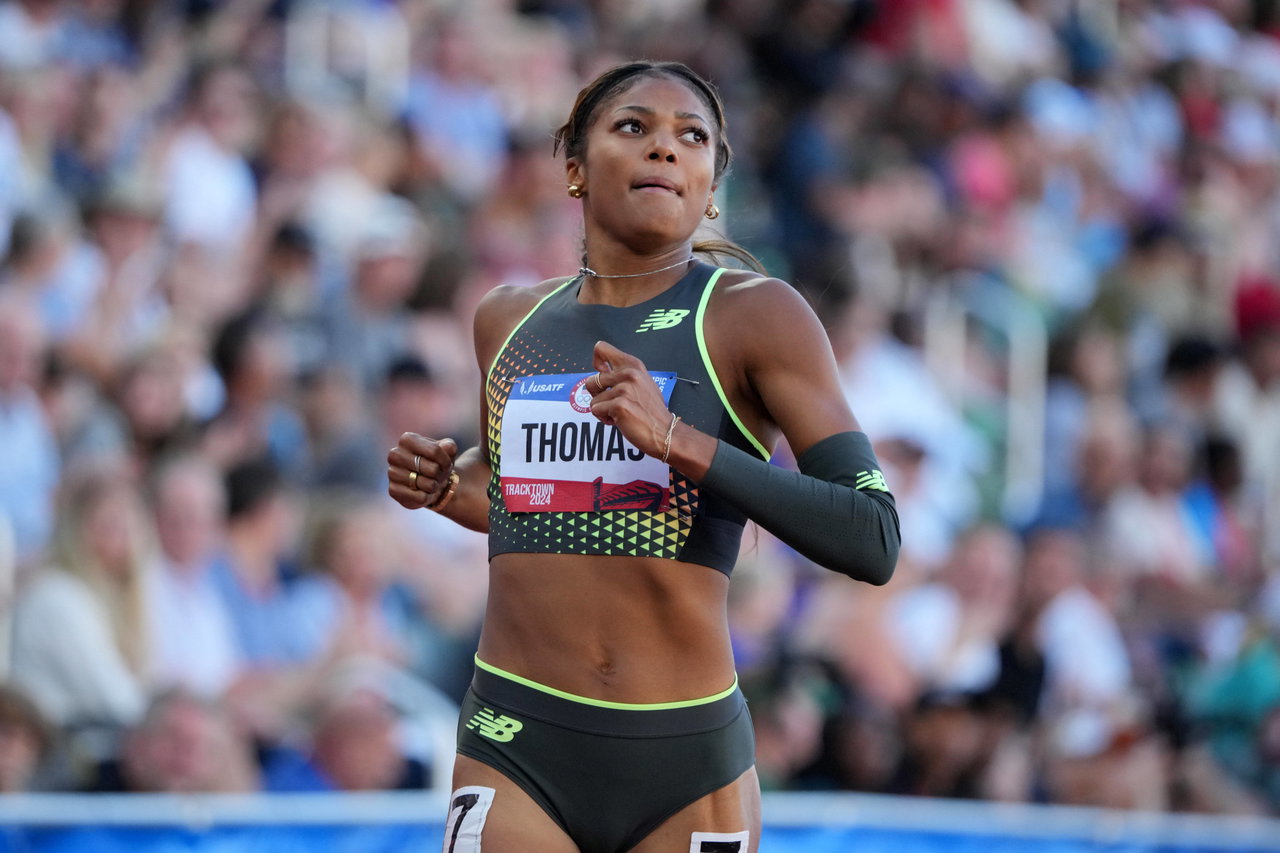
Prior to Gabby Thomas’ Olympic gold medals and a Harvard education, her mother, Jennifer Randall, made a pivotal choice for her daughter’s schooling. When Thomas was 10, Randall moved the family from Georgia to Massachusetts and enrolled her at the private Williston Northampton School to access better opportunities that would shape her academic and athletic path. Years later, Thomas is sharing on that choice after a new New York Times Magazine story put a very different family decision under the spotlight.
Watch What’s Trending Now!
On September 21, Thomas shared an Instagram Story recommending a viral New York Times Magazine article by journalist Nikole Hannah-Jones. The story looks back at a decision Hannah-Jones and her husband made in 2016, when they chose to send their daughter, Najya, to an under-resourced New York City public school despite having the financial means and social connections to pursue other options.
“If you haven’t read the New York Times article by Nikole Hannah-Jones, I definitely recommend reading it,” Thomas said. “It is such a good read and it’s a unique perspective on a conversation that we are still having to this day about the fight for Black children and education.” Hannah-Jones and her husband believed their daughter could manage the challenges of the school because their family had resources that many others did not.
At the same time, they hoped their presence could help improve the experience of other children at the school. “This mom and dad made a decision 10 years ago in 2016… in the hopes of challenging the separate but unequal school system,” Thomas said. The decision became much more complicated a decade later.
Hannah-Jones revisited the choice in her 2026 article after seeing how it affected Najya as she moved through school. Now 16, Najya questioned whether attending the under-resourced school had left her less prepared academically than she should have been. The experience also led Najya to question why her parents had chosen that school when they had the means to give her other options. And this story’s focus on a parent’s educational choice also brought Thomas’ own childhood into the conversation.
Her mother, Jennifer Randall, was pursuing her own education and career when she moved the family from Georgia to Massachusetts. Randall eventually became a professor and researcher at the University of Massachusetts. When Thomas was 10, she enrolled her daughter at Williston Northampton School, a private college-preparatory school in Massachusetts.
The decision opened the door to a strong academic environment for Thomas. She developed as a student and athlete before eventually attending Harvard, where she studied neurobiology and global health. She later earned a master’s degree in epidemiology. But Thomas’s path was shaped by more than resources; it was shaped by race.
Thomas’s childhood experiences made her more conscious of race because Williston Northampton was predominantly white. Randall was able to explain to her those experiences and the racial differences she might meet at a mostly white school. “This is such an important conversation because it’s one that we are still having to this day, and it really resonates with me because my mother made basic…” Thomas said. Even Thomas herself has spoken about some of the challenges she faced during her time there.
Gabby Thomas recalls feeling like she had to prove she belonged
Thomas has spoken about how difficult it could be to find her place as a young Black student at Williston Northampton. In her May 29, 2022 commencement speech at the school, she looked back on arriving there from Georgia and admitted that she initially struggled with fear and self-doubt.
“Twelve years ago, when I arrived on this campus as an awkward young Black girl from Georgia, I felt many of the same things I still feel in those Sixty Seconds of Eternity: Fear, uncertainty, self-doubt,” Thomas said. She also questioned whether she belonged. “I was one of maybe five black students in my class wondering if I belonged,” she said, describing the uncertainty she felt when she first entered the school.
Thomas remembered asking herself questions such as, “What if they don’t like me? What if I’m not good enough? What if I don’t belong here?” Her experience, however, was not entirely negative. Over time, she became more comfortable at Williston, built relationships with teachers and advisors, and eventually described the school as a “second home.”
Thomas’s mother, Jennifer Randall, also spoke about the pressure her daughter could face in those environments.
“The world especially tells Black women all the time that this space does not belong to you,” Randall said. Taken together, Thomas’s experiences show that her connection to Hannah-Jones’s article is not simply about choosing a school. It also touches on the different challenges Black children can face in both under-resourced schools and predominantly white, highly selective environments.