
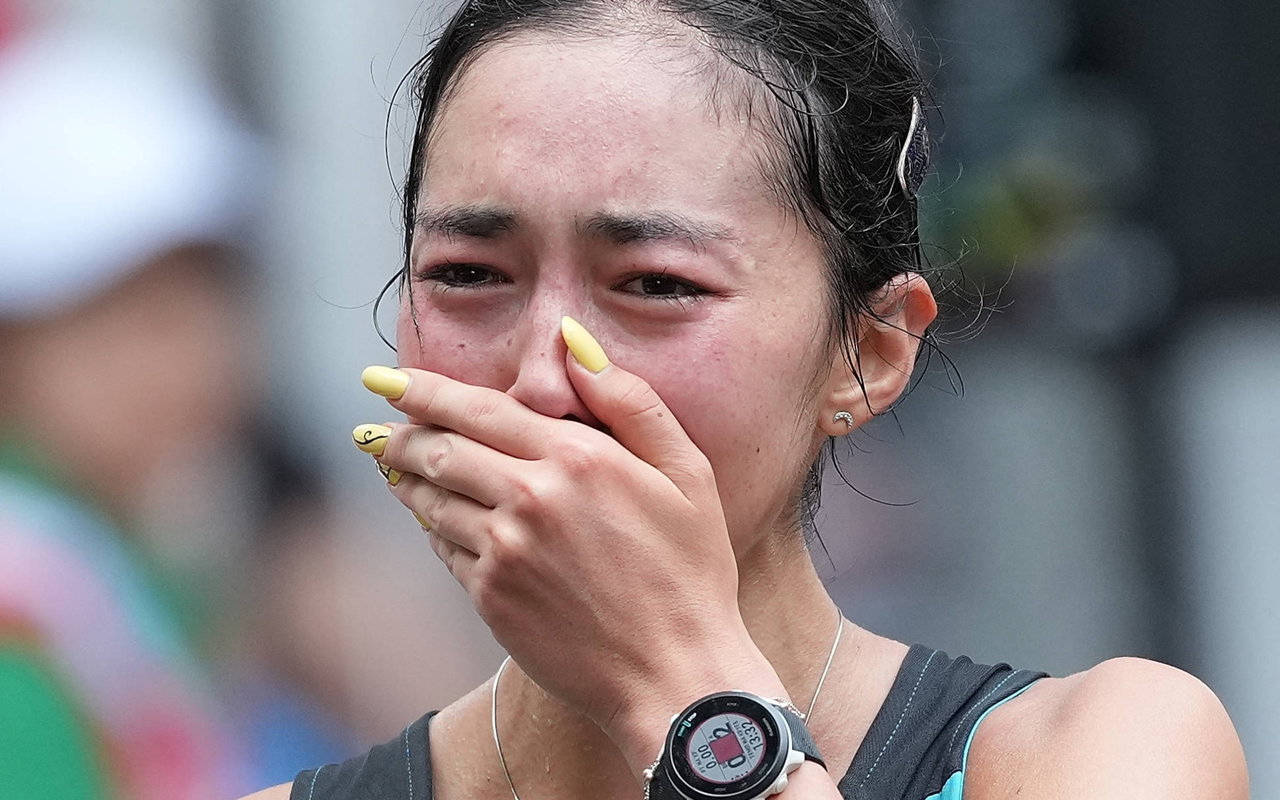
Yasmina Toxanbayeva had every reason to celebrate. The Kazakhstan race walker completed the gruelling 42.195km marathon race walk in Nagoya in 3:22:20, finishing almost four minutes ahead of China’s Danzengquzong. With the event making its Asian Games debut, she appeared to become its first women’s champion. After such a demanding race, the 23-year-old could barely hold back her emotions as she crossed the finish line, breaking down in tears. But just moments later, those tears of happiness turned into tears of heartbreak.
Watch What’s Trending Now!
Later on September 27, just hours after Toxanbayeva had celebrated her victory, a protest was lodged against her result over the footwear she wore during the race. She was competing in the ASICS Magic Speed 4, according to reports and images from the event, and the protest questioned whether the shoes complied with World Athletics’ approved footwear regulations.
World Athletics maintains an approved footwear list, and athletes competing in official events must use shoes that meet the organisation’s requirements for the relevant discipline. Reports comparing the different Magic Speed models found that the Magic Speed 1, 2, 3 and 5 appear on the approved list for road disciplines, while the Magic Speed 4 was not listed for the required event.
Another issue raised in reports was the shoe’s sole height. World Athletics rules set a maximum sole thickness of 40mm for road events, including race walking. Reports measuring the Magic Speed 4 put its heel stack at around 43.5mm, roughly 3.5mm above that limit. The official ruling was framed as a footwear compliance issue.
At that time, she was not disqualified, but her result was placed under review, leaving her gold medal in doubt. She had finished in 3:22:20, with China’s Danzengquzong second in 3:26:09 and compatriot Ma Li third in 3:32:26. Then the following day, September 28, the decision finally arrived. Officials annulled Toxanbayeva’s winning result and disqualified her from the race.
The medal standings were immediately reshuffled. Danzengquzong, who had finished second in 3:26:09, was promoted to gold. China’s Ma Li moved into silver, while Japan’s Yukiko Umeno was awarded bronze.
Toxanbayeva later reacted to the decision on social media, revealing just how quickly her emotions had changed. “Sorry for these fleeting emotions. I really wanted to give gold. The result is cancelled. We fought until the end.” (translated into English using Google Translate).
In less than 24 hours, Toxanbayeva had gone from celebrating a historic Asian Games victory to fighting to keep the medal she had won on the course. Her team has appealed the decision, leaving the final outcome still unresolved. But Toxanbayeva was not the only athlete to face a footwear-related ruling at the 2026 Asian Games.
Iran raises questions after heptathlete’s footwear disqualification
Just two days earlier, on September 25, Iranian heptathlete Fatemeh Mohitizadeh was disqualified during the women’s heptathlon after a protest over her footwear in the long jump. Mohitizadeh had been leading the competition after the opening four events on September 24 with 3,486 points, nearly 100 points clear of her closest rival. She ran 13.64 seconds in the 100m hurdles, cleared 1.77m in the high jump, threw 11.72m in the shot put, and clocked 25.16 seconds in the 200m.
She carried that lead into the second day and then jumped 5.97m in the long jump. However, her footwear became an issue, with reports saying she had competed in sprint spikes that did not meet the requirements for the event. Her long-jump result was later annulled, and she was disqualified under World Athletics rule TR7.1 [TR5.2] [S1].
The decision prompted a strong response from Iran. Mahboubeh Ghayour, the technical supervisor of Iran’s women’s athletics team, questioned how the situation had been handled. Ghayour told the Tehran Times that, “In the call room, where the competition official was present, she checked and confirmed her shoes with the official. Based on the international regulations and after being examined by the official in charge, Mohitizadeh was allowed to enter the competition. She then immediately competed in the javelin throw, but we were informed that she had been disqualified.”
Ghayour also said the Iranian team protested the decision and argued that the responsibility should have fallen on the official who had checked and cleared the athlete’s footwear. She described the treatment of Mohitizadeh as “unfair,” saying, “The main responsibility lies with the official who allowed her to enter the competition.”
The Iranian athletics federation also submitted a written protest over the decision. While Mohitizadeh’s case involved different circumstances from Toxanbayeva’s, it shows that footwear checks had already become a point of contention at the Asian Games before the Kazakhstan race walker saw her own result overturned.