

Athletes chasing LA28 face the toughest qualification standards in Olympic history. World Athletics has just published the qualification system for track and field. It’s a significantly more difficult system with tougher automatic qualification standards, a revised dual pathway ratio, and separate qualification windows for each of the 48 medal events. The system was approved by the World Athletics Council prior to the Games, which are due to take place from July 15 to July 30, 2028. The intent is to maintain a high performance standard while at the same time keeping the overall quota very tight.
LA28 athletics will have 23 men’s events, 23 women’s events and two mixed events, maintaining the exact 905 men/905 women split. That total athlete allocation will include host country places and universality quota places requested by the NOCs to ensure a broad international participation. Each NOC can enter a maximum of three qualified athletes per gender in individual events and one team per relay event. The final team selections are up to each NOC. 1,810 athletes will earn places, same as the Paris 2024 but under a significantly harder qualification system.
A Shifted Dual Pathway and Stricter Quota Caps
For all individual track and field events other than the marathon, relays, and race walks, World Athletics has a two-pronged approach that is a combination of entry standards and the World Athletics World Rankings. It is different from the 50/50 split that has been used for the recent global championships, with LA28 aiming for a 40/60 split. Hence, approximately 40% of the athletes are expected to qualify via the direct entry standard and the other 60% via their World Ranking position.
However, it is important to note that meeting the entry standard in no way guarantees a place in LA. If more athletes achieve the entry standard in a particular discipline than the event’s maximum quota allows, World Athletics will be obliged to restrict entry standard qualification to those with the fastest times/best marks in that discipline over the qualification period, subject to the 3 athletes per NOC cap.
If entry standard qualifiers in a given discipline fill the quota, then zero athletes will progress via the World Rankings. Quotas are allocated by name to individual athletes in all individual track and field events, whereas the marathon and relay quotas are allocated to NOCs.
Tighter Entry Standards Across Track and Field
World Athletics has worked out the LA 2028 entry standards by reference to performance at the 2022, 2023 and 2025 World Championships and at the Paris 2024 Olympic Games. The statisticians observed the top lists (capped at three per nation) across the four qualification cycles, accounting for performance progression and the need for much higher standards in some events based on past performance.
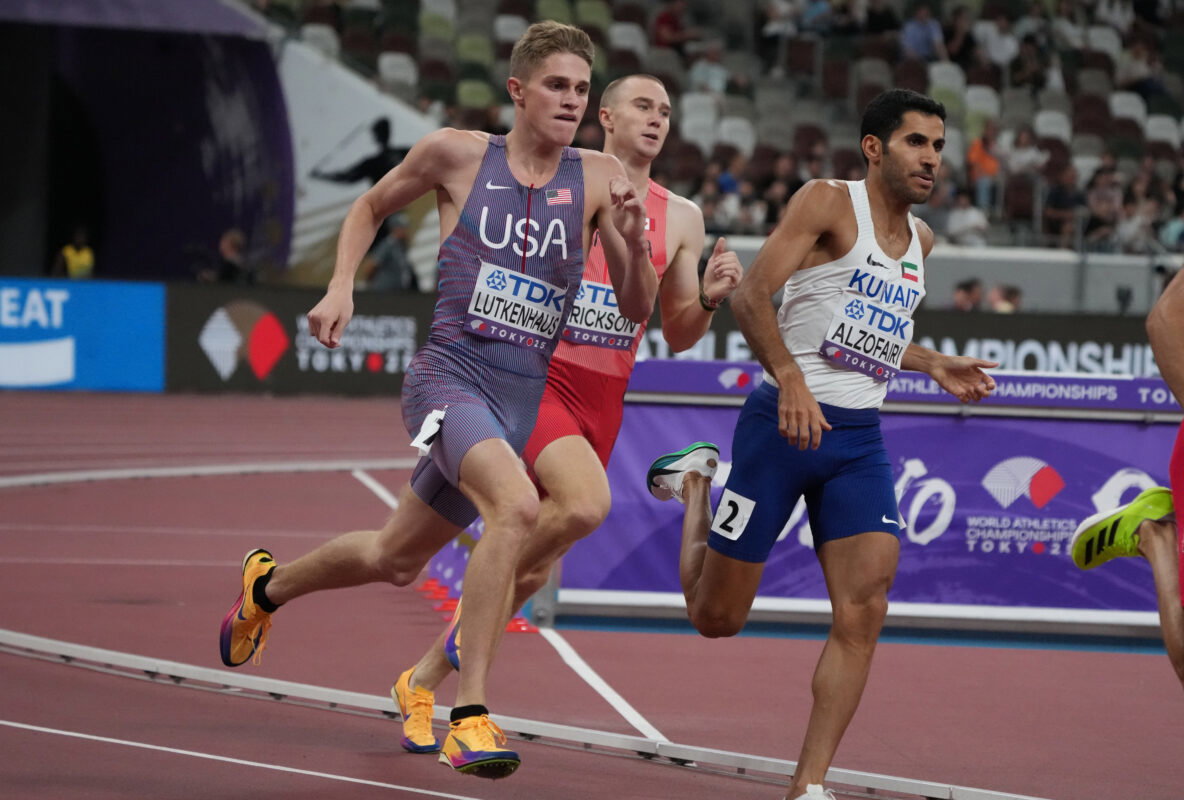
Imago
Sep 16, 2025; Tokyo, Japan; Cooper Lutkenhaus (USA) and Ebrahim Alzofairi (KUW) run in the men’s 800 meters qualifying during the World Athletics Championships at National Stadium. Mandatory Credit: Kirby Lee-Imagn Images
Sprints and distance events saw the biggest reductions against the Paris 2024 benchmarks. The 100m men’s standard was reduced from 10.00 to 9.93, and the women’s from 11.07 to 10.96. The 200m standard is now 19.95 for the men and 22.25 for the women. The 400m is at 44.40 for the men and 49.90 for the women. The hurdlers are no different, with standards at 13.18 for the men’s 110m hurdles, 12.58 for the women’s 100m hurdles, 48.00 for the men’s 400m hurdles and 54.00 for the women’s 400m hurdles.
Middle and long-distance runners are the ones who see the biggest drop-off on the track. The 800m standards are 1:43.00 for the men and 1:57.00 for the women. The 1500m standards are 3:30.00 for the men and 3:57.50 for the women. The 5000m are 12:50.00 for the men and 14:34.00 for the women. The 10,000m are 26:48.00 for the men and 30:30.00 for the women. The 3000m steeplechase standards are 8:07.50 for the men and 9:06.00 for the women.
Field event athletes and multi-events have their own specific qualifying marks. The high jump is 2.32m (M)/1.97m (F), the pole vault is 5.90m (M)/4.80m (F). The long jump is 8.30m (M)/6.90m (F) and the triple jump is 17.35 m (M)/14.50 m (F). The throws are 21.50 m (M)/19.30 m (F) in the shot put, 67.20m (M)/65.00 m (F) in the discus, 78.50m (M)/74.00 m (F) in the hammer, and 85.50m (M)/63.80 m (F) in the javelin. The combined events are 8650 (decathlon)/6550 (heptathlon).
Staggered Qualification Windows and Age Eligibility
Qualification periods vary dramatically depending on the physical demands of the respective disciplines. The marathoners get the earliest start, with their qualification and ranking period opening on November 1st 2026 and closing on 30 April 2028. The 10,000m, the combined events, the race walks and the relays all have 18 months, running from December 19th 2026 to 18th June 2028. All the other individual track and field events have the standard one-year period, starting June 19 2027 and ending 18 June 2028.
Any competition result whose final day falls within the applicable window counts fully towards qualification. With regard to the National Senior Outdoor Championships, World Athletics has provided a specific rule.If a National Senior Outdoor Championships takes place during the relevant qualification period, the results of that championship will count towards Olympic qualification provided they are achieved on or before Thursday June 22 2028. World Athletics will be launching its official “Road to LA” online qualification tracker in the second half of 2027.
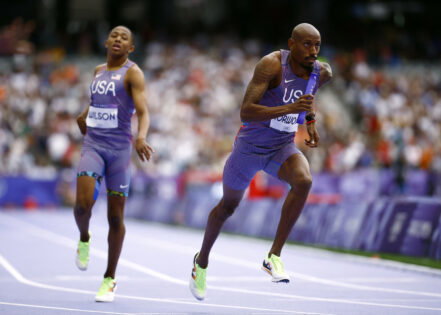
Reuters
Paris 2024 Olympics – Athletics – Men’s 4 x 400m Relay Round 1 – Stade de France, Saint-Denis, France – August 09, 2024. Quincy Wilson of United States Vernon Norwood of United States in action during heat 1. REUTERS/Sarah Meyssonnier
Competitors must also meet strict eligibility and age criteria in addition to the Olympic Charter and World Anti-Doping Code. Senior athletes born in 2008 or earlier (i.e. turning 20 or over in 2028) may enter any event. Under 20s and Under 18s aged 16-19 by 31st December 2028 (born 2009-2012) are eligible for all events except the marathon. Athletes under 16 (born 2013 or later) are not permitted to compete.
Specialized Pathways for Marathons, Relays, and Race Walks
Road events and relays are all governed by qualification structures that are specific to each event and are designed to bring the major international championships to the fore. The marathon is the event with the largest single event quota (70 men, 70 women). Given that Olympic year marathon performances are generally 30 to 60 seconds faster than the long-term statistical projection, World Athletics has set quite demanding entry standards of 2:05:00 for men and 2:22:20 for women.
Any athlete who finishes in the top 5 of the World Athletics Platinum Label marathon during the qualification window will be deemed to have met the entry standard. They will then be placed at the top of the Road to LA monitoring list. On 19th March 2028, all athletes who are in the top 55 on the filtered Road to LA list (with a cap of three per NOC) will be awarded a quota place for their country, thereby taking the quota places out of the pool. The remaining 15 quota places per gender will be filled via the normal dual pathway up to and including April 30, 2028 with no displacement of the early qualifiers. NOCs are also permitted to reallocate a marathon quota to another athlete during the final entries, provided that the replacement has run at least 2:11:00 (men) or 2:29:00 (women) in the qualification window.
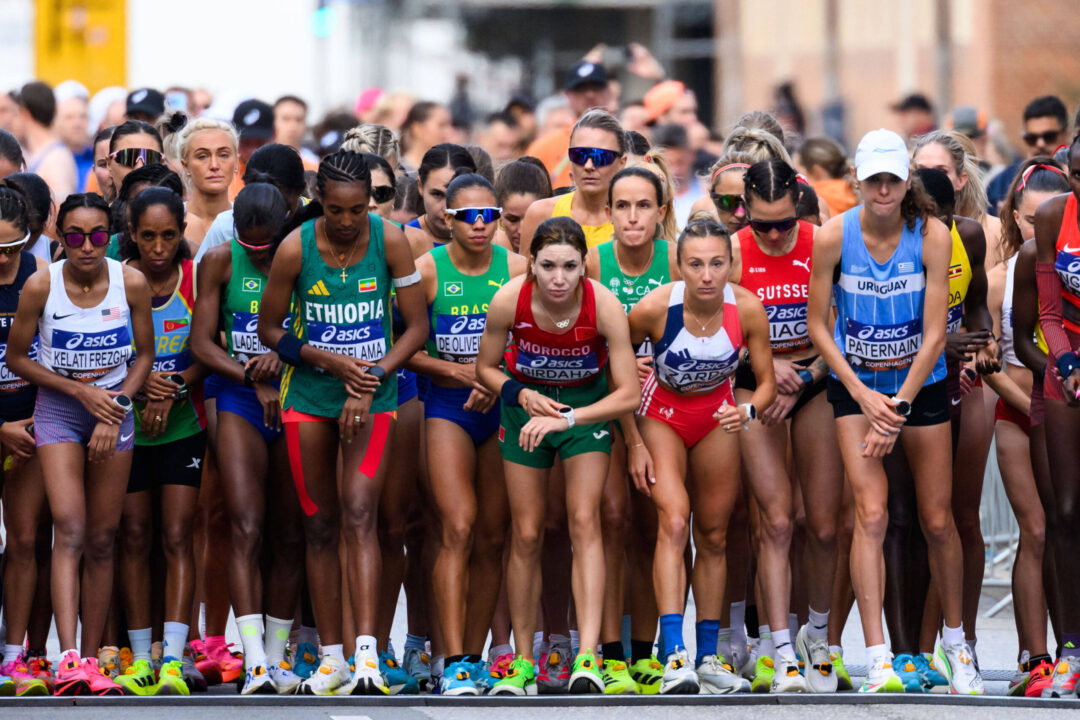
Imago
260920 Carolina Wikström of Sweden during the Copenhagen Half Marathon in the World Athletics Road Running Championships on September 20, 2026 in Copenhagen. Photo: Mathilda Schuler / BILDBYRAN / kod MA / MA1036 friidrott athletics friidrett world athletics road running championships copenhagen half marathon 2026 bbeng half marathon *** September 20, 2026: Carolina Wikström of Sweden during the Copenhagen Half Marathon at the World Athletics Road Running Championships on September 20, 2026 in Copenhagen. Photo by Mathilda Schuler, BILDBYRAN, code MA MA1036. track and field, athletics, friidrett, World Athletics Road Running Championships, Copenhagen Half Marathon 2026, BBENG Half Marathon PUBLICATIONxNOTxINxSWExNORxFINxDEN Copyright: MATHILDAxSCHULER BB260920MA003
Race walking will undergo a major format change at the LA Olympics. The half-marathon race walk will replace the traditional 20km distance, carrying no time-based entry standard. Instead, the top 12 finishers at the World Athletics Race Walking Team Championships in Hefei, China, on April 9, 2028, will earn automatic Olympic qualification. Besides, if any top-12 finisher declines a spot, that berth transfers to the world rankings. This will also determine the remaining 36 quota spots per gender.
In the relay events, 16 teams of four athletes will contest each race after its successful Olympic debut of the 4x100m mixed relay alongside the 4x400m mixed relay and traditional men’s and women’s relays. Fourteen of those 16 spots per event will be decided at the World Athletics Relays in The Bahamas on April 22 and 23, 2028. Teams failing to qualify on day one receive a second opportunity on day two, while the final two berths per discipline will go to the top non-qualified nations on the World Athletics performance list during the qualification period. Once qualified, athletes will compete on an unprecedented Olympic timetable.
Track and field returns to the iconic Los Angeles Memorial Coliseum for a third time, following the 1932 and 1984 Games. Meanwhile, the marathons will begin from Venice Beach Boardwalk. In a historic scheduling shift, in-stadium track and field events will begin the Games immediately after the Opening Ceremony, running from July 15 to 24, 2028.
The women’s 100m kicks off the action on July 15, followed by the men’s 100m final on July 16. It is backed by a refined repechage format offering at least 36 hours of recovery between round one and repechage in the 400m and roughly 24 hours in other eligible track events. Road events will then close out the Olympics, featuring the debut half-marathon race walks on July 27, the women’s marathon on July 29, and the men’s marathon on the final day of LA28, July 30.