
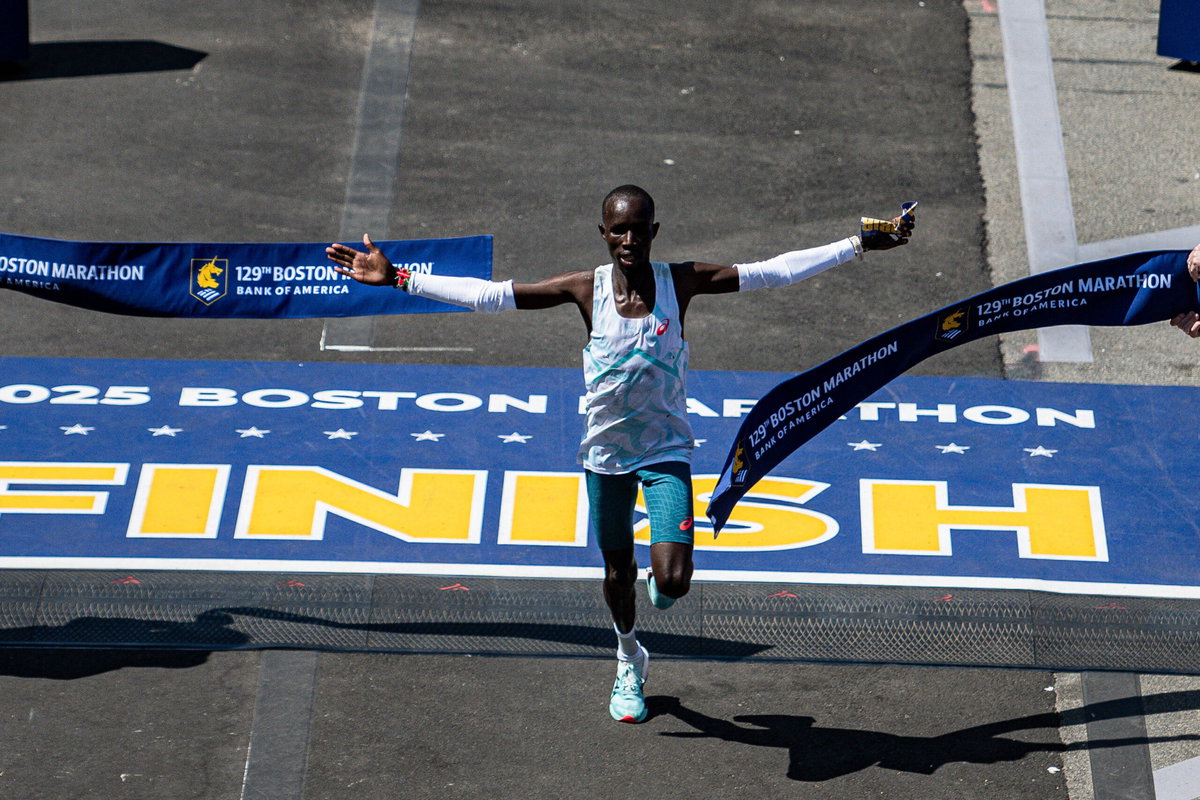
John Korir’s path to Boston Marathon history did not always begin smoothly. Back in the 2025 race, the Kenyan star tripped very early in the race, fell on the road, and his bib number came loose. He briefly lost rhythm and position in the pack, but he got back up, stayed calm, and still fought his way to victory. That comeback made people believe 2026 could be even bigger for him. And it was.
Watch What’s Trending Now!
On April 20, Kenya’s defending champion John Korir won the men’s 2026 Boston Marathon in 2:01:52, finishing 55 seconds ahead of Tanzania’s Alphonce Felix Simbu. With that run, Korir produced the fastest winning time ever recorded in the Boston Marathon.
Interestingly, in doing so he also broke one of the longest standing records in the sport. The previous course record of 2:03:02 set by Geoffrey Mutai in 2011 had lasted 15 years before Korir finally took it down with a performance more than a minute faster. For context the official world record remains Kelvin Kiptum’s 2:00:35 set in Chicago in 2023 but a faster but flatter course.
Behind him, Simbu finished in 2:02:47 and Benson Kipruto in 2:02:50, with both runners also going under the previous record.
“I knew I would defend my title, but I didn’t know I would run that fast,” Korir said after the race even though at the start, he did not take control.
The real change came around the halfway point when an Ethiopian runner, Lemi Berhanu, briefly moved into the lead just before 13 miles. Korir slowly then passed him a few minutes later without wasting energy. Around halfway, Ethiopian runner Lemi Berhanu moved ahead near 13 miles, but Korir closed the gap and passed without forcing a reaction.
But the key moment was in the Newton Hills, which is the hardest section of the Boston course. Another runner, Milkesa Mengesha, tried to break away there and even led for a short time. Korir did not panic. He slowly closed the gap and caught him in the 20th mile. After that, Korir made his winning move. In the 21st mile, which includes Heartbreak Hill, he ran a very fast split of about 4:36. That was the point where he broke away alone.
From there, it was clear. No one could close the gap, and he kept extending his lead, and he finally won. Along with victory, Korir also earned a six-figure payout of $150,000, including a $50,000 bonus for breaking the course record in addition to the winner’s prize. This brings his total earnings to roughly $200,000 or about KSh 25.8 million.
But while one side of the race belonged to Kenya again, another side of the U.S story stretched further back.
American legacy at Boston is still waiting for a win
Historically, Americans have held a deep connection to the Boston Marathon. U.S. runners have won the men’s race 43 times, the highest total for any country. That legacy developed across generations. In the early years, Clarence DeMar dominated the race with seven victories, establishing himself as one of the most successful marathoners in Boston history.
The 1970s and early 1980s marked another defining period for American distance running. Bill Rodgers led that era with four Boston wins and helped elevate marathon running into a major sport in the United States. Around the same time, Alberto Salazar and Greg Meyer also left their mark on the race.
As the international field grew stronger, American victories became less frequent. Meb Keflezighi delivered the last major breakthrough in 2014, winning in 2:08:37. Since then, American runners have not returned to the top step.
That drought has now reached 11 years, and 2026 did not change the trend. The strongest American-linked performances came from within a deep and fast field. Zouhair Talbi finished fifth in 2:03:45, Charles Hicks placed seventh in 2:04:35, and Clayton Young took 11th in 2:05:41.
American depth remains clear, but the finish line story continues to move in a different direction.