
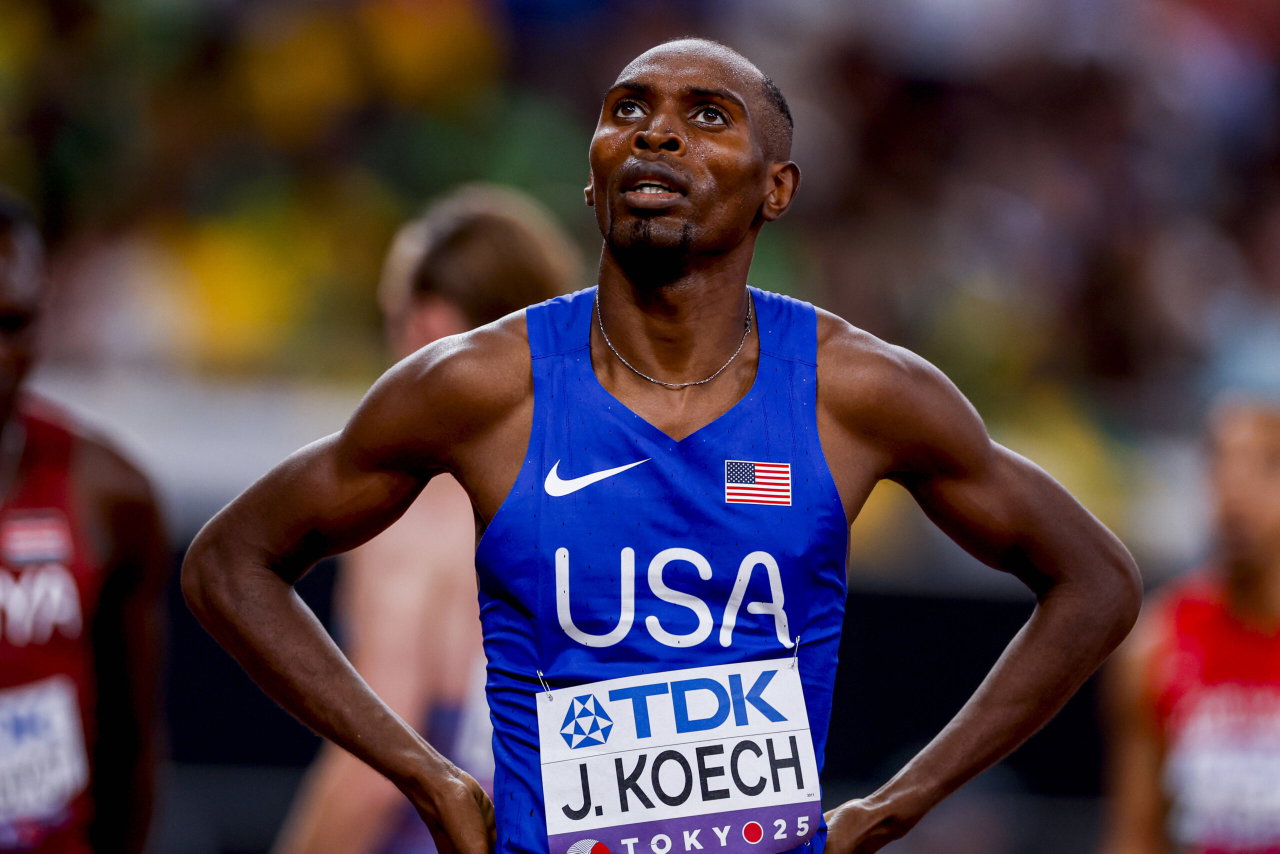
Jonah Koech was not supposed to be the man winning the 1500m at Hayward Field. He was an 800m runner by trade, and he only decided to enter the event at the 2025 USATF Outdoor Championships days before the meet. But by the time he got to the final, there was already a reason to take the experiment seriously.
Watch What’s Trending Now!
Two months earlier in Rabat, Koech had taken more than six seconds off his 1500m personal best, winning the Diamond League race in 3:31.43. In Eugene, he found another gear. He stayed in the fight through the final lap, then held off Ethan Strand by 0.08 seconds to win the national title in 3:30.17, with Olympic champion Cole Hocker third. The victory sent the 800m specialist to the World Championships in the 1500m, an event he had barely planned to run in the first place. Now, that breakthrough has been wiped from the record books, even as Koech has since walked back the admission he made when accepting the ban.
After news of his suspension emerged, Koech discussed the case in Instagram messages with a LetsRun.com reader. “I didn’t take anything…,” Koech wrote. He later repeated his position in an email to LetsRun, writing, “I am clean and I will always be….I will always be if you need all answers, ask USADA to tell you what I use or ask them to give you samples if there is anything in it then tell me.”
His comments conflict with the agreement that led to his reduced suspension.
Under the World Anti-Doping Code, an athlete facing a four-year sanction can receive a one-year reduction by admitting the anti-doping violation and accepting the sanction within 20 days.
That admission is what makes Koech’s reversal difficult to square with the official resolution. USADA says the underlying violation involved a prohibited substance and/or method that resulted in an Adverse Passport Finding after highly atypical blood values in his Athlete Biological Passport were determined to have been caused by blood doping. The agency has not publicly disclosed exactly what Koech admitted beyond the violation covered by his agreement.
“I am 19.5 and they found 19.6 and 18.7…The blood ABP depends on where you are and what you do,” he said. “It goes down when overworking and in high altitude conditions. And it depends on [each individual]. Mine goes up in low altitude while in high altitude [it] goes down which they didn’t want to consider. I explained [this] to them. I gave them all the supplements I was using. I don’t hide anything.”
The timing of those numbers is significant. USADA says Koech gave blood samples on July 30, 2025, the day before his 1500m preliminary heat at the U.S. Championships, and again on August 8, six days after his national-title win. Both sets of values were deemed consistent with blood doping, and an expert panel unanimously reported an Adverse Passport Finding to USADA in February 2026 after additional samples were collected to build out his profile.
That is also why this was not a case of a conventional drug test simply finding a banned substance in one sample. The Athlete Biological Passport follows an athlete’s blood markers over time, allowing experts to identify patterns that can indicate manipulation. USADA says the system is designed to account for natural variation and medical factors while looking for blood profiles that are difficult to explain normally.
Koech also claimed that defending the case properly would have required about $50,000 in legal fees. “They want 50$k to do that. Where is that amount of money?” he wrote. He suggested that he had tried to find better lawyers but could not afford the amount needed to fight the case.
In the messages, Koech went further, saying he felt pressured to accept the sanction. “About accepting it, they threaten me several times,” he wrote. “I gave them all information they wanted and asked them to tell me what I did wrong.” He also said he had provided information about the supplements he was taking and referenced a PRP injection he received. These are Koech’s claims; USADA has not publicly detailed the exchanges behind the agreement.
However, USADA maintains that Koech’s suspension is “in place and final.” The agency also said it continues to investigate the circumstances of the case, while declining to explain exactly what Koech admitted in the agreement. Meanwhile, Koech’s suspension has also affected the official outcome of the 2025 USATF Outdoor Championships.
There is another piece of the timeline that helps explain why the case arrived as such a shock in 2026. Koech did not race at all in 2026 after finishing 13th in the 1500m final at the 2025 World Championships in Tokyo. His absence had become one of the unresolved questions around him before USADA announced the ban.
Koech’s ban changes US 1500m results
At the 2025 USATF Outdoor Championships, Jonah Koech won the national title in 3:30.17. Ethan Strand finished second while Cole Hocker took third in 3:30.37, and Hobbs Kessler finished fourth in 3:31.12.
But a year later, Koech’s three-year USADA suspension has now changed the outcome of that race. His results from July 30, 2025, onward have been disqualified, meaning his 1500m title has been vacated, and Strand is set to be recognized as the 2025 US champion.
The disqualification goes beyond that one race. Koech’s 13th-place finish in the 1500m final at the 2025 World Championships in Tokyo has also been erased, along with every competitive result he recorded on or after July 30, 2025. USADA says that includes medals, points and prize money.
The date is not arbitrary. July 30 was the day Koech gave the first abnormal blood sample, one day before his U.S. Championships preliminary heat. His three-year period of ineligibility, meanwhile, began on July 17, 2026, when his provisional suspension was imposed, and is set to run through July 17, 2029.
“It’s great for the rest of the US to have a real champion,” Strand said. USATF has begun updating the results and said Strand will receive the difference in prize money between second and first place. The federation is also attempting to recover the $8,800 originally awarded to Koech.
For Strand, the correction also has a financial consequence beyond the extra $2,200 in championship prize money. He had signed a professional contract with Nike shortly before the U.S. Championships, and such contracts can include bonuses for national titles. Strand said he expected Nike to correct that as well, though that decision rests with the company.
The change also affects Kessler, who finished fourth on the night and missed the World Championships team. Although he now moves up to third in the revised results, Kessler said the original result had already affected his confidence and momentum through the rest of 2025 and into 2026.
“I’m pretty disappointed because it sucks getting 4th,” Kessler said. “It kind of crushed my momentum, and it really stung. Finding out someone used shortcuts to beat me kind of blows. But it’s over now. It’s not the biggest deal in the world, it sucks, but at the end of the day, my family is healthy and stuff.”
The timing made Kessler’s fourth-place finish especially painful. His 3:31.12 was actually faster than the 3:31.53 he ran to make the U.S. team in 2024, yet this time it left him outside the top three. He later said the disappointment carried into his training and racing, including the start of the 2026 season.
Kessler also said missing the team likely cost him financially through lost prize money, bonuses, and other opportunities. As he put it, missing the World Championships had a “downstream effect” on both money and status within the sport.
Yet while the official results are now being changed, the full details of what Koech admitted to USADA remain undisclosed. For now, the sanction is final, but Koech’s version of what happened is not going away with it.