
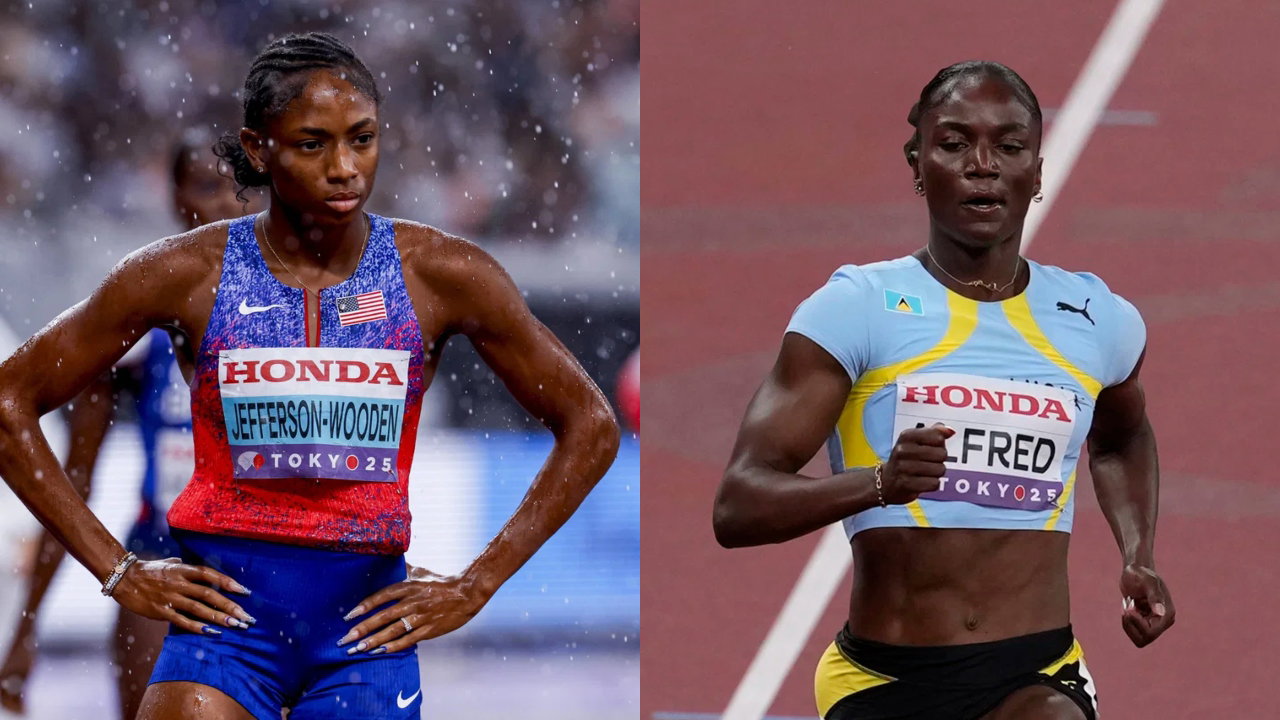
The last time Melissa Jefferson-Wooden tasted defeat in the 100m was at the Paris Olympics in 2024, when she finished third in 10.92 seconds behind Julien Alfred and Sha’Carri Richardson. Since then, the American sprint star had remained unbeaten in the event for more than two years, adding a world title in 2025 and a string of impressive victories in 2026. However, that streak finally came to an end in Zurich, where Alfred edged Jefferson-Wooden by just 0.005 seconds.
Watch What’s Trending Now!
The August 27 showdown lived up to the hype, with the two stars producing another thrilling battle. Julien Alfred crossed the line first in a new lifetime best of 10.70 seconds, while Jefferson-Wooden was also given 10.70 after finishing just 0.005 seconds behind the Olympic champion. The photo finish was needed to separate the pair.
Sha’Carri Richardson took third in 10.97, just ahead of Jamaica’s Tina Clayton, who clocked 10.98. European champion Amy Hunt finished fifth in 11.04. Alfred’s winning time was more than enough to make the night special. The St. Lucian lowered her personal best to 10.70 seconds, setting a new national record in the process, and beating her own 10.72 from Paris 2024.
Speaking after the race, Alfred admitted, “Running this fast is never easy, especially because getting out the blocks is always a challenge for me – I could be sleeping in that box all year.” Despite that weakness, Alfred said she trusted her ability to deliver when it mattered. She also opened up about the pressure that comes with being an Olympic champion. “I mean, going up the mountain, you are still hungry, you want more. It is not much fun when you’re not the one being hunted.”
Alfred explained that winning Olympic gold changed her mentally and emotionally. With expectations now higher than ever, she relied heavily on the people closest to her, including her coach, agent, and family. The new national record was also more than a personal achievement for Alfred. “We have a long way to go in Saint Lucia, but we are getting there. A national record puts Saint Lucia on the map.”
The Zurich victory also allowed Alfred to immediately answer Jefferson-Wooden’s win at the Silesia Diamond League only days earlier. The American had clocked 10.78 seconds to beat Alfred, who finished second in 10.83. For Jefferson-Wooden, the defeat ended an extraordinary unbeaten run in the 100m. Yet the world champion had little reason to be disappointed with her performance.
“I am always happy to see the season’s best. I do not like losing, but you know, it is the name of the game,” Jefferson-Wooden said. The American also praised the quality of her rivalry with Alfred, acknowledging that whenever they step onto the track together, fans can expect a close contest.
Rather than dwelling on the defeat, Jefferson-Wooden is already looking ahead to their next meeting. As she says, “We are still in a really good spot to do some really amazing things. In the end, you cannot be bad with a season’s best at all.” Interestingly, the battle between Alfred and Jefferson-Wooden goes back to the biggest stage in athletics.
How did Alfred and Jefferson-Wooden become rivals?
Alfred and Jefferson-Wooden rivalry has developed through Olympic and world championship showdowns, closely fought Diamond League races, and a series of results that have repeatedly shifted the balance between the two stars.
Their first big showdown was on August 3, 2024, during the Paris Olympic 100m final. Alfred’s historic performance was a 10.72 to win Saint Lucia’s first-ever Olympic gold medal in athletics. Sha’Carri Richardson was second with a time of 10.87, while Jefferson-Wooden finished third with 10.92.
The balance began to shift in 2025 when Jefferson-Wooden got the better of Alfred at the Prefontaine Classic. The American won the 100m in 10.75 seconds despite a headwind, while Alfred finished second in 10.77. The rivalry then reached another level at the 2025 World Championships in Tokyo. Jefferson-Wooden stormed to the world title in a championship-record 10.61 seconds, while Tina Clayton claimed silver in 10.76 and Alfred finished third in 10.84.
It was a major change in the pecking order. Alfred had arrived in Paris as the Olympic champion, but Jefferson-Wooden left Tokyo as the world champion and one of the most dominant 100m sprinters in the world.