
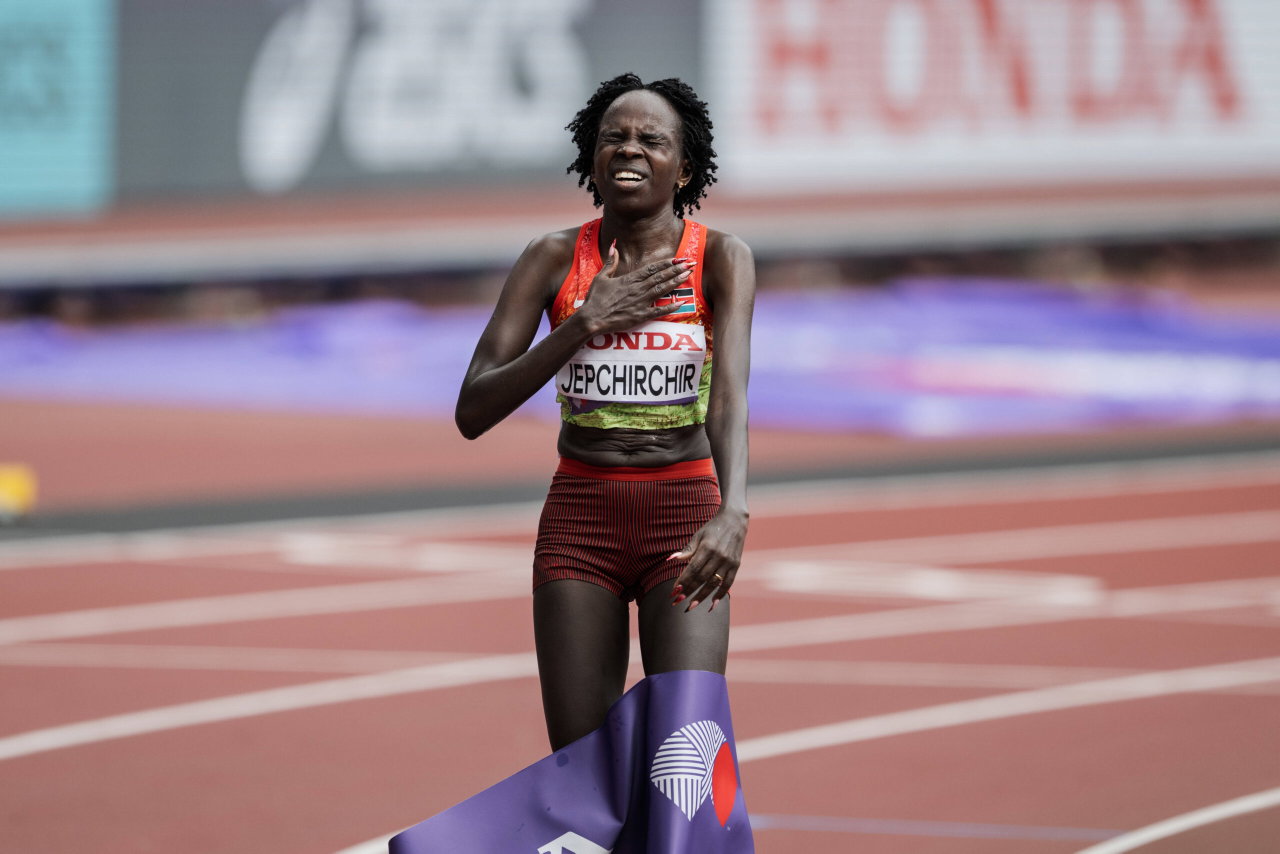
When Olympic champion Peres Jepchirchir was provisionally suspended in October over an alleged EPO violation, the news did not go down well with many athletes. After all, Kenya has already faced several high-profile doping cases involving its top runners. Benson Kipruto, the defending New York City Marathon champion, called the situation “so shameful.” Although Jepchirchir denied using EPO at the time, the case has now taken a different turn. The Athletics Integrity Unit has handed the 33-year-old a three-year ban after she admitted to the anti-doping violations.
Watch What’s Trending Now!
The AIU announced on November 19 that Jepchirchir had violated two anti-doping rules. The first, Rule 2.1, concerns the presence of a prohibited substance or its metabolites or markers in an athlete’s sample, while Rule 2.2 covers the use or attempted use of a prohibited substance or method.
Her case began after an out-of-competition sample collected in Kenya before her Sydney Marathon victory in August returned an adverse analytical finding for EPO on September 17, 2026. Following the test result, Jepchirchir was provisionally suspended on October 20. During an interview with the AIU that day, she denied using EPO and said she did not know how the adverse finding had occurred. However, her position later changed.
She signed an admission of anti-doping rule violations and acceptance of consequences form, admitting the violations and agreeing to the sanctions. Her three-year ban is backdated to October 20, the day her provisional suspension began.
The news had also drawn strong reactions from other athletes when her provisional suspension was announced. Kipruto warned that a high-profile doping case could affect the reputation of clean Kenyan runners around the world. “Somebody like that, high-profile name, can ruin the name of athletes not only in Kenya but all over the world because we are here now, running, and maybe people will say ‘No, these people are not clean’,” he said.
Fellow Kenyan marathon star Hellen Obiri also spoke about the possible impact on the country’s reputation. While making clear that the B-sample process should be respected, she said: “If (it is) true, that would be shocking news and it would be so bad for the Kenyans.”
American Olympic silver medallist Kara Goucher also expressed disappointment, particularly for the runners who finished behind Jepchirchir at the Sydney Marathon. “I am, however, sad for all the athletes who finished behind her and were screwed out of a podium,” she said.
The punishment also strips Jepchirchir of her Sydney Marathon victory. She agreed to the disqualification of all her competitive results from July 17, 2026, including her first-place finish in Sydney. She had crossed the finish line in 2:18:31, more than three minutes ahead of compatriot Irine Cheptai. With Jepchirchir’s result now disqualified, Cheptai has been elevated to the women’s race winner. For Jepchirchir, the decision means losing a major victory from a season that had initially added another achievement to her already decorated career.
Interestingly, Jepchirchir is also not the only Kenyan runner to receive a lengthy suspension in the latest AIU announcement.
Kenyan doping crisis deepens as two more athletes receive lengthy bans
Veronica Loleo, who won silver in the half-marathon at the 2026 World Road Running Championships, was handed a three-year ban after admitting to EPO violations. Her case involved blood and urine samples collected out of competition in Kenya on September 6, 2026, which returned adverse analytical findings.
Marathon runner Ronald Korir received an even longer suspension, with the AIU handing him a six-year ban. Unlike Jepchirchir and Loleo, his case did not involve a positive EPO finding. Instead, abnormalities were identified in his Athlete Biological Passport after 20 blood samples collected between May 2023 and August 2025 were analyzed. An expert panel concluded that the changes in his blood values were likely linked to the use of a prohibited substance or method.
Korir failed to provide written explanations when requested by the AIU and later did not respond to the formal charge against him. He was consequently considered to have admitted the violation and waived his right to a hearing. His results dating back to January 19, 2024, have also been disqualified.
The latest cases have once again brought Kenya’s wider doping problem into focus. In November 2022, the country’s government openly acknowledged a doping ‘crisis’ and urged World Athletics president Sebastian Coe not to suspend Kenya from international athletics. At the time, an Associated Press report by Gerald Imray revealed that at least 45 Kenyan athletes had been sanctioned during that year, while another 20 doping cases were under investigation.
The government promised to strengthen the Anti-Doping Agency of Kenya and take action against criminal networks allegedly making money by supplying banned performance-enhancing substances to runners. Despite those efforts, the country continues to see high-profile athletes face anti-doping sanctions.
AIU chief executive Brett Clothier acknowledged on November 19 that “The Kenyan authorities have made a lot of progress in the fight against doping in the last five years, but these cases highlight that there is still a long way to go,” he said.
Clothier also confirmed that the Kenyan government had committed to further strengthening its anti-doping agency and tackling the criminal networks facilitating doping. With Jepchirchir now joining the list of major Kenyan names handed lengthy suspensions, the country’s fight to restore confidence in its distance-running programme faces another difficulty.