
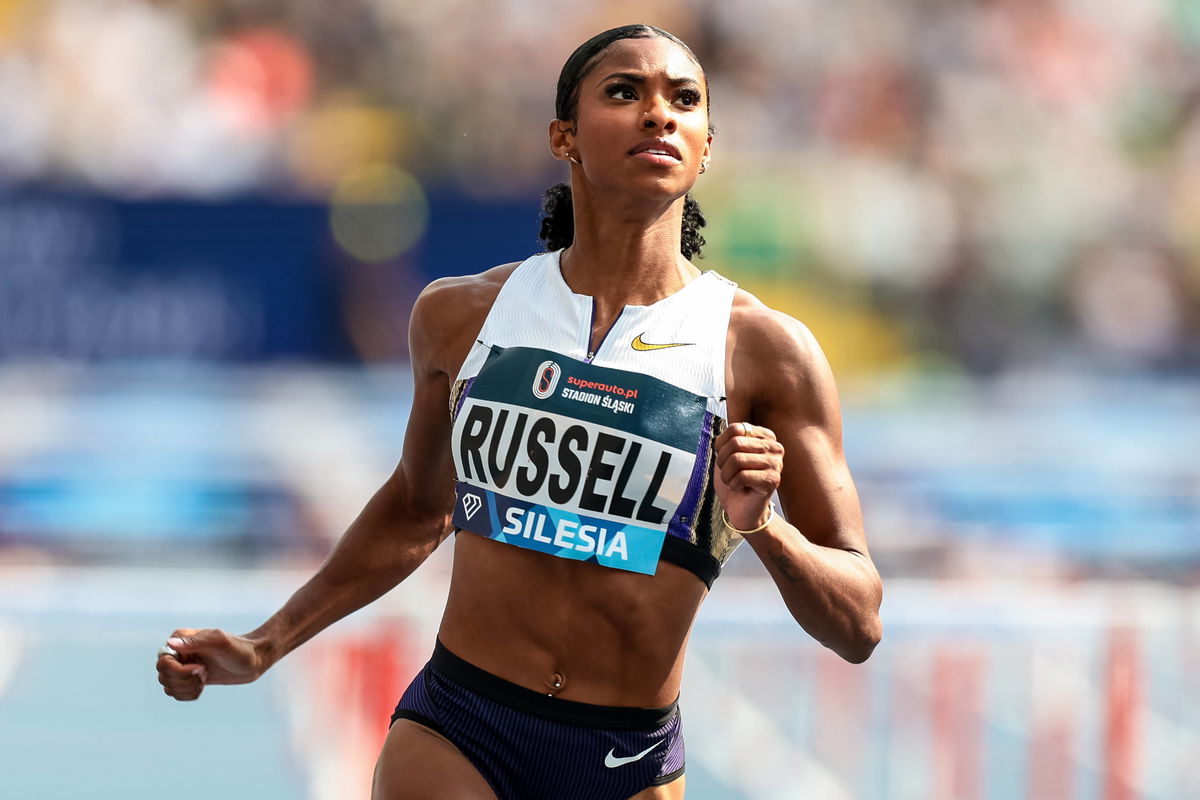
Masai Russell and Ja’Kobe Tharp had little reason to believe they would one day become world-record holders in the hurdles. Yet at the inaugural World Athletics Ultimate Championship in Budapest, Russell won the women’s 100m hurdles in 12.22 seconds, while Tharp took the men’s 110m hurdles in 12.94s. But their paths to the event began very differently. Russell came from gymnastics, while Tharp had basketball in mind. Years later, after taking very different paths into track and field, the two recently came together to reveal how they first found the hurdles.
Watch What’s Trending Now!
On September 16, USA Track and Field shared a video featuring Russell and Tharp, giving fans a look at the lighter side of their journeys. Russell opened the conversation with a simple question from the questionnaire: “What gravitated you to the hurdles?”
For Tharp, the answer was almost as unexpected as his rise in the event. He had not planned on becoming a hurdler. Basketball was his first love, with both of his parents having played the sport. But after he was cut from his middle-school basketball team in seventh grade, he turned to track. Then his coach saw something in him.
“My middle school coach said, ‘You look like you could be a hurdler, so you’re doing this,’” Tharp recalled. It was hardly a smooth beginning. Tharp was initially afraid of falling over the barriers and wanted to run the 100m or 200m instead. At the time, Tharp was still learning the basics of the event. “And I couldn’t three-step in practice. I only do it in the race. So he just threw me into it,” Tharp added. But only one year after starting hurdles, he won a Tennessee middle-school state title.
Russell’s route was different, but hurdles also found her rather than being part of some carefully planned path. She had been involved in gymnastics and ballet as a child before getting into track and initially viewing herself as a 400m runner. Her interest in hurdles first grew through the 400m hurdles. The idea of jumping over barriers made the event seem more enjoyable to her.
But the 100m hurdles brought out something else in Russell: her competitive side. “And then when I see my friends doing the 100 hurdles, I was like, ‘Wait, I feel like I can beat y’all,’” Russell said. “Like just being competitive.” That was enough to pull her toward the event. “So then, yeah, it just looked fun. It looked better than just running, you know,” she added. Neither athlete could have known where those early decisions would lead.
Two hurdle stars rewrite the record books
Back in 2024, Masai Russell made history by capturing the Olympic Gold in the women’s 100m hurdles. However, her greatest success was in 2026. On August 27, Russell clocked 12.09 seconds and in doing so, she broke Tobi Amusan’s 100m hurdles world record of 12.12 set in 2022. The performance also made Russell the fastest woman ever to run the event.
The world record did not come out of nowhere. Earlier in the season, Russell had run 12.14 seconds at the Xiamen Diamond League, setting an American record and moving to second on the all-time list at the time. She then carried that form into the rest of the season, winning the Diamond League Final before adding another win at the inaugural World Athletics Ultimate Championship in Budapest for the women’s 100m hurdles, in which she ran 12.22 seconds to win the race.
Tharp’s achievements have been equally impressive. The young American won the 2024 World U20, NCAA 2025, and U.S. champion. He set the NCAA 60m hurdles record with 7.32 seconds before delivering his career-best performance.
Then, Tharp set her new 110m hurdles world record of 12.75 at the NCAA Outdoor Championships in Eugene on June 10, breaking Aries Merritt’s 12.80 world record that had stood since 2012. The run made Tharp the world-record holder and marked one of the biggest breakthroughs of his young career.
He then carried that momentum into Budapest, where he won the men’s 110m hurdles at the Ultimate Championship in 12.94 seconds. From two very different beginnings, Russell and Tharp eventually arrived at the same destination.