
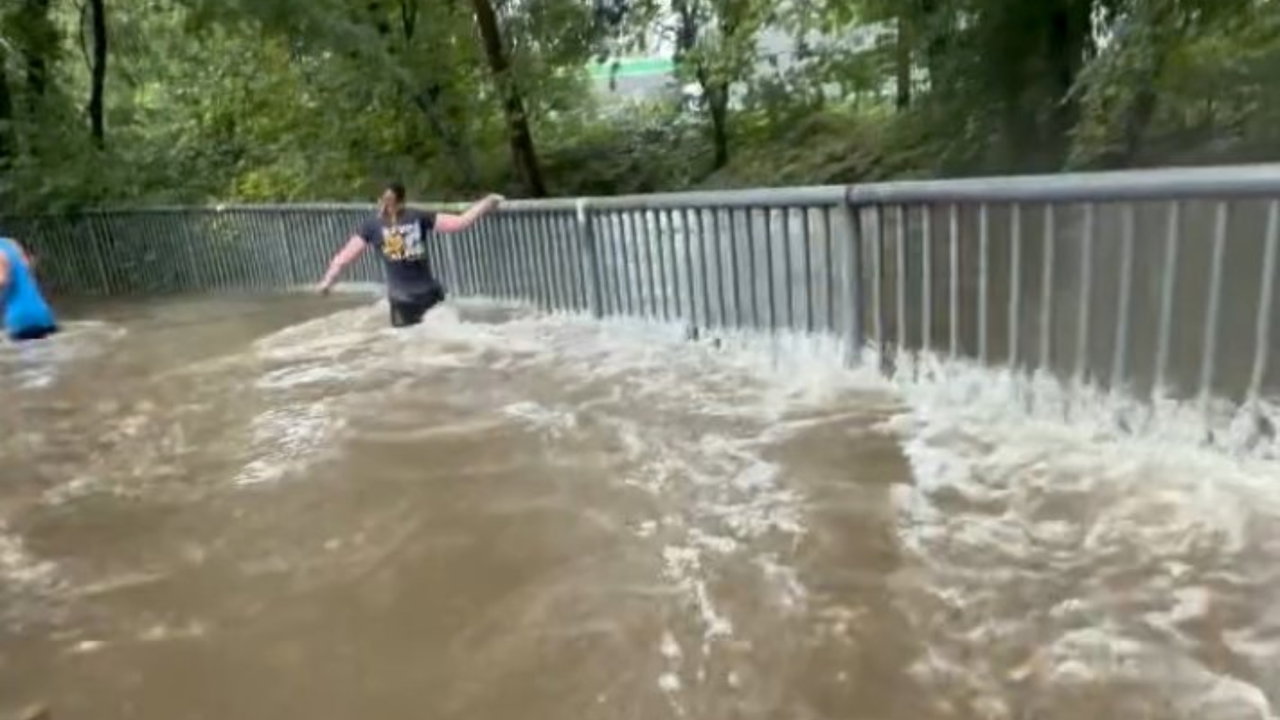
Around 250 runners finished the Racefaster Half Marathon in Paramus on September 13, but the 13.1-mile race quickly turned into a frightening test as heavy rain sent floodwater rushing across the course. Runners found themselves wading through water that reached their waists and, in some sections, their chests. Among them were Matthew Vickers and his cousin, who encountered a 71-year-old woman struggling against the current and stopped to help carry her to safety. With severe weather warnings already in place, the conditions have since raised serious questions about how the race was allowed to continue.
Watch What’s Trending Now!
That question is now at the center of a Bergen County investigation. Officials said Racefaster had been advised by the county Parks Department and public safety personnel to use an alternate route that would keep runners away from the areas most vulnerable to flooding.
But now, officials are also looking at whether Racefaster followed the conditions of its permit and whether runners entered restricted parts of the park. The investigation comes after videos from the race showed participants struggling through deep water, with some holding onto railings as they tried to make their way through the flooded sections.
However, the warning signs were already there before the race began. The National Weather Service had issued a Flood Watch for Bergen County on September 12, covering the early hours of Sunday through noon. By race morning, a Flash Flood Warning was already in effect for the area, as heavy rain continued to push water levels higher. The race had originally been scheduled for 8 a.m. Instead, Racefaster pushed the start back two hours to 10 a.m.
The delay did not turn into a cancellation. By then, around four inches of rain had fallen on the Saddle River Parkway trails, according to meteorologist Matt Brickman, leaving pools of water across parts of the route.
Garrett Nathan was one of the runners who noticed the worsening conditions before the race even started. “I keep checking my email from the race directors and get no notifications about a cancelling,” Nathan told NBC New York. When the 10 a.m. start finally arrived, the race was on. Nathan said the course was already muddy and flooded, and once the clock started, there was no longer any question about whether runners were actually being sent out.
As runners moved farther along the course, the conditions became harder to ignore. Outside Run’s reporting says runners encountered water above their ankles around mile 1, severe flooding around mile 4, water above their knees around mile 7, and chest-high water around mile 9. For some, continuing was no longer worth the risk.
While runners were dealing with the worsening conditions, questions were also growing around the alternate route. Bergen County officials said organizers had been told to avoid the most dangerous flood-prone sections and use a different route. But not every runner understood that a route change had been made. Some participants told News 12 they had no idea an alternative had been arranged and could not understand why the race was continuing despite the weather.
The county’s investigation now goes beyond the question of whether the race should have been cancelled. Bergen County officials said they are reviewing “all of the circumstances” surrounding the privately organized event. They are looking at whether Racefaster complied with the conditions of its permit and whether runners entered restricted areas.
Racefaster has already faced consequences. The organizer has been placed on probation with the Bergen County Parks Department’s permitting office and will not be allowed to organize races in the Bergen County Parks System for at least one year. For now, Racefaster has not responded to requests for comment.
Despite around 250 runners eventually finishing the race, not everyone made it to the end. Some turned around, while those who continued were left trying to work out how to get through the course without being swept off their feet.
Runners recall a terrifying journey through rising floodwaters
For Marijana Dinic, one of the most frightening moments came when the water rose to around her waist and chest. “The flood was up to here. I was grabbing this woman next to me, and she grabbed me and was holding me.” At first, Dinic thought the worst of the water would be over quickly. Instead, another flooded section appeared ahead. “I thought maybe 50 meters and it will be over.”
But the conditions only became more difficult, with the current strong enough that she had to grab a railing beneath a tunnel to keep herself from being pushed away. Looking back on the experience, Dinic questioned, “It should have been cancelled. It was not organized properly, I feel.” She was at least able to walk away without injury, “Luckily, I’m not hurt. I don’t think anyone else was hurt. So that’s a good thing.”
Zac Clark, known from The Bachelorette, also captured the conditions as he made his way through the course. In one video showing runners confronting rushing water and using a railing for support, his reaction was simple: “Bro, this is nuts!” Despite the conditions, Clark completed the 13.1-mile race in 1:40:42, finishing third in his age group. He later summed up the unusual run by saying that “many rivers were crossed.”
For now, the race may be over, but the questions surrounding it are not. With Bergen County still investigating how the event unfolded, the flooded course has left runners, organizers, and officials with plenty to answer for.