
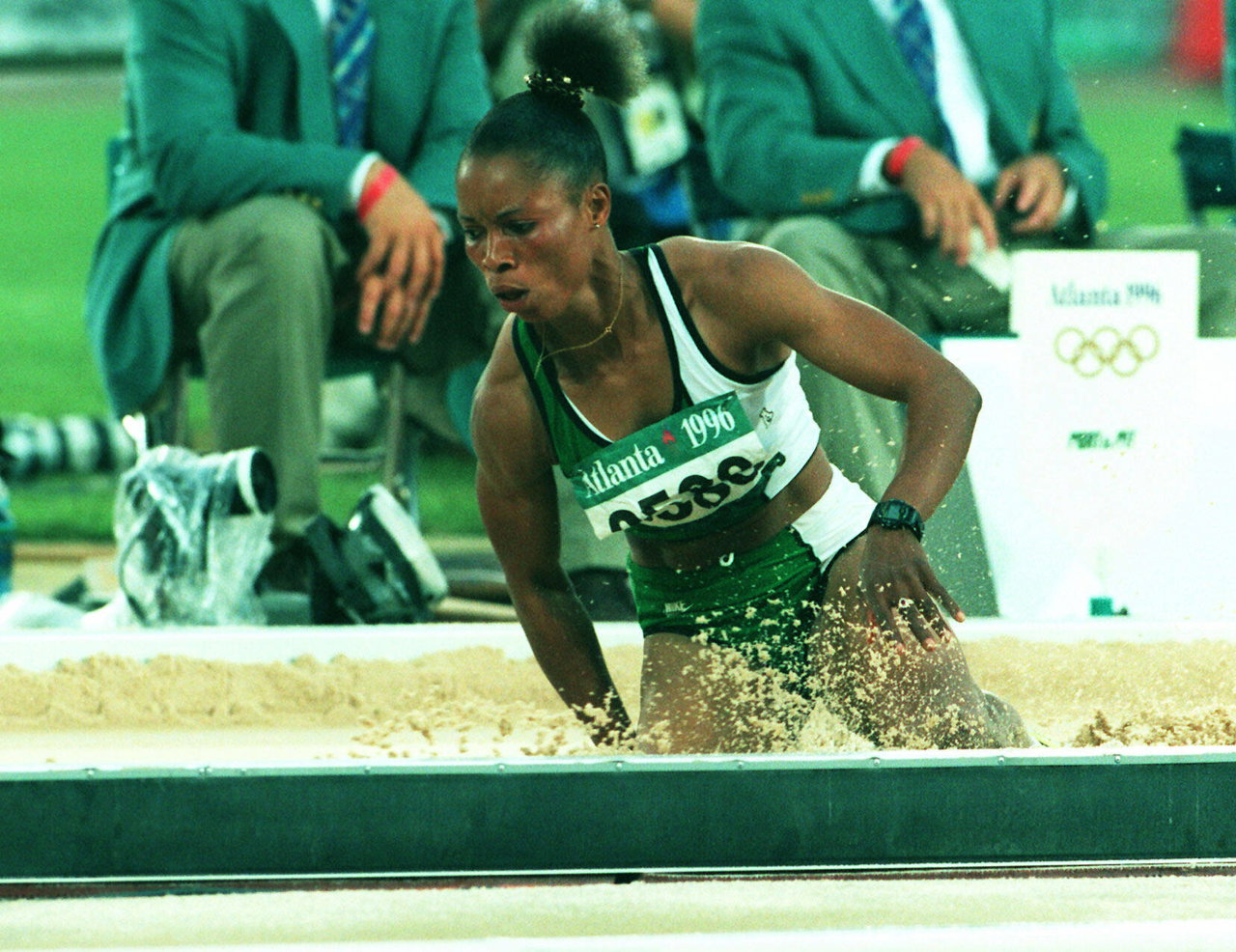
23 years is a long time to remain away from the sport you once made history in. For Nigeria’s Olympic champion Chioma Ajunwa, that is how long her lifetime doping suspension lasted before World Athletics finally lifted it on November 18, 2026. The former long jumper, who won Nigeria’s first individual Olympic gold medal at the 1996 Atlanta Games, is now free to participate in athletics again. But while the decision marks a new chapter for Ajunwa, it has also given Nigeria’s athletics chief a reason to remind young competitors about the consequences of doping.
Watch What’s Trending Now!
On November 24, 2026, AFN President Chief Tonobok Okowa welcomed the decision in comments reported by LEADERSHIP Sports. “We are happy about it, and we hope she will use her experience to guide our younger athletes. She can always advise them. When we are organizing seminars, she can come and speak to them about her experience and explain that it is not a good path to follow,” he said.
His warning comes at a time when Nigeria is still facing concerns over anti-doping violations. Okowa disclosed that the country had around 11 reported cases and ranked approximately 10th globally in the relevant anti-doping classification. He said the AFN wants to improve Nigeria’s standing and move the country out of Category A.
“All we have to do is try to get out of Category A, and the only way we can achieve that is for our athletes to compete cleanly, without using any prohibited substances,” Okowa added. He also wants athletes who have already faced suspensions to speak openly about their experiences. According to Okowa, their advice could help current competitors avoid the same mistakes and protect their careers.
“Not all athletes are naive. I don’t believe ignorance is an excuse. When you are wrong, you are wrong. When you are fair, you are in for it,” he stated. Nigeria’s anti-doping situation is one reason the AFN wants to step up its education efforts. The federation plans to organise seminars and awareness programmes to help athletes understand the rules and avoid prohibited substances.
Ajunwa’s own case shows how long a doping violation can affect an athlete. Her first violation came in 1992, when she tested positive for methandienone on June 11. She received a four-year suspension. A decade later, another sample collected at the Athens Grand Prix Tsiklitiria on June 10, 2002, returned an adverse analytical finding for nandrolone.
The second violation led to a lifetime ban. The International Association of Athletics Federations, now known as World Athletics, recorded the sanction in February 2003. The punishment ended Ajunwa’s competitive athletics career, leaving her away from the sport for more than two decades. In 2026, Ajunwa sought a review of the punishment. A request was submitted to the Athletics Integrity Unit on August 28, asking for her case to be considered under revised anti-doping regulations that came into effect on January 1, 2026.
Under the updated rules, the applicable sanction for her second violation was calculated at eight years rather than a lifetime ban. Since she had already spent more than 23 years suspended, the AIU reduced the sanction to the period she had served. The AIU’s decision on November 18 restored her eligibility to participate in athletics activities. However, the original violation remains on her record. The decision reduced her punishment but did not erase the case. But getting to this point was not easy for Ajunwa.
Chioma Ajunwa opens up about struggle to challenge 23-year doping ban
When the Athletics Integrity Unit reduced Ajunwa’s lifetime suspension to the period she had already served on November 18, 2026, the former Nigerian long jumper welcomed the decision with happiness and gratitude. “I’m happy now. What can I do? I am happy. I thank God,” she said. She further expressed her gratitude and said she was not angry with those involved in the case. “Whoever that I have got, no matter what you think you are doing, I thank God for everything. I’m not angry with anybody,” she added.
However, while Ajunwa was relieved by the outcome, she also spoke about the difficulties she faced when trying to challenge the original punishment. She alleged that former Athletics Federation of Nigeria officials failed to support her efforts to seek another hearing, even after fellow athlete Rosa Collins travelled to Monaco to pursue the matter.
According to Ajunwa, Collins was directed to take the case through the AFN. But when she returned to Nigeria and approached the federation officials, they were unwilling to help. “She came back and went to the AFN officials but they were not ready to listen to her and that is how I was meted an undeserved punishment, which brought my career to an abrupt end,” Ajunwa said.
Despite the years she spent away from the sport, Ajunwa is now free to participate in athletics activities again. Reflecting on what the decision means to her, she said: “I give thanks to God that the stain has been removed from my athletics career. I am now free to participate in all activities.” Ajunwa made history at the 1996 Atlanta Olympics, winning the women’s long jump with a leap of 7.12 metres. She became the first Nigerian to win an individual Olympic gold medal and the first African woman to claim Olympic gold in a field event. She had also represented Nigeria in football at the 1991 FIFA Women’s World Cup.
Now that her suspension has been lifted, Okowa hopes Ajunwa’s experience will help prevent other athletes from facing a similar fate.