
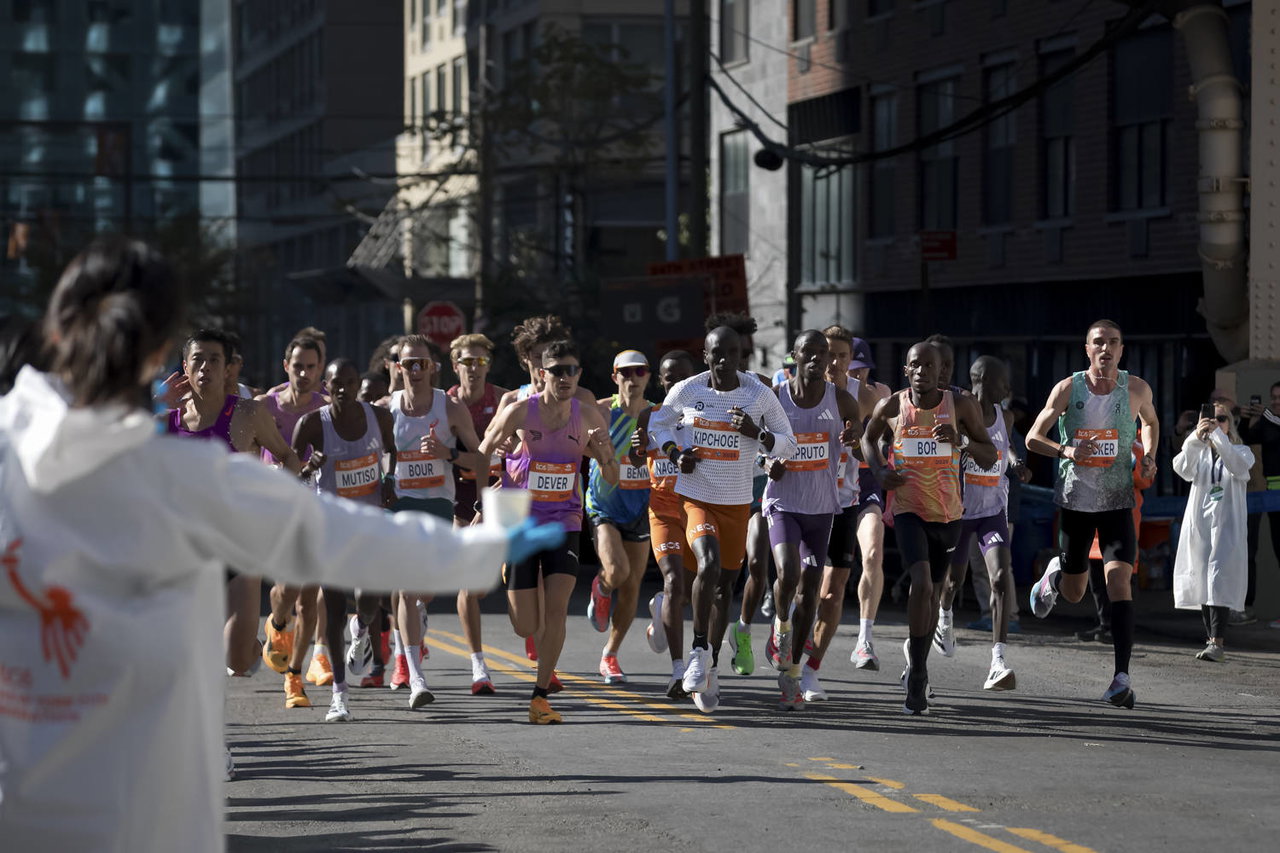
Three days before the 2026 New York City Marathon, on October 29, British runner Patrick Dever finally received the third-place trophy he had missed out on a year earlier. The presentation took place during a pre-race media event in Central Park. Dever had originally finished fourth in the 2025 race, just one second behind Kenya’s Albert Korir. But in March 2026, Korir was handed a five-year ban after testing positive for CERA. His results from October 3, 2025, onward were disqualified, including his third-place finish in New York, which moved Dever up to the podium. However, getting an official third-place finish months later is not enough to make up for everything he missed on race day, as On Athletics Club head coach Dathan Ritzenhein shares the bitter reality behind this belated victory.
Watch What’s Trending Now!
Speaking to Front Office Sports ahead of Sunday’s race, retired American Olympic marathoner Dathan Ritzenhein explained why a delayed result correction cannot replace the attention an athlete receives on race day. “Your marketability from that moment is so much lower,” Ritzenhein said.
He further added, “You might be considered the champion later, but no one remembers. There’s no pictures of you standing on top of the podium, and that’s the stuff that sells. … When you can’t utilize that, it doesn’t have the same impact for an athlete.”
Dever did receive financial compensation after the results were changed. Third place at the New York City Marathon comes with $40,000 in prize money, compared with $25,000 for fourth. With Korir’s prize money forfeited, Dever received an additional $15,000. He also received a retroactive third-place bonus from his sponsor, Puma, although he did not disclose the amount. Still, the extra money could not replace the experience of celebrating a podium finish on race day.
However, Dever acknowledged that he was glad the anti-doping system was catching athletes who cheated, but he also explained that no runner wants to be promoted to the podium this way. “Some people could go their whole career and you might never know if someone’s cheated who’s finished ahead of you, so I suppose in that sense, I’m glad that the system is working and people are getting caught,” Dever told Front Office Sports in New York. “But yeah, you never want to be the one in that position, obviously. You want to have that moment on the day, but I guess this is the next best thing.”
Looking back at the 2025 race, Dever had finished just one second behind Korir. Benson Kipruto won the men’s race in 2:08:09, with Alexander Mutiso taking second in 2:08:09.03. Korir finished third in 2:08:57, while Dever crossed the line fourth in 2:08:58. At the time, Dever had no idea that he would later be awarded third place. After the race, he reflected on the closing stages and admitted that he could have tried to make a move before the final sprint.
“I know it’s easy to say, but I think I could have tried harder to, I don’t know, do something a little bit before the sprint,” he said. The later decision changed his official result, but it could not give him the experience of celebrating that achievement in front of the cameras on race day. Dever, however, will have another chance to make his mark in New York.
New York Road Runners has included him in the men’s professional elite field for the 2026 race, scheduled for November 1. The British runner enters with a personal best of 2:06:18. This time, he will be hoping to earn his place on the podium on race day and experience the moment for himself.
But the effects of doping cases are not limited to athletes who lose out on podium places. While runners like Dever may eventually get their results corrected, a positive test can also put years of success and an athlete’s entire reputation under question. This is another concern raised by Dathan Ritzenhein, who also spoke about how one doping test could overshadow an entire career of a Kenyan marathon star.
Peres Jepchirchir’s long list of wins faces new questions after positive test
Peres Jepchirchir spent years building a reputation as one of the world’s best marathon runners. She won the women’s marathon at the 2020 Tokyo Olympics, claimed the New York City Marathon title in 2021 and won the Boston Marathon in 2022. She then added another major victory at the 2024 London Marathon, where she set a women’s-only world record of 2:16:16. In 2025, she returned to Japan to win the World Athletics Championships marathon title.
Her winning streak continued in 2026. On August 30, Jepchirchir won the Sydney Marathon in 2:18:31, finishing more than three minutes ahead of the runner-up. However, a sample collected from her in Kenya before that race later returned an adverse analytical finding for EPO. Then, the Athletics Integrity Unit announced her provisional suspension on October 23.
Speaking to Front Office Sports,Dathan Ritzenhein shared his thoughts on what such a case can mean for an athlete’s reputation. “I think it’s unfortunate, because now you have a person that has had this really long, great career, and none of it really matters,” Ritzenhein said. “That one test tells the whole story.”
The situation also affects the runners who competed against her. Jepchirchir won four World Marathon Majors, including New York, Boston, London and Sydney. Athletes who finished behind her in those races may now be wondering whether they could eventually receive a higher placing if the anti-doping case leads to disqualifications.