
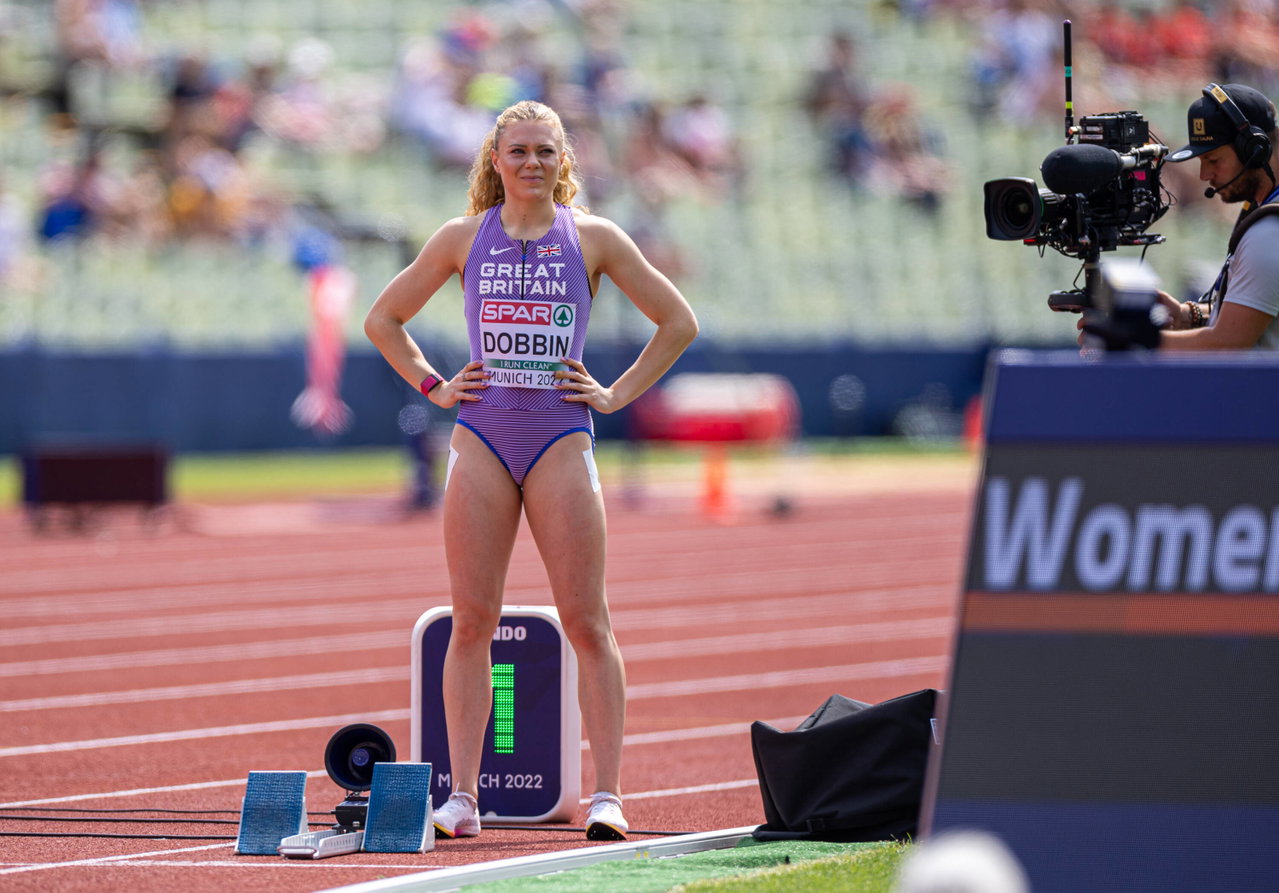
After contracting COVID-19 and glandular fever in the winter of 2021 to 2022, former British Olympic sprinter Beth Dobbin began experiencing excessive sleep, sore glands, and declining athletic performance. Initially, medical tests failed to explain her symptoms, and she continued competing throughout 2022. After taking six weeks off following the European Athletics Championships, she returned to training for just three weeks before her symptoms worsened. Following consultations with several specialists, she was diagnosed with myalgic encephalomyelitis, a debilitating condition with no approved treatments. Now spending around 22 hours a day in bed, Dobbin has made a special appeal for greater government attention to the illness.
Watch What’s Trending Now!
On October 21, Dobbin shared a post on Instagram following the response to her recent BBC Sport interview. In the post, she revealed that she and her supporters had written to Prime Minister Andy Burnham, calling for greater government funding for ME research.
“My name is Beth Dobbin and I’m an Olympian who represented Team GB at the Tokyo Olympics,” she wrote. “I’ve gone from training 5 hours a day to being bed bound 22 hours a day, due to developing severe ME (Myalgic Encephalomyelitis) after subsequent Covid and Glandular Fever infections.” Dobbin also highlighted the response to her BBC Sport interview, which explored the impact of the illness on her life. She said the interview had received more than one million views on both Instagram and X, adding that she believed the response reflected how many people were living with the same condition.
“There are over 400,000 people with an ME diagnosis in the UK,” Dobbin wrote, citing estimates from charities that the actual number could be around 1.35 million. She also pointed to the lengthy process many patients face before receiving a diagnosis, saying it takes an average of six years. Dobbin argued that the illness has been neglected for years and has received too little government research funding, leaving patients without approved treatments.
She also raised concerns about the lack of NHS provisions for people with severe ME, whom she said make up around 25% of those living with the condition. “What other illness this prevalent would leave patients with nowhere to go within the NHS, or no specialists other than to seek private care?” she asked in her message to Burnham.
Dobbin also linked greater investment in ME research to the government’s efforts to reduce welfare spending, arguing that finding effective treatments could help people affected by the illness regain their independence. “The funding towards research would be significantly lower than the millions spent on PIP, Universal Credit and Carers Allowance over the years for those who can’t work due to this illness,” she wrote.
She urged Burnham to support greater research funding, adding, “To get the welfare bill down, I believe you need to fund research into this spiralling illness and help us all get our lives back.” Her appeal comes amid wider concerns about rising UK welfare spending, which the Department for Work and Pensions forecasts will reach £408.6 billion in 2030-31. Between April 2019 and March 2024, the UK government invested around £6.5 million in ME research, highlighting the funding gap Dobbin wants addressed.
Having retired from athletics in April 2026 after years of health struggles, Dobbin is now using her platform to raise awareness of severe ME. But for the 32-year-old athlete, the disease has taken away the career she spent years building.
How Beth Dobbin went from Olympic sprinter to bedbound
Dobbin was introduced to athletics by her father, Jim Dobbin, a former professional footballer who played for Celtic and Barnsley. However, she did not initially plan to become an elite sprinter. In a 2021 interview with Scottish Athletics, she explained that she joined a track team at 18, mainly to stay fit, and had originally been interested in trying the high jump.
However, her path to the top was also shaped by a serious health challenge during her teenage years. At 13, she suffered an epileptic seizure that temporarily left her unable to walk or speak. It took months for her to regain her speech fully, and the experience affected her mental health. Despite these difficulties, she continued pursuing athletics and gradually worked her way into the British elite ranks.
In 2018, Dobbin won the British 200m title and broke a Scottish record that had stood for 34 years. She also made her international debut for Great Britain at the Athletics World Cup in London, winning bronze in the 200m. The following year, she lowered the Scottish 200m record to 22.50 seconds at the Müller Anniversary Games in London.
Her progress continued when she represented Great Britain in the women’s 200m at the Tokyo Olympics in 2021, reaching the semifinals. At the 2022 Commonwealth Games in Birmingham, she won bronze as part of Scotland’s women’s 4x400m relay team and finished eighth in the 200m final. These achievements marked the peak of a career she had worked hard to build.
However, Dobbin’s health began to deteriorate during the winter of 2021 to 2022. The 2022 season proved particularly difficult. At the World Championships, she struggled with a painful throat and unusual sleep patterns, while at the Commonwealth Games, she experienced dizziness and increased soreness. Her condition worsened further at the European Athletics Championships in August, where she lost feeling in her legs while in the starting blocks and false-started. She later described that period as her “year of hell.”
Looking back on what followed, Dobbin told BBC Sport: “When the Europeans had finished, I had this huge rest and the symptoms were just piling on. Things were getting worse and worse.” After consulting four or five specialists, she was diagnosed with myalgic encephalomyelitis. In her BBC Sport interview, published on October 16, 2026, journalist Katie Falkingham spoke with Dobbin about how dramatically the illness had changed her life.
The former sprinter revealed that she now spends more than 22 hours a day in bed, usually getting up only to eat or use the bathroom. She also explained that even simple activities can trigger a serious worsening of her symptoms. The illness has taken away much of the independence she once had as an elite athlete. Reflecting on the impact, Dobbin said, “I feel like I’ve lost everything. I have still got my family, but I’ve lost my independence, my health, the ability to work, the ability to exercise.”
She also stressed that ME is far more debilitating than ordinary tiredness. “I wish it was just fatigue, that would be a walk in the park,” she said, describing the severity of a condition that has left her largely confined to her bed. Dobbin revealed that she had left her home only five times during 2026 by the time of the interview.
Even speaking with a journalist carried risks because the physical and mental effort could trigger a setback. “But I felt like it was really important to do that to get the message out,” she explained.
Although her career ended earlier than she had hoped, she is still using her experience to bring greater attention to ME and the challenges faced by those living with severe forms of the condition.