
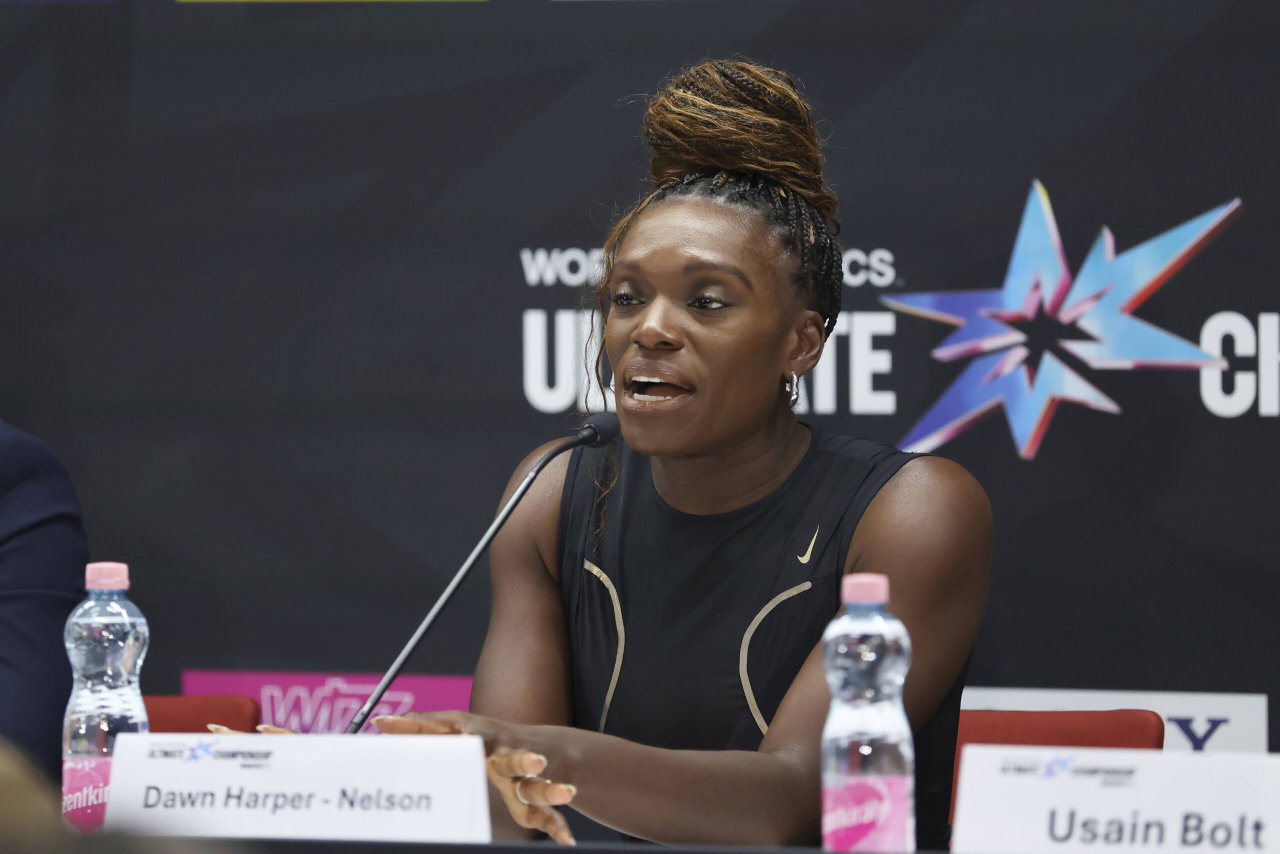
Athletes hoping to compete at the LA28 are already facing a tough challenge after World Athletics announced the new qualification standards. Several events now require faster times and better performances than those needed for Paris 2024. For instance, the men’s 100m standard has been set at 9.93 seconds, while the women’s 800m mark is 1:57.00. These numbers have left many surprised, with athlete Kelvin Titong even describing the standards as “crazy.” But while some are still coming to terms with just how difficult the road to LA28 could be, former Olympic champion Dawn Harper-Nelson is urging athletes to look at things differently.
Watch What’s Trending Now!
Harper-Nelson, who won 100m hurdles gold at the 2008 Beijing Olympics before claiming silver at the 2012 London Games, shared a video on November 15 addressing the reactions. She began by referring to the videos circulating about the new qualification standards and said, “Oh my God! Oh my God!” She then explained that she had been watching people express their surprise over the marks.
“Because like I said, I’m seeing all these videos talking about, oh my goodness, the qualification standards. I can’t believe they lowered them. It got me so crazy,” she said. However, she did not want athletes to spend too much time worrying about the numbers. Turning directly to those hoping to compete in Los Angeles, she asked, “But y’all done?” She then reminded them that there was still work to do, adding, “Because those of you that’s going after LA28, I’m here to bring you back to the reality of this dream. We got work to do. Let’s get it.”
Harper-Nelson also shared a message alongside the women’s qualification standards on Instagram. “Now I’m not saying these aren’t mind-blowing standards, but I am saying a lot of you that say you want to go to the Olympics are getting caught up in the ‘OMG, these are insane!'” she wrote.
She then explained why this mindset worried her, warning that athletes could end up convincing themselves that the standards were impossible to reach. “The only issue I have is that if you stay in that mindset the goal will soon be impossible because you have joked yourself into saying and now believing these are too fast and too far,” she added.
Harper-Nelson also reminded athletes that qualifying for the Olympics had never been an easy task. “This isn’t a new obstacle because you always had to qualify,” she wrote, urging them to stay focused on their preparations. She ended her message with a clear reminder: “LET’S STAY LOCKED IN.” She also offered encouragement to anyone who needed it as they worked towards their Olympic dream.
Under the LA28 qualification system, athletes will have two main routes to the Games. Around 40% of places are expected to be filled by athletes who meet the entry standards, while the remaining 60% will be decided through world rankings. Meeting the required mark does not automatically guarantee a place, as athletes must also compete for a limited number of spots in each event. But even before qualification begins, the new standards have already sparked strong reactions.
Athletes raise concerns over tough LA28 Olympic qualification standards
World Athletics released the athletics qualification standards for the 2028 Los Angeles Olympics on November 10, 2026, and some of the new marks have already raised eyebrows. Several events now have tougher entry requirements than they did for Paris 2024. The men’s 100m standard, for example, has dropped from 10.00 seconds to 9.93 seconds, while women will now need to run 10.96 seconds instead of 11.07 seconds. The women’s 800m requirement has also moved from 1:59.30 to 1:57.00, while the men’s standard has changed from 1:44.70 to 1:43.00.
The new requirements have not gone down well with everyone. Kenyan sprinter Kelvin Titong was among those who questioned the men’s 100m mark, pointing out how much faster athletes will now have to run just to meet the automatic entry standard. “Paris 2024: 10.00s LA 2028: 9.93s 2032: 9.86? 9.93s just to meet the entry standard is crazy,” he wrote on social media.
Kenyan Olympic 800m bronze medallist Mary Moraa also raised concerns about the new women’s standard of 1:57.00. She explained that meeting the time could force Kenyan athletes to travel abroad more often in search of competitive races. “That means we must have Kenyan athletes running races outside to either attain the time or qualify through the world ranking where athletes from Africa are disadvantaged,” she said.
Middle-distance runner Reynold Cheruiyot was also unhappy with the demanding marks, particularly the men’s 1500m and 5000m requirements. He described the times as “crazy” and pointed out how difficult it would be for athletes to achieve them. “Those times are crazy and one has to be in their best form but can only hit once,” he said. He also called on Athletics Kenya to support athletes or ask World Athletics to review some of the standards.
Olympic javelin silver medallist Julius Yego shared concerns about Kenya’s ability to send a strong team to Los Angeles if athletes struggle to meet the new requirements. He warned that the country needed to take the situation seriously, saying, “If you critically analyse the performances of Kenyan athletes in the last few years, then we should be worried about whether we will manage to take a big, strong team to Los Angeles in 2028.”
Yego also stressed that the challenge would affect more than just a few athletes. “I personally have no issue in qualifying but the rest will have a big problem hence we must have a conversation as a country,” he added.
The concerns have also reached the coaching ranks. Kenya Defence Forces sprint coach Vincent Mumo told The Star that the new requirements would be difficult for athletes to achieve. “The standards for LA are way too high for athletes. They are very tough times to meet,” he said. His comments added to the growing discussion about whether athletes, particularly those competing in middle-distance and long-distance events, will have enough opportunities and support to meet the marks.
The marathon standards have also become considerably tougher. Men will now need to run 2:05:00 to meet the automatic entry requirement, compared with 2:08:10 for Paris 2024. The women’s standard has dropped from 2:26:50 to 2:22:20. With several events demanding faster times and better performances, athletes have a difficult qualification campaign ahead as they begin preparing for the Los Angeles Games.