
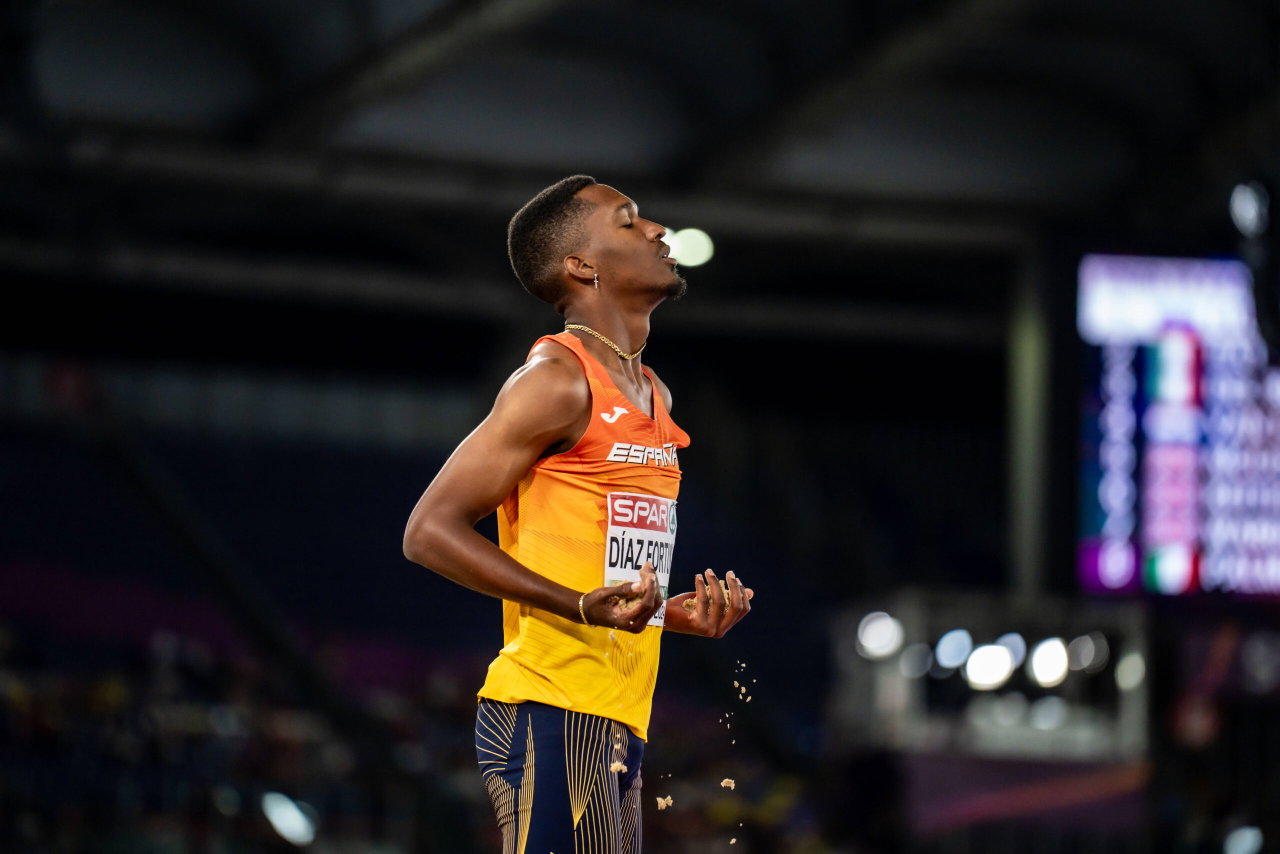
Jordan Díaz had everything going his way in Paris. The Spanish triple jumper won Olympic gold at the 2024 Games with an 18.06m effort, just weeks after soaring to a Spanish record of 18.18m in Rome. But life after the Olympic win wasn’t smooth at all. Díaz has struggled with injuries and consistency, barely competing since that gold-medal triumph and eventually stepping away from the 2026 season altogether. Now, with the 25-year-old preparing to return in 2027 and hoping to start a new chapter in his training, he has run into another obstacle, this time away from the track: a U.S. visa.
Díaz is hoping to move to Kansas and train under Travis Geopfert, the coach of Olympic long jump champion Tara Davis-Woodhall, as he looks for a different environment. But the move has been put on hold because of visa issues. According to ABC, the Cuban-born Spanish jumper is currently in Guadalajara while he waits for his U.S. visa. Sources close to Díaz said he is “still working on his visa application,” leaving his plans to begin training in Kansas uncertain for now.
The visa issue is linked to Díaz’s background. Born in Havana, he later became a Spanish citizen and now represents Spain internationally. The U.S. introduced additional visa restrictions affecting Cuban nationals in 2026, including partial suspensions for several visa categories, with exceptions. However, there is no confirmation that Díaz has been denied a visa or that a specific restriction has been applied to his case. But what is clear is that the process has delayed his move to the United States.
The visa issue comes after a difficult period for Díaz on the track. His first full season after Paris did not go as planned. He returned to competition at the Spanish Championships in Tarragona in August 2025, almost a year after his Olympic triumph, and won the title with a 17.16m jump, in what was his only valid attempt.
His World Championships campaign in Tokyo a few weeks later ended just as quickly. Díaz failed to register a valid mark in qualifying and did not advance. It was another sign that the Olympic champion was struggling to rediscover the form that had taken him to 18.18m the previous year. The problems continued into 2026.
Díaz attempted to return at the indoor meeting in Liévin in February but stopped during the warm-up. He then missed the Spanish Indoor Championships in Valencia. Díaz eventually withdrew from the European Championships in Birmingham, where he had been expected to defend his continental title. Instead, he shared a video of himself training in Guadalajara with a simple message: “Road to 2027.”
That decision came as Díaz was also making one of the biggest changes of his career away from competition. In March 2026, he left Iván Pedroso’s training group in Guadalajara. Pedroso had worked with Díaz since the athlete left the Cuban delegation in 2021. Together, they went from rebuilding his career in Spain to celebrating Olympic gold in Paris.
Díaz also parted ways with his manager, Alberto Suárez. The decision to leave Pedroso surprised some people in Spanish athletics. Ramón Cid, a 13-time Spanish triple jump champion, told ABC that the split “doesn’t seem logical,” while also acknowledging that there can be factors in an athlete-coach relationship that outsiders cannot fully understand. But Cid has not lost faith in Díaz’s ability.
“Jordan’s potential is incredible,” Cid told ABC. “I think he’s the greatest talent in the triple jump and capable of easily breaking the world record if things go his way.” For now, though, Díaz is still waiting for his next chapter to begin. Without a coach, he has been carrying out relatively light preseason training in Guadalajara, including work in parks and at a local gym.
Long before Jordan Díaz became an Olympic champion, he was already being viewed as one of the most exciting young talents in the triple jump.
Díaz first caught major attention at just 16 when he won the 2017 World U18 Championships in Nairobi with a 17.30m jump, breaking the previous world U18 best of 17.24m. A year later, he went even farther. At 17, Díaz improved the world U18 best to 17.41m, a mark that also placed him third on the world U20 all-time list at the time.
His rise continued at the 2018 World U20 Championships, where he won the triple jump title with 17.15m and broke the championship record. His performances that year were enough to earn him a place among the five finalists for the 2018 Male Rising Star Award, alongside future stars such as Armand Duplantis and Jakob Ingebrigtsen.
A young talent grows into a global contender, only to face trouble after reaching the top
Díaz was already making an impression against senior competition by 2019. At just 18, he jumped 17.49m, putting him sixth on the senior world list for the season. His progress was slowed in 2020, however, when the COVID-19 pandemic disrupted the athletics calendar. He was able to continue his 2019 breakthrough in February in Liévin, as he posted 17.07m.
He continued to develop after that. Díaz won a Diamond League event in 2022 in Paris with 17.66m, beating Andy Díaz and Pedro Pichardo. His biggest breakthrough before the Olympics came at the 2024 European Championships in Rome. Díaz produced a huge 18.18m to win the triple jump, defeating defending European champion Pedro Pichardo’s 18.04m. The performance was the third-longest jump in men’s triple jump history at the time and showed just how far his early promise had developed.
After that performance, Díaz admitted that even he had not expected to jump that far, saying, “I did not really expect this, but the goal is always to keep improving.” He also revealed how Pichardo’s own 18.04m effort had pushed him to respond, saying, “Seeing Pichardo jumping 18 was a motivation to jump even farther because nobody came to these championships to finish second or third.”
Just weeks later, Díaz would take the biggest step of his career by winning Olympic gold in Paris. But after reaching the top in Paris, his career took a very different turn.