
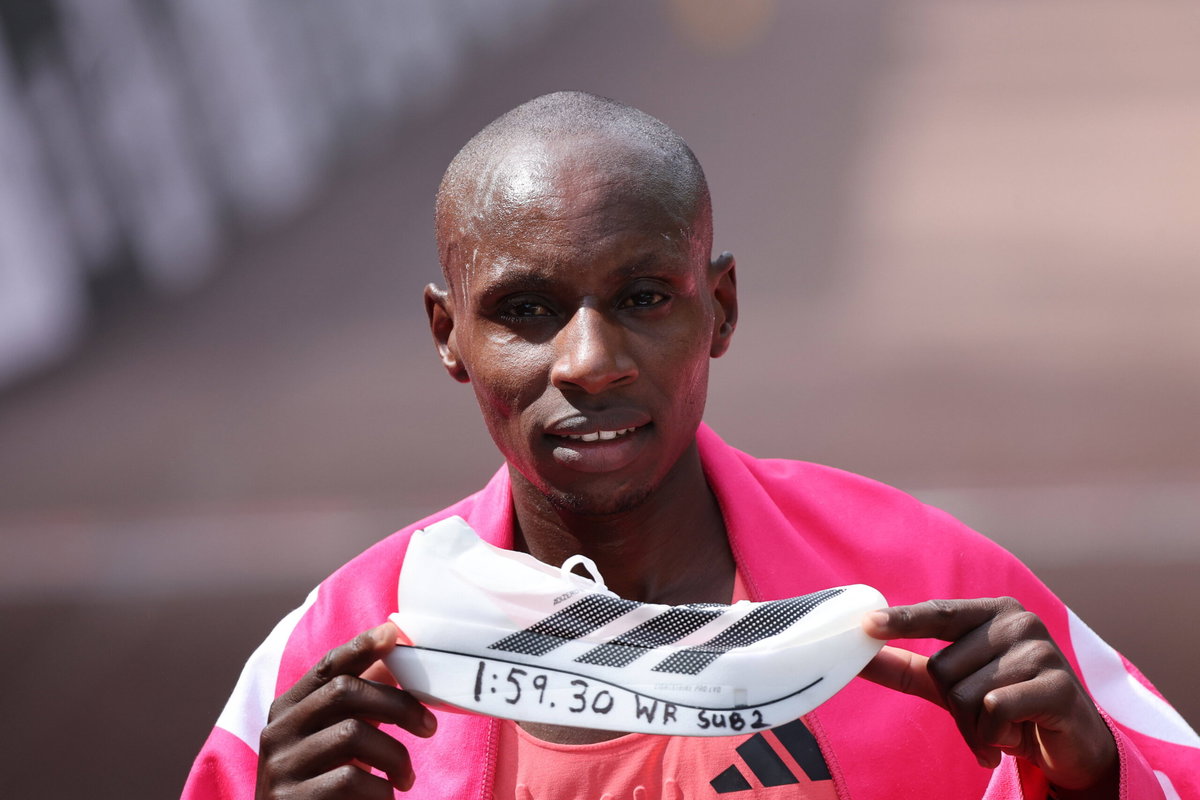
When Ruth Chepngetich crossed the finish line in Chicago in 2:09:56, it was a world record. However, it wasn’t long before the Athletics Integrity Unit (AIU) banned her in 2025 for three years after she tested positive for a banned diuretic. This led people to doubt Kenyan marathon running. Even Kenyan athletes who had nothing to do with it came under suspicion, including Sabastian Sawe. Instead of ignoring the suspicion, he cleared his name by following a strict routine, and now the results have paid off.
Watch What’s Trending Now!
On April 26, at the 2026 London Marathon, he not only won the race but also challenged the very perception of what’s possible. Sawe broke the marathon world record with a time of 1:59:30, becoming the first man to run under two hours in a race.
Sawe finished 65 seconds faster, beating the previous record set by Kelvin Kiptum in 2023. “I am feeling good, I am so happy,” said Sawe. Sawe led all the way through the first half of the race and sped up to finish minutes ahead of others. Yomif Kejelcha followed in at 1:59:41, while Jacob Kiplimo finished in 2:00:28, both still under the old world record.
But in the end, the question remains: was Sawe’s victory valid? The AIU has currently suspended over 140 Kenyan athletes for doping violations, and so Kenya is facing ridicule in every tournament.

Watch Sabastian Sawe 🇰🇪 run 1:59:30 to destroy the Marathon World Record in London!!🤯🔥 First man ever to break 2 hours in a marathon. 2. Yomif Kejelcha 🇪🇹 1:59:41 3. Jacob Kiplimo 🇺🇬 2:00:28 All under the previous World Record.
Sawe previously won the 2025 Berlin Marathon with a time of 2:02:16. But during his Berlin build-up, he entered a special anti-doping arrangement, funded by a $50,000 contribution from Adidas, which subjected him to an intense barrage of roughly 25 unannounced, out-of-competition tests. They wanted to show that he was clean.
Reportedly, Adidas continued to invest Sawe’s anti-doping program in 2026. However, instead of one intense testing block, it spread the checks across the year. A similar testing protocol was in place before London, but Sawe pointed out the difference:
“For this preparation for London, I was not tested much like Berlin.”
Sawe’s agent Eric Lilot told LetsRun.com before the race, “We knew that (clean) Kenyan athletes and their performances would be under even more suspicion, and to no fault of their own.”
But despite this win, Sawe’s victory still placed him in a common position in London Marathon history, where people question success.
London Marathon winners’ curse of doping cases
Over the past 15 years, about one in five men’s London Marathon winners has subsequently faced a drugs case and/or sanctions for testing positive later in their career.
One of the most famous examples is Daniel Wanjiru, who won the London Marathon in 2017. Doping violations linked to biological passport abnormalities later led to a four-year ban for him.
Jemima Sumgong, who won the women’s London Marathon in 2016 with a time of 2:22:58, was one of the strongest marathon runners in the world at that point, but soon after, things changed.
In 2017, Kenyan anti-doping officials tested her outside of competition, and she later tested positive for EPO. The authorities provisionally suspended her in April of that year and removed her from competition, which also eliminated her chance to defend her London title.
In November 2017, she received a four-year ban after authorities rejected her explanation involving medical treatment. The case further escalated in 2019 when her sanction increased to eight years after investigators found issues, including false medical records, inconsistent explanations, and attempts to mislead the process.
The 2010 women’s winner, Liliya Shobukhova, represents another cautionary tale from London’s history. Though she finished in 2:22:00, her results came under scrutiny in 2014 when investigators flagged abnormal blood values in her biological passport.
The fallout was severe: the authorities erased all of her results dating back to October 2009, the organizers officially retracted her 2010 London Marathon title, and the sport’s governing body handed her a lengthy ban.