
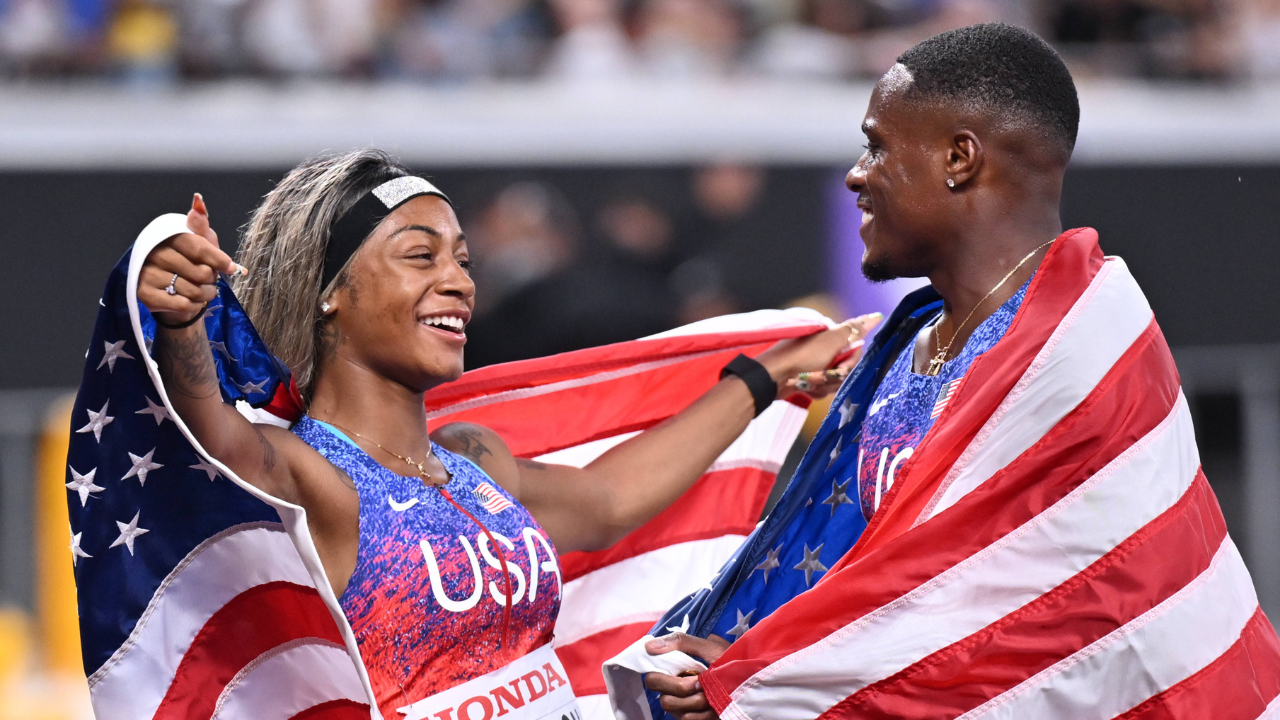
The Olympic flame is set to make a special return to Atlanta before beginning one of the biggest journeys in U.S. Olympic history. Thirty years after the city hosted the 1996 Summer Games, Atlanta has been chosen as the starting point for the 2028 Olympic Torch Relay, with the flame set to travel through all 50 states before reaching Los Angeles. And now, this announcement has brought together Olympic figures, LA28 representatives and members of the athlete community, including Sha’Carri Richardson and her boyfriend Christian Coleman.
Watch What’s Trending Now!
LA28 and Atlanta officials announced the plan on September 29 at Atlanta City Hall, confirming that the Olympic flame will return to the city in spring 2028 before beginning its journey across the country. The relay will visit every U.S. state before ending in Los Angeles for the Opening Ceremony on July 14, 2028. Soon after the announcement, the LA28 official handle shared pictures from the event on Instagram, giving fans a closer look at the people who gathered in Atlanta.
In the first pic, which was a group picture, Richardson and Coleman were seen at the front alongside several major figures connected to the Olympic movement, including LA28 Chairperson and President Casey Wasserman, Atlanta Mayor Andre Dickens, LA28 Chief Athlete Officer Janet Evans, Billy Payne and Lonnie Ali, the wife of Muhammad Ali. Other officials and members of the athlete community were also part of the gathering.
Coleman kept his look casual for the occasion, wearing a black baseball cap, a brown short-sleeved button-up shirt with contrasting black-and-white panels, a white long-sleeved shirt underneath and black trousers. Richardson, meanwhile, opted for an all-black outfit, wearing a sleeveless top with a cut-out around the waist and wide-legged black trousers. The pictures quickly caught the attention of fans, as one fan commented, “Great to see @_coleman2 and @itsshacarri there!! 🔥🔥👏👏.”
But the Atlanta announcement was about more than the future of the Olympic Torch Relay. It also brought back memories of one of the most unforgettable moments from the city’s Olympic history, when Muhammad Ali lit the Olympic cauldron at the 1996 Games. Ali had died in 2016, but his connection to Atlanta was still represented at the announcement through his wife, Lonnie Ali, who attended the event. Reflecting on her husband’s role in 1996, she said, “He knew the magnitude of what this was.”
Richardson also spoke about Ali’s influence during the event. “What his presence has done for sports, both in and out of what it is to be an athlete and just a person, I feel like that showed up in that moment and that’s what everyone connected to,” Richardson said.
While Atlanta is already confirmed, the rest of the route is still to be determined. The participating cities and route information will be shared in 2027, according to LA28. But the ambitious 50-state relay also comes with some challenges and unanswered questions.
LA28 faces funding questions as Atlanta’s Olympic legacy sparks debate
One of the major issues with the 50-state relay is transportation funding and logistics to make such a relay happen, but organizers are still working on this.
LA28 is still seeking millions of dollars in funding to support transportation during the 2028 Olympic and Paralympic Games. With much of the event spending expected to come in the final stages, the organizing committee is now moving closer to the point where major plans need to be finalized.
“The part now [that] we are in is making sure all of our plans are clear, all of our difficult decisions are being made, so that when we go, we have as few changes and as few course corrections as possible,” Wasserman said. “Not that there won’t be any, but to limit those as much as possible, so that we operate towards the start line with as much certainty as possible, which is the only way to deliver a project of this scale.”
The torch relay itself has already raised another question in Atlanta, where the Olympic flame has a strong connection to the city’s 1996 Games. A controversial plan is underway to move the 1996 Olympic cauldron from the Summerhill neighborhood to Centennial Olympic Park, but Mayor Andre Dickens and many Summerhill residents have pushed back against the proposal.
Dickens has argued that the cauldron has become part of Summerhill’s history and identity. In a letter to Atlanta Legacy ’96 President Jeff Cravens, he wrote, “A city’s greatest moments should belong to its people first.” He also said, “The Olympic cauldron should remain in the neighborhood it has called home for the past 30 years, just as thousands of residents have.”
Summerhill resident Dyral Rooks described the proposed move as: “It’s heartbreaking. It’s like a slap in our face.” He also said residents felt that promises made to the neighborhood had not been fulfilled. Nearly two dozen former Olympians have signed a petition calling for the cauldron to remain in Summerhill. The local campaign also had more than 2,100 signatures as of August 17, according to the Atlanta Journal-Constitution. For now, Atlanta’s role in the 2028 Olympics is set, with the city preparing to send the flame on its 50-state journey.