
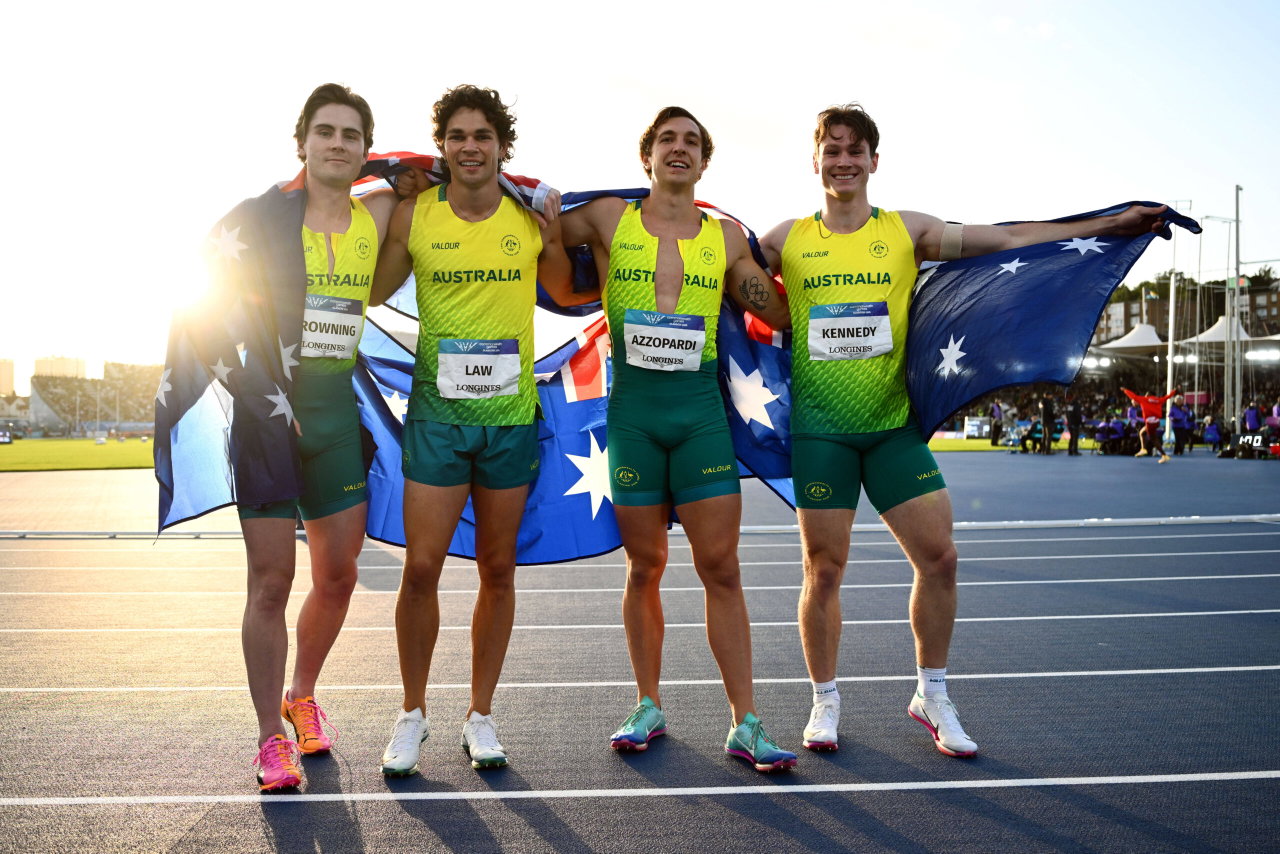
Canada initially finished second in 38.11 seconds, just ahead of Nigeria at 38.12. But Canada was later disqualified, temporarily moving Nigeria up to silver before a successful appeal restored Canada’s medal. South Africa, meanwhile, remained disqualified after its own protest was rejected. With four teams separated by just 0.06 seconds, two appeals, and more than four hours of chaos, the men’s 4x100m relay turned into one of the most dramatic finishes in Commonwealth Games history. Then, attention turned to the gold medalists, Australia.
Watch What’s Trending Now!
Australia’s anchor, Rohan Browning, appeared to briefly drift into lane 7 despite starting in lane 8, with screenshots of the moment quickly spreading online and prompting fans to question whether the newly crowned champions should have been disqualified as well.
Lachlan Kennedy got the team off to a strong start, pulling ahead early before handing the baton to Joshua Azzopardi. Azzopardi maintained the pace, Calab Law carried the lead into the final exchange, and Browning finished the job on the anchor leg at 38.07 seconds.
Browning played a crucial role in the victory. After falling in the heats at the 2022 Commonwealth Games and contributing to Australia’s disqualification, he helped the team win its first Commonwealth relay gold since 1974.
“These guys did all the hard work, put me in a winning position. All I had to do was hold on. Four years ago I fell over in the heat, got this team DQ’d, had to carry the burden of that for the past four years, and today makes gold taste extra sweet,” Browning said.
Looking back at that history, it is clear this victory did not come easily. The Australian team finally put the disappointment of 2022 behind them and capped off a dominant day. By the end of the night, Australia had won seven gold medals, setting a new national record for track and field at the Commonwealth Games.
Onwuzurike, Nigeria, told the reporters that “Shout-out to them, for real, I can only give them respect, because I know how hard it is to run out of lane eight, so proud of them.”
But as Browning celebrated what felt like a full-circle moment, social media had already begun dissecting one brief sequence from his anchor leg.
Fans react to Australia’s potential lane infringement
According to World Athletics rules, TR17.3.2 allows an athlete to step or run outside the assigned lane on the straight, or beyond the outer lane line on a bend, as long as no other runner is obstructed and no material advantage is gained. TR17.3.3 permits a single contact with the inside lane line on a bend without automatic disqualification, but a second infringement may result in disqualification. TR17.4 further states that an athlete or relay team must be disqualified if the lane infringement provides a material advantage.
However, eagle-eyed fans believed Australia’s Rohan Browning should have been disqualified. One fan posted a photo on X showing Browning appearing to commit a lane infringement on the home straight, asking, “Should Australia have been disqualified???” Browning’s case is believed to fall under Rule 17.3.2, but fans have interpreted the incident differently.
“Yes!!!!! Omg I wanted someone else to see this He ran his entire leg in lane 7😭😭 Like the whole race!!!!,” one fan commented on X.
That is not true. The video of the race does indeed show Browning crossing into lane 7 from his designated lane 8 during the home stretch. What it doesn’t show is the Olympian doing that the entire stretch of his 100m anchor run. In fact, the 28-year-old only did that for a few seconds during his sprint down the home stretch before returning back to his lane.
That didn’t stop fans from going after the Australian team though, as one wrote, “Yup, the Australians too should have been disqualified.” Another echoed the same sentiment, with “Simple Answer, Yes. Appeal or no appeal.”
Well, the Australians were never going to be disqualified. That’s because of what one user pointed out: “You are allowed to step on the line in the straightaway, just not on the curves.” Guess he is aware of the technical rules.
Browning crossed the lane line on the straight, where it did not warrant disqualification. Had it happened on the curve or during the handoff, Australia could have been disqualified alongside South Africa.
Lane violations on the curve or during a handoff can provide a material advantage and lead to disqualification. The same does not apply on the straight unless the runner gains an advantage or obstructs another athlete.
The distinction is what separated Australia’s situation from the other controversies unfolding around the same race.
Canada had initially been disqualified for an alleged lane infringement under Rule TR17.2.3 during the baton exchange involving Aaron Brown and Jerome Blake before successfully overturning the decision on appeal and reclaiming silver. South Africa also protested its own lane infringement ruling, but officials rejected the appeal, leaving the team disqualified.
Against that backdrop, it wasn’t surprising that viewers scrutinized Browning’s every step. But unlike the incidents involving Canada and South Africa, Australia’s moment came on the home straight, where officials determined there was neither obstruction nor any material advantage.
The images may have convinced plenty of viewers that Australia “should have been disqualified”.
In a relay where almost every result was questioned, Browning’s lane infringement became the one controversy that looked dramatic on television but never threatened Australia’s gold.