Imago
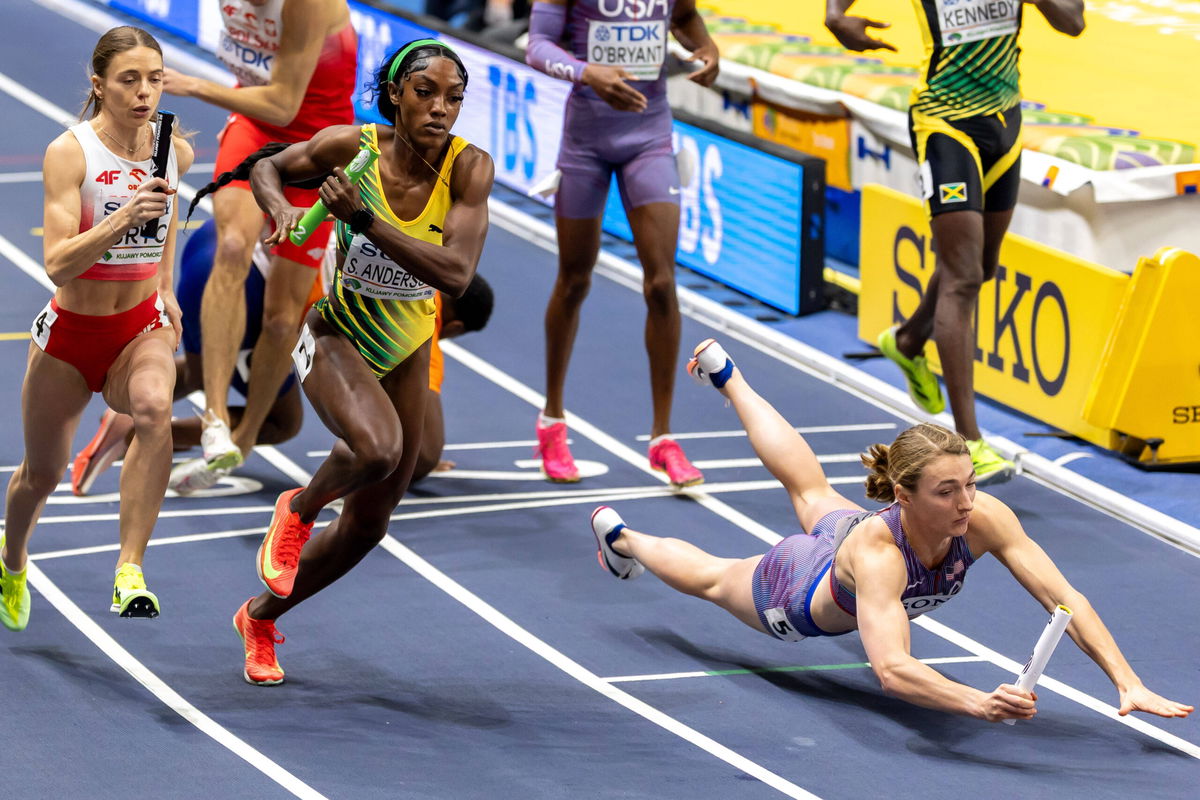
2026 World Athletics Indoor Championships, Kujawsko-Pomorska Arena ToruÅ , ToruÅ , Poland 21/3/2026 Mixed 4×400 Metres Relay The USAs Sara Reifenrath collides with Jamaicas Shana Anderson leaving her sprawling on the track during the first changeover Sara Reifenrath and Shana Anderson 21/3/2026 PUBLICATIONxNOTxINxUKxIRLxFRAxNZL Copyright: x INPHO/MorganxTreacyx 0U6A2690
Imago
2026 World Athletics Indoor Championships, Kujawsko-Pomorska Arena ToruÅ , ToruÅ , Poland 21/3/2026 Mixed 4×400 Metres Relay The USAs Sara Reifenrath collides with Jamaicas Shana Anderson leaving her sprawling on the track during the first changeover Sara Reifenrath and Shana Anderson 21/3/2026 PUBLICATIONxNOTxINxUKxIRLxFRAxNZL Copyright: x INPHO/MorganxTreacyx 0U6A2690
Relay mishaps have followed Team USA track and field for years, and at the 2026 World Athletics Indoor Championships, the pattern returned in the worst way. On March 21 in the mixed 4×400m relay final, the U.S lined up a strong quartet that included Sara Reifenrath. But within seconds, a chaotic moment during the opening exchange changed everything, which pushed them out of contention early.
Watch What’s Trending Now!
The chaos began at the opening baton exchange. Runners were crowded in the zone, jostling for position, and in the middle of the shuffle, contact happened. Amid the chaos, Reifenrath collided with Jamaica’s Shana Kaye Anderson and fell onto the track while passing the baton to Jevon O’Bryant.
And as she stood up, she lost her left shoe in the process. Even then, she didn’t give up. Scrambling back to her feet with only one shoe, Reifenrath kept running with her sock and a single spike.
“I don’t know, I just fell and I just felt it, like my heel popped out and I just started running,” the track and field athlete explained. “It was gone and I wasn’t going to stop and go put it back on.” But the race was already slipping, and instinct took over.
“I don’t know. I just fell and my heel popped out. I wasn’t going to stop and put it back on.”
The USA mixed 4x400m relay team reflect on finishing sixth at the World Indoor Championships in Toruń.
The quartet found themselves in difficulty after Sara Reifenrath lost her spike… pic.twitter.com/3lGyxEvZ3D
— AW (@AthleticsWeekly) March 21, 2026
“The adrenaline’s already so high and then you fall and it almost doubles it,” she explained. “You’re not even really thinking anymore. You’re just trying to run as fast as you can to make up for time lost.” By then, the damage had already been done.
Because the fall came so early in the race, the United States lost crucial seconds right away. They crossed the line in sixth place. Meanwhile, Belgium won the gold in 3:15.60, Spain took silver in 3:16.96, and Jamaica originally placed third but got disqualified.
However, in the case of Team USA, this was one more episode of the relay mayhem they have faced on several occasions before.
USA’s tough luck in important track and field relay races
At the 2024 Olympics, the U.S. men’s 4x100m relay team came to the Stade de France having clocked the fastest time in heats. Their team included Christian Coleman, Kenny Bednarek, Kyree King, and Fred Kerley, a feisty combination that soared medal expectations. But the race started disastrously.
During the very first baton exchange between Coleman and Bednarek, the timing went horribly wrong. Bednarek began his run too soon, and he was too far ahead of Coleman to safely hand over to him. Consequently, the baton was relayed outside the legal 30m exchange zone, which is a disqualification in terms of relay. The team crossed the finish line well behind the leaders, but track and field officials removed them from the results.
Ever since, Team USA’s relay squads have been under great scrutiny. And against this backdrop comes in a crucial update.
Looking ahead to the 2026 World Relays in Gaborone on May 2-3, USATF made a big move. Just two months before the event, they announced the U.S. would not send men’s or women’s 4×400m relay teams.
Two key reasons were responsible. First, athlete availability was limited. “It is difficult for us to find top-tier US athletes who want to go,” explained USATF’s Holder. Many of the A-team athletes had no interest in competing.
Second, the financial cost was too high for teams. “Sending B or even C teams to Botswana is really significant,” Holder said. “We feel there’s potentially a better use of resources for programming that can support our medal goals for 2027 and 2028.”
That being said, the U.S. track and field opted for strategy over tradition, and it proved that there are occasions when relay battles do occur off the track.