
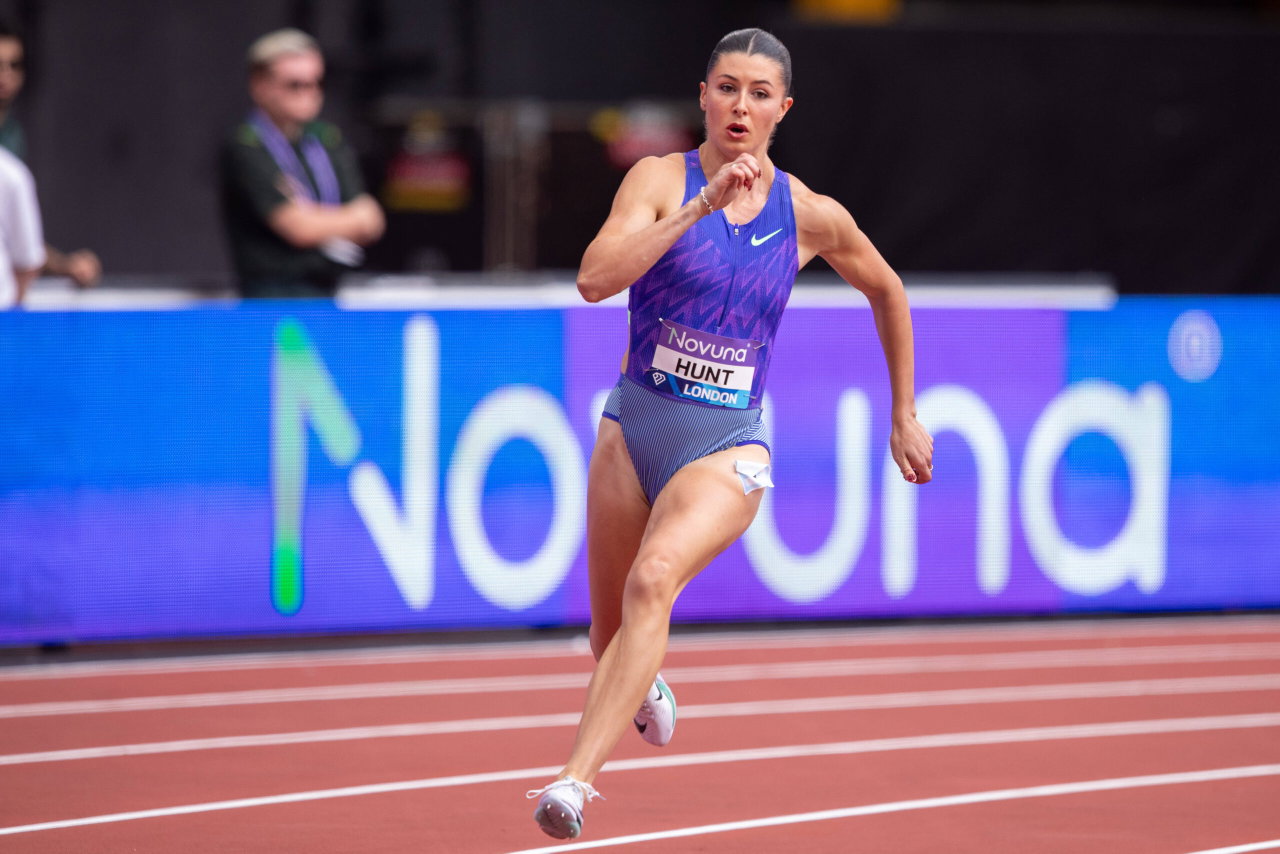
Amy Hunt once wondered if she would ever become the athlete everyone thought she could be. After breaking the world under-18 200m record at just 17, the British sprinter looked destined to be “Track Goddess”. Instead, the years that followed brought injuries, difficult moments at Cambridge and the challenge of trying to keep her athletics career alive while completing her English Literature degree. And even a serious quadriceps tendon injury in 2022 made her question whether she would ever get back to the level when she used to beat boys in races, including a future Olympic bronze medallist.
Watch What’s Trending Now!
In a September 23 profile for The Times, Hunt recalled how her childhood pursuits included triathlon, ballet and cello, but it was playing chase in the primary-school playground that first made her realise how fast she was. She would race the boys and beat them, sometimes leaving them so frustrated that they refused to shake her hand afterward. “I found it hilarious,” Hunt recalled.
By around 14, her speed had already taken her beyond schoolyard races. Hunt defeated Louie Hinchliffe, who would later become part of the Great Britain 4x100m relay team that won Olympic bronze at Paris 2024. Recalling it now, Hunt said: “Imagine if he’d given up after I beat him!”
But that assurance was soon to be put to the test in the following years. Expectations were high for Hunt when she made her debut in 2019 with her teenage world record. Her performance of 22.42 seconds in 200m was good enough to break the world U18 record. But the years that followed were not easy. Her injury prevented her from being able to compete in the World Championships in 2019. She then went to Cambridge University where she studied English Literature, while maintaining her elite sporting credentials. Initially, Hunt thought she could manage both. However, she was not able to hold up.
And then came the major injury. Hunt suffered a serious quadriceps tendon rupture, which required surgery. The injury was so severe that her mother had to help her in and out of the shower while she recovered. The injury was a major reason her early senior career stalled. Still, Hunt never forgot the talent she showed as a child. She knew she was “too talented for it to go to waste.” And she eventually found her way back.
After graduating from Cambridge in 2023, Hunt moved to Padua, Italy, to train with coach Marco Airale. She helped Great Britain win Olympic 4x100m silver at Paris 2024 and then produced a major individual breakthrough with 200m silver at the 2025 World Championships. Then came 2026, the season that finally showed just how far Hunt could go.
Amy Hunt turns teenage promise into a historic 2026 season
Hunt started the season with a 7.04 career-best in 60m before even more impressive improvement in the 100m, where she broke the 11-second barrier for the first time in 10.97 in Stockholm in June. She became only the fourth British woman to achieve the feat, and followed it with Commonwealth 100m silver in Glasgow. But Hunt’s biggest moment of the year came on home soil at the European Championships in Birmingham.
She won her first senior European 100m title in 11.00 before adding the 200m crown. She then helped Great Britain win the women’s 4x100m relay and anchored the mixed 4x100m team to a European record of 39.97. Four gold medals made Hunt the first athlete in European Championship history to win four titles at a single edition.
After everything she had been through, could there have been a better reminder that the talent she showed at 17 was still there? Hunt’s own confidence appeared to have returned with those results. Before the European 100m final, she said, “I knew I could come away with gold. I had such a big premonition.” After winning, she described the feeling as “magical” and said she had reached a point where she was ready to show what she could do.
The transformation was striking. Only a few years earlier, Hunt was questioning whether she would ever fulfil her teenage potential. Now, the self-proclaimed “academic badass and track goddess” was no longer simply trying to live up to the promise of her younger years. She was winning senior titles, making European history, and proving that the talent she had always believed was there had not disappeared.